There is a complete three-tier networking certification ladder that a great many working engineers have never once seen mentioned. H3C, the enterprise networking vendor spun out of the old 3Com joint venture, runs its own engineer, senior engineer and expert credentials, and the entry rung is GB0-192, Routing and Switching Essentials, which awards H3CNE-RS+. In parts of the world it is a hiring requirement. In English-language networking discussion it is almost invisible.
That gap is worth closing, because the exam itself is not obscure at all. GB0-192 asks 50 questions in 60 minutes for $165 USD, needs 600 out of 1000 to pass, and covers eight sections that run from CSMA/CD and MAC addressing all the way to SDN and NFV. This guide works through all eight, what each genuinely tests, how much of it transfers from any other networking background, and how to prepare without a rack of Comware kit.
Why Have Most Network Engineers Never Heard of H3CNE-RS+?
Because H3C’s certification programme is documented mainly for markets where H3C equipment is common, and English-language networking discussion is dominated by vendors with a larger Western install base. The credential is not small or informal. H3C describes H3CNE-RS+ as covering the planning, design, configuration and maintenance of small and medium-sized networks, and it is awarded by New H3C on passing a single exam.
The practical consequence for a reader is that the usual signals are missing. There are few independent study blogs, almost no video walkthroughs in English, and very little forum discussion. What there is instead is an unusually complete official syllabus, which is why this article works from the published sections rather than from community folklore.
H3C is not Huawei, and the distinction matters
The two are frequently conflated because both are large Chinese networking vendors with their own certification programmes. They are separate companies with separate equipment lines, separate operating systems and entirely separate credentials. H3C’s platform is Comware; the exam names it directly. Studying Huawei material for an H3C exam will get the vendor-neutral half right and the device half wrong.
The full certification structure is set out on the official H3CNE-RS+ page, which also confirms that this exam has no advanced certification prerequisites, so it can be sat as a first H3C credential with nothing behind it.
What Are the Eight GB0-192 Exam Sections?
GB0-192 publishes eight sections and no weightings for any of them. They run from computer network fundamentals and H3C device operation, through LAN switching, advanced TCP/IP and IP routing, into secure branch configuration and WAN access, and close with a section on virtualization, SDN and NFV.
| Section | Core content |
|---|---|
| Computer Network Fundamentals | Network concepts and classification, the OSI and TCP/IP models, LAN and Ethernet fundamentals, CSMA/CD, MAC addressing, IP principles, ARP and proxy ARP, and TCP and UDP behaviour |
| Getting Started with H3C Network Devices | Router and switch components, the Comware system, command line basics, the device file system, configuration and system file management, boot process, ping, tracert and debugging |
| LAN Switching | Switch learning and forwarding logic, VLANs and 802.1Q trunks, STP, RSTP and MSTP, port security with 802.1x, port isolation and binding, link aggregation, and WLAN basics |
| Advanced TCP/IP | Subnetting, VLSM and CIDR, DNS structure and resolution, FTP and TFTP, DHCP and DHCP relay, and IPv6 addressing, Neighbor Discovery and autoconfiguration |
| IP Routing | Routing principles, tables, sources, metrics, priorities and loops, direct and static routes, inter-VLAN routing, routing protocol classification, and OSPF basics including DR election and LSAs |
| Configuring a Secure Branch Network | ACL types and working principles, packet filtering on firewalls, and NAT covering Basic NAT, NAPT, Easy IP, NAT Server and NAT ALG |
| WAN Access and Interconnection | WAN technologies, connection methods and interface standards, PPP with LCP, NCP, PAP and CHAP, and segment routing fundamentals |
| The Evolution of Network Technologies | Virtualization concepts across compute, storage and network, SDN background, architecture and value, and NFV concepts, standards bodies and H3C’s own NFV architecture |
With eight sections, 50 questions and no published weightings, the even-distribution assumption gives roughly six questions per section. That is a working planning figure rather than a published one, and the honest position is that no section can be written off as cheap because there is no basis on which to do it. The full objective detail sits on the GB0-192 exam topics listing.
What Is the GB0-192 Exam Format?
GB0-192 is 50 questions in 60 minutes at $165 USD, with a passing score of 600 out of 1000. Registration runs through Prometric rather than Pearson VUE, which is worth noting because it is the less common of the two routes for networking exams. The recommended training is H3C’s own Routing and Switching Essentials V1.0 course.
| Specification | Detail |
|---|---|
| Exam number | GB0-192 |
| Credential awarded | H3CNE-RS+ |
| Questions | 50 |
| Duration | 60 minutes |
| Passing score | 600 out of 1000 |
| Price | $165 USD |
| Registration | Prometric |
| Prerequisites | None |
| Validity | Three years |
The clock is tighter than it looks
Fifty questions in 60 minutes is 72 seconds each, which is brisk for a syllabus that includes subnet arithmetic. Subnetting, VLSM and CIDR calculations all appear in the Advanced TCP/IP section, and a subnet question you have to work out on paper eats two or three times the average. The way to protect the clock is to make the arithmetic automatic before exam day rather than to hurry it on the day.
One detail the money-site syllabus page does not carry, and which comes from H3C directly: the credential is valid for three years. Plan the exam with that in mind, because a certification earned early in a job search is a certification that expires early in the role that follows it.
How Much of GB0-192 Is Vendor-Neutral Networking?
Most of it. Of the eight sections, only one is explicitly about H3C equipment, and a second is partly so. Computer Network Fundamentals, Advanced TCP/IP, IP Routing and much of LAN Switching describe standards that behave the same on any vendor’s hardware, which means an engineer arriving from another platform already knows a substantial share of the material.
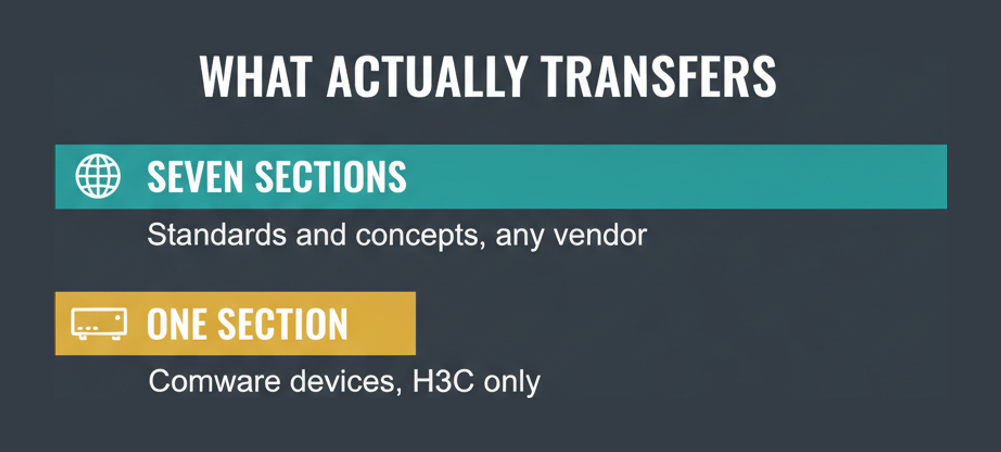
That is genuinely useful for planning. Someone with a solid grounding in the OSI model, subnetting, VLANs, spanning tree and OSPF is not starting this exam from zero; they are starting from the device half. The section that will actually be new is Getting Started with H3C Network Devices, covering Comware, its command line, its file system and its boot process.
Where the standards are the same, the exam still names them
The syllabus does not paraphrase. It names 802.1Q for VLAN tagging and 802.1x for port access control directly, so the specifications are worth reading at source rather than through a vendor’s summary. The IEEE’s own page for 802.1Q virtual LANs is the reference, and the same is true of 802.1X port-based control for the port security objectives.
The reverse warning applies too. Vendor-neutral does not mean identical syntax. Everything you know about how spanning tree behaves transfers; nothing you know about how to configure it on another vendor’s command line does. Keep those two categories separate in your notes and the study load becomes much clearer.
What Does the LAN Switching Section Expect You to Configure?
LAN Switching is the broadest single section on GB0-192. It covers shared versus switched Ethernet and the learning, forwarding and filtering logic of a switch, VLAN concepts and allocation modes, 802.1Q tags and trunk links, the full spanning tree family, port security, link aggregation, and WLAN fundamentals with basic configuration.
The spanning tree material is the deepest part and the syllabus is unusually explicit about it. It names STP, RSTP and MSTP, their relationships, Ethernet ring generation, switch roles, port states and BPDUs, then asks separately for the improvements RSTP brings over STP and the improvements MSTP brings over RSTP. That is a comparison question waiting to be asked, and it is answerable if you have learned the three as a progression rather than three protocols.
Port security is four separate topics, not one
The objectives name 802.1x functions, features and system architecture, port access control, port isolation and port binding as distinct items. They solve different problems: 802.1x authenticates a device before it gets a network, isolation stops two ports on the same VLAN talking to each other, and binding ties a port to a specific address. Candidates who treat the four as one topic lose marks on the distinctions between them.
Link aggregation is smaller but reliably examinable, and the split the syllabus draws is between static aggregation groups and dynamic ones. WLAN appears here at introductory depth only, covering key concepts, device types and basic configuration, so it does not need the study time a wireless-specific credential would demand.
How Deep Does GB0-192 Go Into IP Routing?
Deeper than the entry-level label suggests, but only in one direction. The section covers routing principles, the routing table, how routers process packets, route sources, metrics, priorities and loops, then direct and static routes and inter-VLAN routing, a general classification of routing protocols, and OSPF basics. There is no BGP, no EIGRP equivalent, and no route redistribution.
The concentration on OSPF is the point. The objectives name its features, basic working process, DR election, LSAs and the link state database, and domain-based OSPF, which is a real depth of coverage for a single protocol on an entry exam. DR election in particular is a favourite because it has clear rules and a clear failure mode.
Anyone who wants the behaviour from the source rather than a summary can read RFC 2328 on OSPF, which is the specification the vendor implementations follow. It is long, and the sections on the link state database and designated router election are the ones that map onto this syllabus.
The other half of the section is quieter but just as examinable: route priority and metric. Knowing why a router prefers one route over another when two protocols offer a path to the same destination is the kind of question that separates people who have configured routing from people who have read about it, and it appears in the objectives as route sources, metrics and priorities in a single line.
Why Does an Entry-Level Exam Include SDN and NFV?
Because H3C has put its own architectural direction into the blueprint. The eighth section, The Evolution of Network Technologies, covers virtualization fundamentals across compute, storage and network, then SDN background, architecture and value, then NFV background, concepts, standards organisations, and H3C’s own NFV products and architecture. It is conceptual rather than configurational.
That placement is unusual for an entry credential and it tells you something about how the exam is meant to be read. The first seven sections describe a network you can build today; the eighth describes where the vendor believes the discipline is going. Questions here will be definitional, asking what SDN separates from what, or what problem NFV solves, rather than asking you to deploy a controller.
The study effort is correspondingly light, and that is the honest advice: this section rewards a clear conceptual grasp and punishes nothing else. Understand the separation of control and forwarding planes, understand why moving network functions onto general-purpose compute changes the economics, and know that H3C has its own product line in this space. Six questions of conceptual material is not where a pass is won or lost.
Segment routing sits in the WAN section rather than this one, but belongs to the same modernising impulse. The objectives ask for its origin, advantages, principles and application scenarios, which is again a conceptual rather than a configuration expectation.
How Should You Prepare Without Comware Hardware?
Most candidates will not have H3C equipment to practise on, and the blueprint is structured in a way that makes that survivable. Seven of the eight sections are either standards-based or conceptual, and only the device section genuinely needs the platform. The order below reflects that, and it is deliberately sequential because each stage supplies what the next assumes.
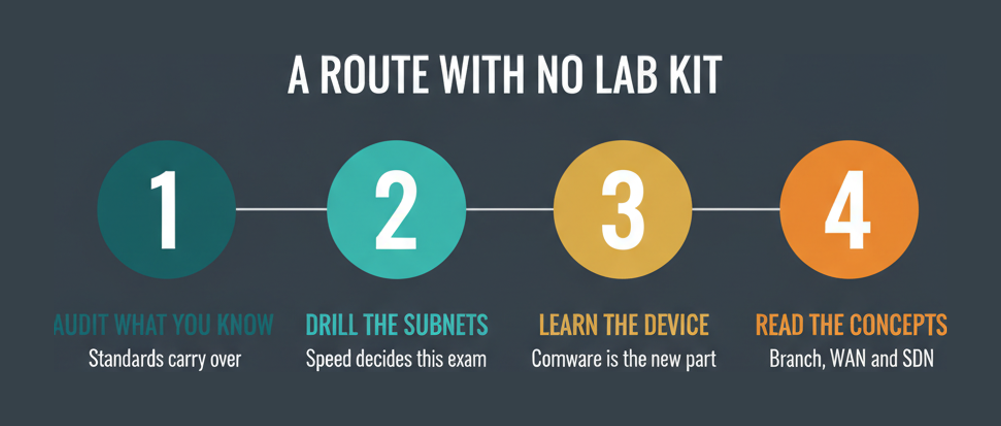
- Audit what already transfers by working through the fundamentals, TCP/IP and IP routing sections first, since these describe standards that behave identically on any vendor and are where an experienced engineer can move fastest.
- Close the arithmetic gap next, drilling subnetting, VLSM and CIDR until the calculations are automatic, because a 72 second average per question leaves no room to work a subnet out on paper.
- Learn the Comware device layer deliberately as the one genuinely vendor-specific block, covering the command line, the file system, configuration and system file management and the boot process from the official course material.
- Finish with the conceptual sections on secure branch configuration, WAN access and the virtualization, SDN and NFV material, which reward clear definitions rather than hands-on practice.
Where a lab is available, spend it on the switching section rather than anywhere else. Spanning tree behaviour, VLAN trunking and link aggregation are the topics where watching the thing happen genuinely beats reading about it, and they sit in the broadest section on the paper.
Beyond that, treat the official syllabus as the scope boundary rather than a starting point. Because independent English study material is scarce, the temptation is to substitute another vendor’s course and hope the overlap covers it. The overlap is real but partial, and everything in the device section and the NFV architecture material sits outside it.
Where Does H3CNE-RS+ Lead, and How Long Does It Last?
H3CNE-RS+ is the engineer tier of a three-level ladder, and it is valid for three years. Above it sits H3CSE for senior engineers and H3CIE at expert level, with the routing and switching track continuing directly upward. Alongside it, the H3CNE tier itself branches into other specialisms rather than being a single credential.
The direct continuation in this track is the senior routing and switching material, which moves from OSPF basics into the advanced protocol work an enterprise network actually runs on. A walkthrough of that next tier sits in this guide to the H3CSE advanced routing exam, which is the natural follow-on once the essentials credential is in hand.
The sideways moves at the same tier are worth knowing about too, because they are cheaper than climbing and often more relevant to a specific job. H3C runs H3CNE credentials for areas including project management, server platforms, cloud and security, and this look at the H3CNE project management exam shows how different those siblings can be from the routing track.
On the validity question, three years is shorter than some vendors and the same as many. The practical implication is that timing matters: earning the credential at the point where it supports an application is better than earning it speculatively and watching a third of its life expire before anyone asks about it.
Frequently Asked Questions
How many questions are on the GB0-192 exam?
Fifty questions in 60 minutes, which is 72 seconds each. The passing score is 600 out of 1000, and there are no prerequisites of any kind for sitting it.
How much does the H3C GB0-192 exam cost?
One hundred and sixty-five US dollars. Registration runs through Prometric rather than Pearson VUE, which is the less common of the two routes for networking exams.
What certification does GB0-192 award?
H3CNE-RS+, the H3C Certified Network Engineer for Routing and Switching Plus. H3C confirms that passing this single exam is the whole requirement for the credential.
How long is H3CNE-RS+ valid?
Three years. That detail comes from H3C’s own certification page rather than the money-site syllabus page, which does not mention validity at all.
Is H3C certification the same as Huawei certification?
No. They are separate companies with separate equipment, separate operating systems and separate credentials. H3C’s platform is Comware, and the GB0-192 syllabus names it directly.
How many sections does GB0-192 have?
Eight, and none of them carries a published weighting. On a 50 question paper that averages roughly six questions per section if the distribution is even.
Does GB0-192 cover BGP?
No. The IP Routing section covers routing principles, static and direct routes, inter-VLAN routing, a general classification of protocols, and OSPF basics. BGP is not in the objectives.
Do you need H3C hardware to prepare?
Not for most of it. Seven of the eight sections are standards-based or conceptual. Only the device section, covering Comware, its command line and file system, genuinely needs the platform.
Why does an entry-level exam include SDN and NFV?
The eighth section covers virtualization, SDN and NFV conceptually rather than as configuration. It reflects H3C’s own architectural direction, and questions there are definitional.
What comes after H3CNE-RS+?
H3CSE at senior engineer level and H3CIE at expert level. The routing and switching track continues upward directly, and other H3CNE credentials sit alongside it as sideways moves.
Conclusion
GB0-192 is a broader exam than its entry-level position suggests, and a more transferable one than its vendor obscurity implies. Eight sections, 50 questions, 60 minutes, 600 out of 1000, $165, no prerequisites, and a credential valid for three years. Seven of the eight sections describe standards or concepts that behave the same anywhere.
Prepare by auditing what already transfers, closing the subnetting arithmetic gap so the 72 second average holds, then learning the Comware device layer as the one genuinely new block and finishing with the conceptual sections. Treat the published syllabus as the scope boundary, because independent English-language material is scarce and another vendor’s course will cover the standards and miss the platform entirely.


