
Forty percent of one exam, spread across eight methods that the blueprint names out loud: k-means clustering, association rules, linear regression, logistic regression, naive Bayesian classifiers, decision trees, time series analysis and text analytics. That single objective is the Dell Data Science Foundations certification in miniature. D-DS-FN-23 puts 60 questions in front of you over 90 minutes, asks for 60 percent, and costs $230, and almost half of what it asks about is the theory, application and interpretation of those eight techniques.
The rest of the paper is not filler, though. A second domain worth 22 percent covers the big data tooling underneath the methods, and a third worth 15 percent covers the statistics you need before any of the modelling makes sense. Read the weightings as a map and the study plan writes itself. This guide walks all six domains, converts each weight into questions on a 60-item paper, and shows where candidates tend to spend time they cannot afford.
Why Do Eight Methods Carry Forty Percent of D-DS-FN-23?
Because Dell built the Data Science Foundations certification around technique rather than tooling. The largest objective on D-DS-FN-23 is worth 40 percent and asks you to describe the theory, application and interpretation of results for eight specific methods. No other domain comes close. Method fluency is the credential’s definition of a foundation.
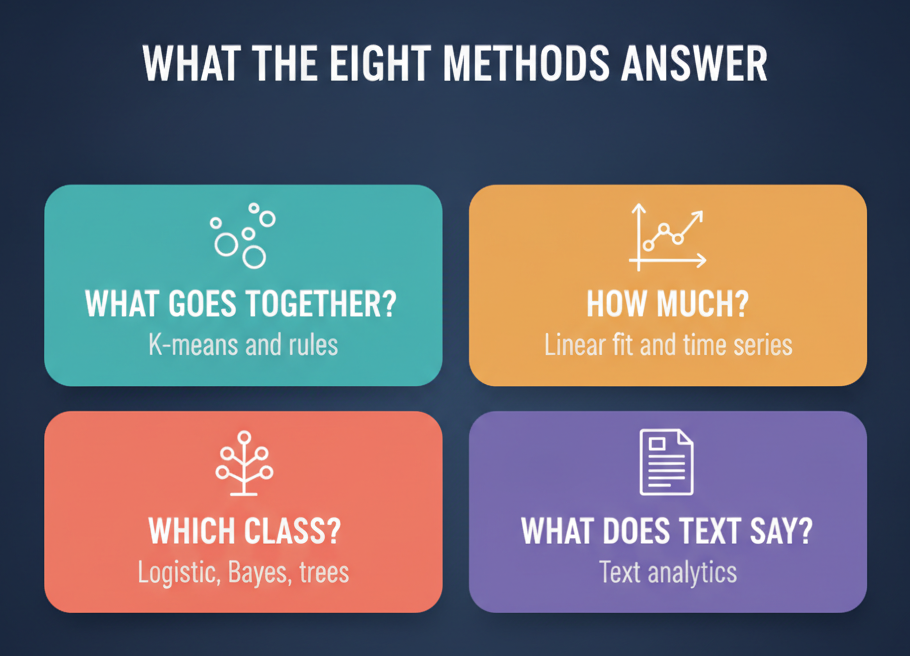
That design choice separates this exam from most vendor credentials, which usually reward knowing a product. Here the product barely appears. You are asked whether you can tell when association rules are the right instrument and when a decision tree is, and then whether you can read what the output means once the model has run.
It also sets the bar for what “interpretation” means. The objective does not stop at application. A question can hand you a result and ask what it supports, which is a different skill from knowing how to produce it. Candidates who can run a logistic regression but cannot explain what an odds ratio implies for the business tend to lose marks in exactly this domain.
The Six Domains and What Each Weight Buys You
D-DS-FN-23 publishes six weighted objectives that sum to 100 percent. They run from a 5 percent opener on big data and the data scientist role, through the analytics lifecycle and initial data analysis, into the 40 percent advanced analytics block, then a 22 percent tooling domain and a 10 percent close on communicating and operationalizing the work.
| Objective | Weight | What it actually asks |
|---|---|---|
| Big Data, Analytics, and the Data Scientist Role | 5% | Characteristics of big data, the business drivers behind analytics, and the data scientist role with its related skills |
| Data Analytics Lifecycle | 8% | The purpose and sequence of the phases, then Discovery, Data preparation, Model planning and Model building with their activities and roles |
| Initial Analysis of the Data | 15% | Basic R commands for exploration, the important statistical measures and effective visualizations, and hypothesis testing used to evaluate a model |
| Advanced Analytics: theory, application and interpretation for eight methods | 40% | K-means clustering, association rules, linear regression, logistic regression, naive Bayesian classifiers, decision trees, time series analysis and text analytics |
| Advanced Analytics for Big Data: technology and tools | 22% | Big data technology challenges, MapReduce and Apache Hadoop, the Hadoop ecosystem, in-database analytics and SQL essentials, plus window functions, ordered aggregates and MADlib |
| Operationalizing an Analytics Project and Data Visualization Techniques | 10% | Communicating findings, building presentations for specific audiences, and planning effective visualizations |
Two of the six are worth less than a tenth each. The first objective at 5 percent is the definitional one, and candidates routinely over-study it because it is the first thing they read. It is the smallest domain on the paper.
How Many Questions Does Each Analytics Method Get?
Applying the published weights to a 60-question paper gives roughly 24 questions in the advanced analytics domain, 13 in the big data tooling domain, 9 in initial analysis, 6 in operationalizing, 5 in the lifecycle and 3 in the opening domain. Split those 24 across eight named methods and each one is worth about three questions.
Three questions per method is the number worth carrying into study. It means no single technique can be skipped safely, because dropping one costs roughly 5 percent of the paper when the whole margin above a 60 percent pass is 24 marks. It also means no single technique deserves a week of deep theory either.
| Domain | Weight | Approximate questions of 60 |
|---|---|---|
| Advanced Analytics, eight methods | 40% | 24 |
| Advanced Analytics for Big Data | 22% | 13 |
| Initial Analysis of the Data | 15% | 9 |
| Operationalizing and Visualization | 10% | 6 |
| Data Analytics Lifecycle | 8% | 5 |
| Big Data and the Data Scientist Role | 5% | 3 |
Treat those counts as arithmetic on the published weights rather than a guarantee about any one form. The useful conclusion is proportional: the eight methods plus the tooling domain together account for close to two thirds of the exam, so two thirds of preparation belongs there. Working through D-DS-FN-23 sample questions method by method is the quickest way to find which of the eight you cannot yet interpret under time.
What Is the D-DS-FN-23 Exam Format?
D-DS-FN-23 is a 60-question exam with a 90-minute limit, a 60 percent passing score and a $230 price in US dollars. Registration runs through Pearson VUE. Ninety minutes across 60 questions works out at 90 seconds each, which is comfortable for definitional items and tight for anything asking you to read a result.
| Detail | Value |
|---|---|
| Exam name | Dell Data Science Foundations 2023 |
| Exam code | D-DS-FN-23 |
| Questions | 60 |
| Duration | 90 minutes |
| Passing score | 60% |
| Price | $230 USD |
| Registration | Pearson VUE |
| Recommended training | Data Science Foundations |
Sixty percent of 60 questions is 36 correct answers, so the margin is 24. That is a genuinely forgiving threshold by certification standards, and it is why the weighting map matters more than perfection in any one area. You can be weak somewhere. You cannot be weak across the 40 percent domain.
Booking runs through Pearson VUE for Dell, and the exam is offered in English, French and Japanese. The Dell exam listing publishes the same six topic weightings used above.
Big Data Tools the Blueprint Names by Hand
The 22 percent tooling domain is unusually specific for a foundations exam. It names MapReduce and Apache Hadoop directly, then the Hadoop ecosystem and its product use cases, then in-database analytics and SQL essentials, and finally three advanced SQL techniques: window functions, ordered aggregates and MADlib. Nothing there is left to inference.
Hadoop and MapReduce
The objective asks for the nature and use of MapReduce, not for the ability to write a job. Expect questions about what the model is good at, where it breaks down, and which ecosystem component solves which problem. Reading the Apache Hadoop project pages for the component list is a faster route than any summary, because the exam is asking about use cases rather than internals.
SQL that goes past SELECT
Window functions and ordered aggregates are the part candidates underestimate. They are examined as analytics tools, so the question is usually what a window function lets you compute without leaving the database, rather than syntax recall. MADlib sits alongside them as the in-database machine learning library, and the Apache MADlib documentation is the reference of record for what it actually offers.
The common thread across this domain is the argument for moving computation to the data instead of moving data to the computation. If you can articulate why that matters at scale, most of the 13 questions here become straightforward.
How Much Statistics Do You Need Before the Modelling?
Enough to pass a 15 percent domain that covers exploratory analysis with basic R commands, the important statistical measures, effective visualizations, and the theory, process and analysis of results for hypothesis testing. Initial Analysis of the Data is the third-largest objective on D-DS-FN-23 and it functions as the prerequisite for the 40 percent block above it.
Hypothesis testing is the piece to take seriously. The blueprint ties it explicitly to evaluating a model, which is a narrower framing than a statistics course would use. You need to know what a test is telling you about whether a result is worth acting on, and what it is not telling you.
R appears here as an exploration language rather than a development one. The objective asks how basic commands are used to explore and analyse data, so familiarity with reading R output matters more than writing it fluently. Candidates who arrive from Python find this domain the least comfortable, and it is worth a deliberate week rather than an afternoon.
Where Does the Data Analytics Lifecycle Fit?
At 8 percent, or roughly five questions, the Data Analytics Lifecycle is a small domain that pays back quickly. It asks for the purpose and sequence of the phases, then for the detail of four of them: Discovery, Data preparation, Model planning and Model building, each with its activities and the roles associated with it.
The word “roles” is doing real work in that objective. Questions here are as likely to ask who does something as what gets done, which reflects how Dell frames the credential: a data scientist working inside a project team rather than alone. Knowing that the business sponsor belongs in Discovery is examinable content.
Because it is only five questions, the efficient approach is to learn the phase order cold and the four detailed phases properly, then stop. The lifecycle also gives the rest of the syllabus a spine. Initial analysis belongs to Data preparation, the eight methods belong to Model planning and Model building, and the 10 percent operationalizing domain is what happens after.
Who Is This Foundations Credential Actually For?
Dell points the Data Science Foundations certification at systems engineers and technical consultants, and describes it as validating the practical foundation skills a data scientist needs to join big data and analytics projects immediately. It is a starting credential, not a specialist one, and the syllabus is deliberately vendor-neutral in its method coverage.
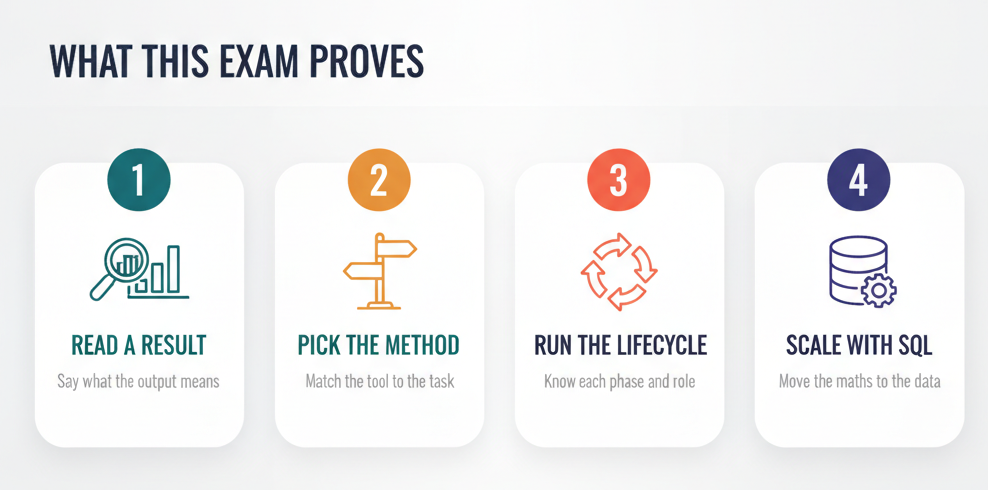
In practice that suits three groups. Infrastructure people who now support analytics platforms and need the vocabulary. Analysts who want a structured method inventory rather than a tool certificate. And consultants who need something on paper before joining a project team where the modelling is done by someone more senior.
If your goal is the advanced analytics tier rather than the foundation, the natural next step inside Dell’s own track is Dell Data Science Optimize, which goes considerably deeper into method selection and tuning. Foundations first is the sensible order, because the Optimize syllabus assumes the eight methods are already familiar.
One practical note on availability: the exam is published in English, French and Japanese, which is broader than many Dell credentials and matters if English is not your working language for statistical terminology.
How Should You Sequence Preparation for D-DS-FN-23?
Work outward from the lifecycle, because it organises everything else, then spend the bulk of your time on the eight methods and the tooling domain that together carry 62 percent of the paper. The sequence below follows the dependency order rather than the syllabus order, which puts the small domains first for a reason.
- Learn the Data Analytics Lifecycle phase order first, along with the activities and roles inside Discovery, Data preparation, Model planning and Model building, because every later domain hangs off one of those phases.
- Cover the 15 percent initial analysis domain next, working through basic R exploration output, the core statistical measures and hypothesis testing, since the advanced analytics block assumes all three.
- Take the eight methods one at a time and force yourself to write, for each, what it is for, what input it needs and what its output actually means in business terms.
- Move to the big data tooling domain, concentrating on MapReduce use cases, the Hadoop ecosystem components, and why window functions, ordered aggregates and MADlib let analytics happen inside the database.
- Finish with the 10 percent operationalizing and visualization domain, which is short, concrete and easy to pick up once you know what the models produce.
- Test yourself against sample items method by method, and treat any of the eight you cannot interpret under 90 seconds as unfinished work.
Six weeks is a realistic run at this for someone already working around analytics, and closer to ten for a candidate meeting hypothesis testing and Hadoop for the first time. Browsing the wider Dell certification hub is worth doing before you book, because the Proven Professional track has several adjacent credentials and picking the wrong tier wastes a fee.
Frequently Asked Questions
How many questions are on the D-DS-FN-23 exam?
Sixty questions with a 90-minute limit, which is 90 seconds per question. That is generous for definitional items and tight for questions that ask you to read and interpret a model result.
What is the passing score for Dell Data Science Foundations?
Sixty percent, so 36 correct answers out of 60. The margin is 24 marks, which is forgiving by certification standards but not enough to survive skipping the 40 percent advanced analytics domain.
How much does the D-DS-FN-23 exam cost?
Two hundred and thirty US dollars, booked through Pearson VUE. Dell does not publish the price on its own exam listing, so that figure comes from the money-site syllabus page.
Which eight methods does the advanced analytics domain cover?
K-means clustering, association rules, linear regression, logistic regression, naive Bayesian classifiers, decision trees, time series analysis and text analytics. All eight are named individually on the blueprint.
Do you need to write R code for this exam?
No. The objective asks how basic R commands are used to explore and analyse data, which is a reading skill rather than a development one. Being able to interpret R output matters more than writing it.
What programming or SQL knowledge does D-DS-FN-23 assume?
SQL essentials plus three named advanced techniques: window functions, ordered aggregates and MADlib. They are examined as analytics instruments, so expect questions about what they let you compute rather than syntax recall.
Which languages is the exam offered in?
English, French and Japanese, according to Dell’s own exam listing. That is broader coverage than several other Dell credentials offer, which helps if statistical terminology is easier for you in French or Japanese.
Is D-DS-FN-23 tied to Dell products?
Barely. The syllabus is built around methods, the analytics lifecycle and open technology such as Apache Hadoop and MADlib. The credential carries Dell’s name but tests portable data science knowledge.
Who does Dell say this certification is for?
Systems engineers and technical consultants. Dell frames it as validating practical foundation skills so the holder can participate immediately in big data and analytics projects rather than lead them.
How long should preparation take?
Roughly six weeks for someone already working near analytics, and closer to ten weeks for a candidate meeting hypothesis testing, Hadoop and the eight methods for the first time.
Conclusion
The weighting map is the whole story on D-DS-FN-23. Two domains, the eight advanced analytics methods at 40 percent and the big data tooling block at 22 percent, carry 62 percent of a 60-question paper between them. The other four objectives are worth 38 percent combined, and the smallest of them is the definitional opener most candidates read first and study hardest.
Plan around that and the exam becomes a manageable piece of work: learn the lifecycle for structure, get comfortable reading R output and hypothesis tests, then give the eight methods the time their share of the marks deserves. Once each method is something you can explain rather than merely name, sample items covering all eight are the fastest way to confirm you are ready to book.


