If the answers are allowed to be in front of you, what exactly is there to revise? That is the question worth settling before booking the DevSecOps Foundation exam, because DSOF is delivered open book, and almost every piece of study advice written for it ignores that fact entirely. Forty multiple choice questions, 60 minutes, a 65 percent pass mark, and permission to look things up while you answer.
The honest answer is that open book removes recall and leaves comprehension, which is a harder problem on a 90-second-per-question clock than most candidates expect. The DevOps Institute DevSecOps Foundation credential covers eight named topics, from the cyber threat landscape through pipelines and continuous compliance to how learning programmes are run, and the syllabus names the OWASP Top Ten, published CVEs and common software weaknesses outright. This guide sets out what those topics contain, what open-book delivery actually changes, and who the $257 is genuinely worth spending by.
What Is the DevSecOps Foundation Exam?
DSOF is the entry-level credential in the DevOps Institute’s security track. The DevSecOps Foundation exam contains 40 multiple choice questions, runs for 60 minutes, and is passed at 65 percent, which means 26 correct answers. It costs $257 US dollars, is delivered over the web, and carries a three-year validity.
The credential’s ownership matters for anyone planning around it. DevOps Institute is now part of the PeopleCert Group, and application, purchase and delivery all route through the PeopleCert platform. That change is also why the validity period is three years: certifications taken on the PeopleCert platform fall under its Continuing Professional Development programme rather than the older two-year Continuing Education cycle.
Language availability is wider than the foundation tier usually offers, covering English, Brazilian Portuguese, Chinese and Japanese. Preparation can be instructor-led, online, or entirely self-directed, and no formal prerequisite blocks a booking.
Is the DSOF Exam Really Open Book?
Yes. The DevOps Institute lists Open Book: Yes among the certification details for DSOF, alongside the 40 questions, 65 percent pass mark and 60-minute duration. It is a web-based exam, so the reference material is genuinely to hand rather than notionally permitted.
Candidates hear that and relax, which is the mistake. Sixty minutes across 40 questions is 90 seconds each. Looking up a term costs perhaps 30 to 45 seconds by the time you have found it and read enough to be sure, so the format tolerates roughly a dozen lookups across the whole paper before the clock becomes the binding constraint rather than your knowledge. Practitioners who want a vendor-specific follow-on often look at the Oracle DevOps professional certification.
What that produces is an exam that punishes unfamiliarity rather than imperfect memory. If you recognise every term and merely cannot recall one definition precisely, open book saves you. If half the vocabulary is new, no amount of reference material rescues a 90-second budget.
What Does Open Book Change About Preparation?
It moves the target from memorising to navigating. The useful preparation for a closed-book exam is repetition until recall is automatic; the useful preparation for an open-book one is building a mental index so that you know where an answer lives and can reach it in seconds rather than searching for it.
Four practical differences follow.
- Flashcards lose most of their value. Recall drills solve a problem the format has already solved for you.
- Organising your reference material becomes a study activity in its own right, because a well-structured set of notes is faster to search than a well-remembered one is to recall.
- Reading comprehension under time pressure matters more than content coverage, since the questions are scenario-flavoured rather than definitional.
- Deciding quickly whether to look something up is a skill. The candidates who run out of time are usually the ones who checked answers they already knew.
Working through the topics against DSOF exam preparation material under a timer is the fastest way to discover which of those two habits you have.
What Topics Does DSOF Cover?
Eight named topics, published without weightings. They move from context to practice to people: the threat landscape first, then how DevSecOps outcomes are realised, the practices and the response model, how to get started, who the stakeholders are, pipelines and continuous compliance, and finally how learning is run.
| Topic | What sits inside it |
|---|---|
| Cyber Threat Landscape | Tactics, techniques and procedures; threat models identifying objectives and vulnerabilities including the OWASP Top Ten; continuous delivery practices supporting governance, risk management and compliance |
| Realizing DevSecOps Outcomes | Security built into the value stream, empowered teams implementing features securely, shift-left testing, automated feedback tooling, culture improvement rather than policy enforcement |
| DevSecOps Practices | Security integrated into people, process, technology and governance; continuous security in onboarding; data-driven monitoring of security outcomes; lean and value stream thinking so security adds no waste |
| Responsive DevSecOps Model | Continuously adaptive and auditable security, breaking silos between security and other business units, security practices and toolsets as code, observable security KPIs inside the value stream |
| Getting Started | Value stream mapping to locate security activities and bottlenecks; collaborative target-state design covering artifact management, risk management, identity and access, secrets, encryption, governance, monitoring, logging and incident response |
| DevSecOps Stakeholders | Closing the gap between waterfall security culture and DevOps pace through credibility, reliability and empathy; decisions informed by everyone affected; shared metrics and adaptable governance |
| Pipelines and Continuous Compliance | Security testing and scanning integrated into CI/CD to find published CVEs and common software weaknesses; automated configuration and fuzz testing; compliance as code |
| Learning Using Outcomes | Continuous learning programmes through lunch and learns, mentoring, professional education, employee learning plans, structured classes, Dojos, retrospective learning and gamification |
The balance is worth noticing. Only two of the eight topics are primarily technical. The rest are about culture, stakeholders, value streams and learning, which tells you what kind of exam this is before you read a single question.
Which Frameworks Does the Syllabus Name Directly?
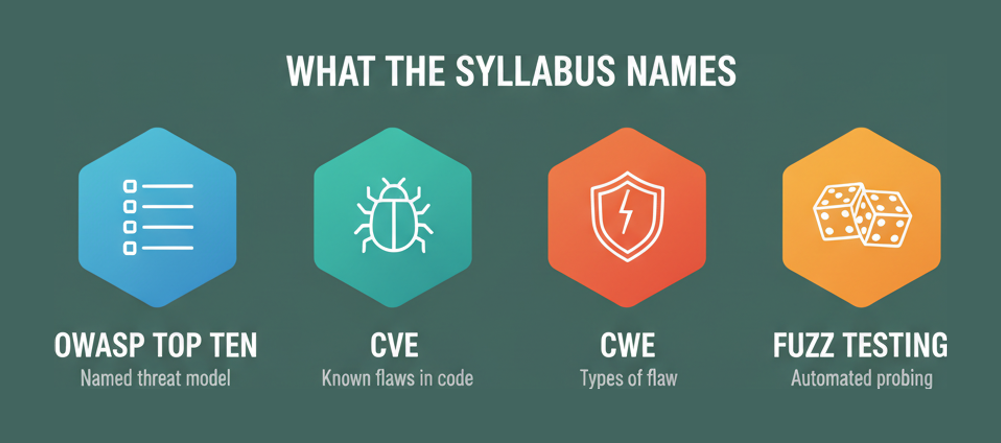
Three, and all three are open industry references rather than vendor material: the OWASP Top Ten under the threat landscape topic, and published CVEs together with common software weaknesses under pipelines and continuous compliance. That specificity is unusual for a foundation syllabus and makes the reading list short and concrete.
The threat side
The syllabus describes threat models as optimising security by identifying objectives and vulnerabilities before counter-measures are defined, and names the OWASP list as the example. The OWASP Top Ten project is the reference of record here, and reading the current list once is worth more than any summary of it.
The pipeline side
For pipelines, the objectives distinguish between known vulnerabilities in shipped components and weaknesses in the code itself, which is the CVE and CWE distinction stated plainly. MITRE’s Common Weakness Enumeration is the catalogue behind the second half of that pairing, and understanding why the two lists exist separately is the point the exam is likely to test.
Alongside those, the syllabus names compliance as code, fuzz testing and value stream mapping as techniques rather than as concepts, so each one needs a working definition rather than a recognition-level one.
What Are the DSOF Exam Details?
DSOF is 40 multiple choice questions in 60 minutes, passed at 65 percent, which is 26 correct answers with 14 to spare. The fee is $257 US dollars, delivery is web-based and open book, and the credential remains valid for three years.
| Detail | Value |
|---|---|
| Exam name | DevOps Institute DevSecOps Foundation |
| Exam code | DSOF |
| Questions | 40, multiple choice |
| Duration | 60 minutes |
| Passing score | 65 percent, or 26 correct |
| Fee | $257 USD |
| Delivery | Web-based, open book |
| Languages | English, Brazilian Portuguese, Chinese, Japanese |
| Validity | 3 years |
| Preparation | Instructor-led training, online learning, or self-study |
Fourteen permitted mistakes across eight topics is a comfortable margin on paper, and the format is what makes it less comfortable than it looks. The full certification details, including the open-book confirmation, sit on the official DevSecOps Foundation page, and the exam itself is now booked and sat through the PeopleCert platform.
For readers who want the study material gathered rather than scattered, our DSOF resource page collects it in one place alongside the topic list above.
What Is the Difference Between DevOps and DevSecOps?
DevOps removes the handoff between building software and running it. DevSecOps removes a second handoff, the one where security reviews the result after it is built. The syllabus frames the difference as culture rather than tooling: security integrated into people, process, technology and governance, with culture improvements replacing policy enforcement.
That framing is why the exam spends so little time on scanners. Two of the eight topics deal with pipelines and threats; the other six deal with outcomes, practices, response models, stakeholders, getting started and learning. A candidate expecting a tools exam will find a change-management exam wearing a security badge.
The stakeholder topic makes the distinction concrete. It describes closing the gap between a traditional waterfall security culture and a fast-moving DevOps culture by building credibility, reliability and empathy while reducing self-interest, with decisions informed by everyone affected. That is organisational work, and it is examinable.
How Should You Prepare for an Open Book Paper?
Build a reference you can navigate rather than a memory you can recall. The goal is that any term in the eight topics is either already familiar or findable in under 30 seconds, because the 90-second question budget will not absorb more than a dozen genuine lookups.
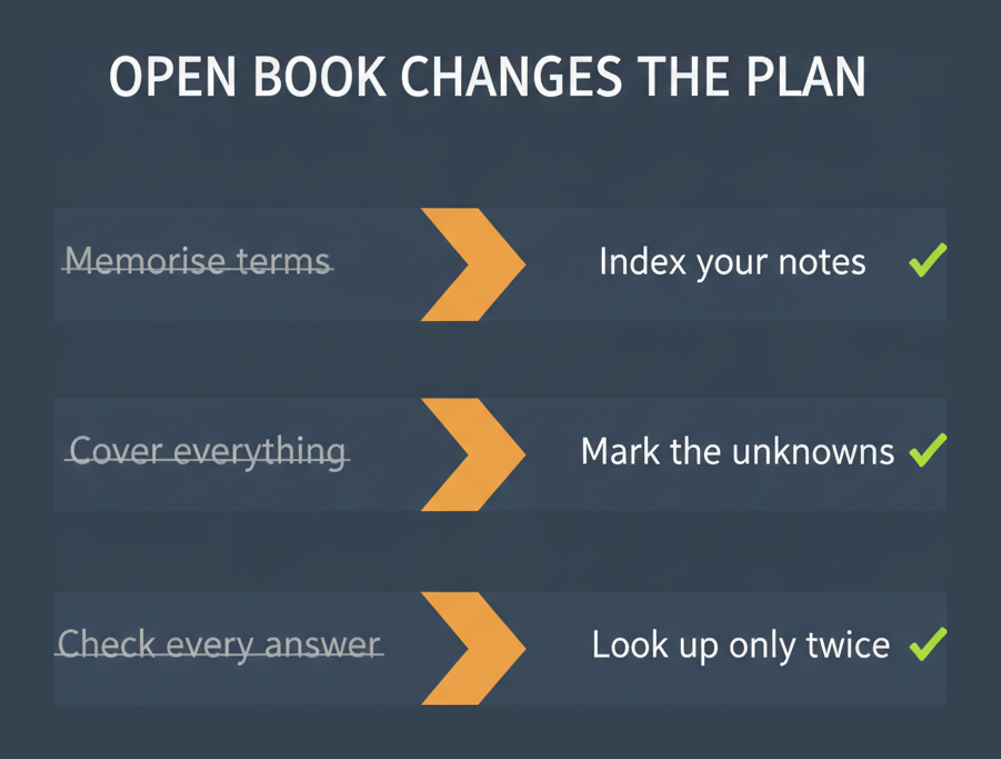
- Read all eight topic descriptions once without taking notes, marking only the terms you could not define aloud to a colleague, because that list is your entire revision scope.
- Build a single structured reference document organised by the eight topic names, so that during the exam you know which section to open before you know what you are looking for.
- Read the current OWASP Top Ten in full rather than a summary, since it is the one list the syllabus names by name under the threat landscape topic.
- Settle the CVE and CWE distinction properly, because the pipelines topic treats known vulnerabilities and common weaknesses as two separate things and a question turning on that difference is easy to lose.
- Work the culture topics with the same seriousness as the technical ones, given that six of the eight topics deal with outcomes, stakeholders, practices and learning rather than with tooling.
- Rehearse at 90 seconds per question with your reference open, deliberately practising the decision of whether to look something up, because the candidates who run out of time are the ones who checked what they already knew.
Anyone already working in a DevSecOps team will find steps one and six do most of the work. The credential’s difficulty for practitioners is rarely the content; it is the vendor’s specific vocabulary for practices they already run under different names.
Who the Credential Is Actually Aimed At
Broader than the name suggests. The DevOps Institute names compliance and delivery staff, project and product managers, IT managers, security professionals, site reliability engineers, DevOps engineers, software engineers, support staff, managed service providers, quality assurance teams, release managers, scrum masters and testers among the roles this credential suits.
Read that list carefully and the design intent becomes clear: DSOF is built to give a mixed team one shared vocabulary rather than to deepen a specialist’s expertise. It is a reasonable team-wide credential and a thin individual one for anyone already senior in application security.
Practitioners who find the foundation content already familiar should look straight past it. The practitioner tier is the one that adds depth, and our guide to the DSOP practitioner credential covers what changes at that level and whether the step up is worth taking.
Frequently Asked Questions
What is the DevSecOps Foundation exam?
DSOF is the DevOps Institute’s entry-level DevSecOps credential. It contains 40 multiple choice questions, runs 60 minutes, is passed at 65 percent, and covers eight topics spanning threats, practices, pipelines, stakeholders and learning.
Is the DSOF exam open book?
Yes. The DevOps Institute lists Open Book: Yes among the certification details, and the exam is delivered over the web. Reference material is genuinely available while you answer, though the 90-second question budget limits how often you can use it.
How much does the DevSecOps Foundation certification cost?
Two hundred and fifty seven US dollars for the exam. Training is priced separately, and the vendor supports instructor-led, online and self-study routes, so the fee is the only unavoidable cost.
What is the passing score for DSOF?
Sixty-five percent, which is 26 correct answers from 40. That leaves 14 permitted mistakes, a reasonable margin for a foundation paper delivered under open-book conditions.
How long is the DevSecOps Foundation certification valid?
Three years. The period changed after DevOps Institute joined the PeopleCert Group, since certifications taken on the PeopleCert platform fall under its Continuing Professional Development programme.
What is the difference between DevOps and DevSecOps?
DevOps closes the gap between building and running software. DevSecOps closes a second gap by integrating security into people, process, technology and governance rather than reviewing the finished product after the fact.
Does DSOF cover the OWASP Top Ten?
Yes, by name. The cyber threat landscape topic describes threat models identifying objectives and vulnerabilities such as the OWASP Top Ten before counter-measures are defined, so the current list is required reading.
Is DSOF worth it for an experienced security engineer?
Marginally. Six of the eight topics cover culture, stakeholders and learning rather than tooling, so an experienced practitioner mostly gains shared vocabulary. The practitioner-tier credential is the better fit for depth.
What languages is the DSOF exam available in?
English, Brazilian Portuguese, Chinese and Japanese. That is wider coverage than most foundation-level credentials offer, and all four are available through the same web-based delivery.
Are there prerequisites for the DevSecOps Foundation exam?
None. The vendor recommends training but does not require it, and no prior certification gates a booking. The audience list runs from software engineers to release managers and compliance staff.
Conclusion
The DevSecOps Foundation exam is easier to underestimate than to fail. Open book, 40 questions, 65 percent and 60 minutes describes a paper that rewards familiarity and punishes unfamiliarity, and six of its eight topics are about how organisations work rather than about how scanners work.
Prepare by building a reference you can navigate under time pressure, read the OWASP Top Ten properly, settle the CVE and CWE distinction, and take the culture topics as seriously as the technical ones. If most of that already describes your week, the credential is a vocabulary exercise worth three years of validity rather than a learning one.


