A pallet arrives at a customer loading bay. Inside are the nodes, the switches and the rails for a Hitachi Content Platform, and somebody has to turn that into a running system on a network they did not design, in a rack they did not build, before the customer’s change window closes. The HQT-4420 exam is written for that person.
Hitachi Vantara calls the credential Content Platform Installation Professional, and the word doing the work is installation. This is not a storage administration paper. It does not test capacity planning, tenant policy or day-to-day operations. It tests whether you can identify the physical components in front of you, configure the network and storage correctly the first time, bring nodes up in the right order, and keep the system healthy afterwards. This guide walks the six syllabus sections as Hitachi publishes them, sets out the exam mechanics, and explains why the absence of percentage weightings tells you something useful about how to prepare.
What Does the HQT-4420 Exam Cover?
HQT-4420 covers installing and configuring Hitachi Content Platform across six published sections: the platform’s functionality and protection concepts, the hardware architecture of HCP nodes, the hardware architecture of S-series nodes, network and storage configuration, installation and virtualization options, and ongoing maintenance including upgrades and node replacement.
Hitachi Content Platform is an object storage system, which is the frame worth holding on to while you study. Objects carry their own metadata and are addressed rather than located, which is why HCP behaves differently from a filer at every layer, from how you size storage to how you replace a failed node. If object storage architecture is unfamiliar territory, that gap will show up repeatedly across the syllabus.
Hitachi lists HQT-4420 in the Installation and Support row of its Qualified Professional programme, alongside the other installation credentials rather than the administration ones. That placement is the clearest statement of scope the vendor makes, and it matches what the sections ask for.
What Are the HQT-4420 Exam Details?
HQT-4420 is 35 questions in 60 minutes with a 65 percent pass mark, priced at 100 US dollars and registered through Kryterion Webassessor rather than Pearson VUE. Thirty-five questions across 60 minutes gives you roughly 103 seconds each, which is comfortable, and the low fee reflects that this is a partner-facing operational credential rather than a flagship one.
| Detail | Value |
|---|---|
| Certification name | Hitachi Vantara Content Platform Installation Professional |
| Exam code | HQT-4420 |
| Questions | 35 |
| Duration | 60 minutes |
| Passing score | 65% |
| Price | $100 USD |
| Registration | Kryterion Webassessor |
| Recommended training | TCI2741 Installing and Configuring Hitachi Content Platform, a three day instructor-led course |
A 65 percent pass mark on 35 questions means 23 correct answers, so you can afford to lose twelve. That sounds generous until you notice how few questions each section gets: with six sections and 35 items, several sections are carrying only four or five questions, and losing one section entirely is close to losing the exam.
Hitachi names one recommended course, TCI2741, and it runs for three days as instructor-led training. It is a recommendation rather than a requirement, but the fact that the vendor points to a hands-on course rather than a reading list says something about the intended preparation route. Working through HQT-4420 sample questions alongside that course is the quickest way to find which of the six sections you are thin on.
Why Does the Syllabus Carry No Weightings?
Hitachi publishes the six HQT-4420 sections without percentage weightings, which is unusual and worth taking seriously. Most vendors weight their domains so candidates can triage. The absence of weights here means you cannot decide which section to under-prepare, and on a 35-question paper that is a real constraint rather than a formality.
| Section | What it asks you to do |
|---|---|
| Hitachi Content Platform overview | Describe HCP functionality, protection concepts and configurations |
| HCP nodes hardware architecture | Identify physical components and describe network components |
| HCP S-nodes hardware architecture | Identify the physical components of S-series nodes |
| Network and storage configuration | Describe the HCP network and storage configuration design |
| Installation and virtualization options | Configure a node, install nodes, integrate in virtualized environments, install S-series |
| Maintenance | Hardware maintenance, software upgrades, node replacement, adding SSD, S-series upgrades |
Read the table as a sequence rather than a list and the exam’s logic appears. You learn what the platform is, then what the hardware is, then how it connects, then how you bring it up, then how you keep it running. Every section depends on the one before it, which is a strong argument for studying them in published order rather than starting with whatever feels weakest.
What Do the Two Hardware Sections Ask About?
Two of the six sections are hardware identification, and they are deliberately separated because HCP nodes and S-series nodes are different machines with different roles. The first asks you to identify the physical components of HCP nodes and describe their network components. The second asks the same identification question about S-series nodes.
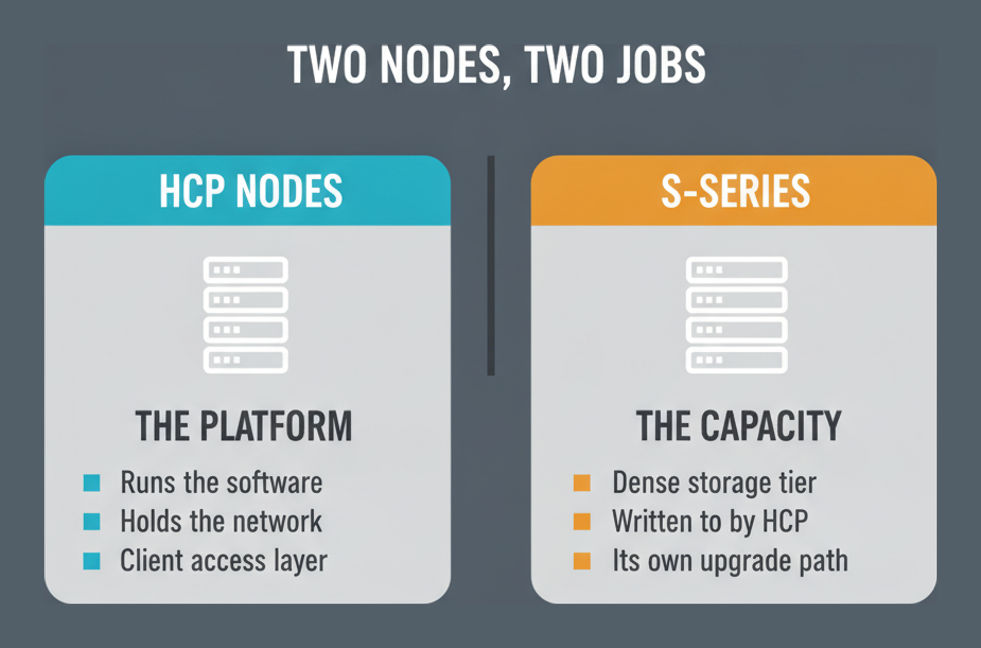
The distinction matters on site. HCP nodes run the platform and hold the access layer. S-series nodes are the dense storage tier the platform writes to, and they are physically and logically different enough that an installer who conflates the two will cable the wrong thing. Splitting them into separate syllabus sections is Hitachi making that point structurally.
Note also that only the HCP node section mentions network components. That asymmetry is a genuine hint about where the questions sit: the network expectations attach to the platform nodes, and the S-series section stays on physical identification.
How Much Network and Storage Configuration Is on It?
One full section is devoted to describing the HCP network and to storage configuration design, which on a six-section paper makes it a substantial share. It sits between hardware identification and installation for a reason: this is the planning work that has to be right before a single node is powered on.
Storage configuration design is the phrase to notice. The syllabus says design, not configure. You are being asked to reason about how a storage layout should be arranged for a given deployment rather than to recall a menu path, which is a different and harder kind of question.
The networking side is described rather than configured too. Understanding how the HCP network is structured, which interfaces carry which traffic, and how the nodes talk to each other and to clients is the knowledge that makes the installation section survivable. Get this section wrong and the installation questions become guesswork, because they assume the network model is already in your head.
What Does the Maintenance Section Actually Test?
Maintenance is the broadest section by objective count, covering hardware maintenance procedures for HCP nodes, software upgrade procedures, node replacement, adding SSD storage to a G11 node, and S-series software upgrades. It is the section most likely to be underestimated, because installers think of their job as ending at handover.
The G11 SSD objective is unusually specific. Where the rest of the syllabus is written in general terms, this one names a hardware generation and a component, which suggests a procedure with enough particular steps to be examinable in its own right. Treat it as a discrete thing to learn rather than as an example of a general skill.
Node replacement is the other objective worth deliberate work. Replacing a node in an object store is not the same as swapping a disk: data placement, protection and cluster membership all have to be re-established, and the sequence matters. Questions in this area tend to be about order of operations rather than about which cable goes where.
Software upgrades appear twice, once for HCP nodes and once for S-series, and that repetition is a signal too. The two upgrade paths are separate procedures, and the syllabus lists them separately rather than folding them together.
How Should You Prepare for HQT-4420?
Preparation for HQT-4420 works best in the syllabus’s own published order, because each section is the foundation of the next. Hardware identification without the platform concepts is memorisation, and installation steps without the network model are a recipe you cannot troubleshoot.
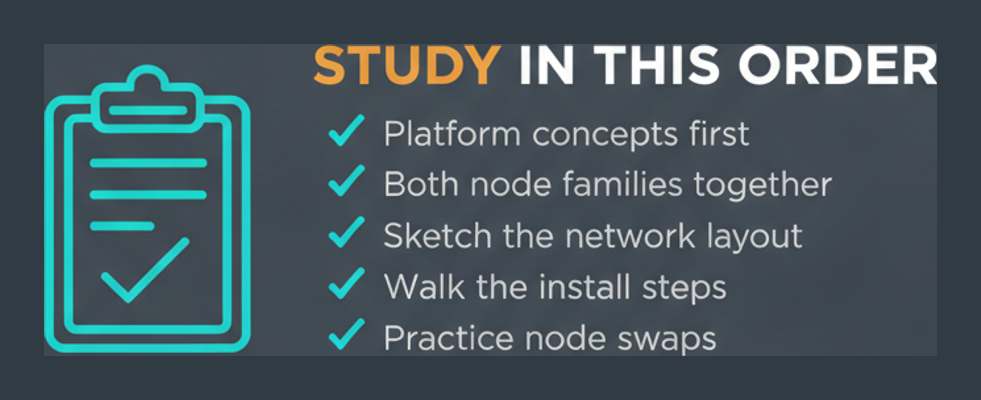
- Start with the platform concepts, making sure you can explain HCP protection and the available configurations in your own words before touching hardware.
- Learn the two node families side by side rather than separately, so the differences between HCP nodes and S-series nodes are the thing you remember rather than two isolated component lists.
- Work through the network and storage design section next, sketching a deployment layout by hand until you can justify where each interface and each storage decision goes.
- Only then take on installation and virtualization, walking the node configuration and installation sequence end to end, including the virtualized deployment path.
- Finish on maintenance, rehearsing node replacement and both upgrade paths as ordered procedures, and treat the G11 SSD addition as its own small drill.
Hitachi’s own recommended course, TCI2741, is three days of instructor-led work and covers installing and configuring the platform directly. If you can get on it, it removes most of the guesswork from steps four and five. For a structured view of the objectives before you book anything, the site’s HQT-4420 study guide lays the six sections out in the order Hitachi publishes them.
The step candidates skip is the third one. Sketching the network and storage layout feels like homework rather than study, and it is the single thing that makes the installation questions read as obvious rather than as a memory test.
Who Should Sit This Exam?
HQT-4420 is aimed at Hitachi Vantara employees and partners who install Content Platform systems at customer sites. That is a narrower audience than most certifications address, and it explains both the low fee and the operational focus of every section.
If you work for a Hitachi partner and object storage installations are part of your delivery work, this credential is a direct match. If you administer an HCP estate that somebody else installed, it is the wrong exam: the syllabus never reaches tenant configuration, policy or day-to-day operations, and the parts you would find useful are not on it.
The transferable value sits in the platform knowledge rather than the credential itself. Hitachi describes what HCP is built to do on its own Content Platform product page, and the architecture concepts behind it carry across to any object store you meet later. Infrastructure roles that involve this kind of on-site build work sit in the broader systems administration market, where systems administrator pay data gives a reasonable benchmark for what the surrounding skill set is worth.
Within Hitachi’s own programme, HQT-4420 is a Professional-tier credential. Candidates who already hold an installation credential on another Hitachi platform will find the structure familiar, and our HQT-4180 exam guide covers the equivalent paper on the VSP midrange side, which follows the same identify, configure, install, maintain shape.
Frequently Asked Questions
How many questions are on the HQT-4420 exam?
Thirty-five questions in 60 minutes, which is roughly 103 seconds each. That is a comfortable pace, and the practical difficulty comes from the breadth of the six sections rather than from time pressure.
What is the passing score for HQT-4420?
Sixty-five percent, which works out at 23 correct answers from 35. With six sections sharing 35 questions, being blank in one whole section puts a pass in serious doubt.
How much does the HQT-4420 exam cost?
One hundred US dollars. The fee is low compared with most vendor certifications, which fits its role as a partner-facing operational credential rather than a flagship architecture qualification.
Where do you register for HQT-4420?
Through Kryterion Webassessor, not Pearson VUE. Hitachi Vantara runs its Qualified Professional programme on Kryterion, so candidates used to booking through Pearson need a separate account.
Does the HQT-4420 syllabus have domain weightings?
No. Hitachi publishes the six sections without percentages, so there is no published basis for deciding which area to under-prepare. On a 35-question paper that makes even coverage the safer strategy.
What is the difference between HCP nodes and S-series nodes?
They are different machines with different roles, which is why the syllabus gives each its own section. HCP nodes run the platform and carry the network components; S-series nodes are the dense storage tier the platform writes to.
Is HQT-4420 a storage administration exam?
No. It is an installation credential, listed by Hitachi in the Installation and Support row of its programme. Tenant configuration, policy and daily operations are all outside its scope.
What training does Hitachi recommend for HQT-4420?
TCI2741, Installing and Configuring Hitachi Content Platform, a three day instructor-led course. It is recommended rather than required, but it maps closely to the installation and virtualization section.
Does the exam cover virtualized deployments?
Yes. The installation section explicitly includes integration procedures for Hitachi Content Platform in virtualized environments, alongside the physical node installation and the S-series installation path.
Who is the HQT-4420 exam intended for?
Hitachi Vantara employees and partners who install Content Platform systems at customer sites. Administrators who inherit a running estate rather than building one will find the syllabus points away from their day job.
Conclusion
HQT-4420 is a field engineer’s exam. Thirty-five questions, 60 minutes, a 65 percent pass mark and six sections that run from platform concepts through hardware identification and network design to installation and maintenance. No section carries a published weighting, which removes the option of triaging one away.
Work the sections in Hitachi’s own order, learn the two node families against each other rather than in isolation, and give the network and storage design section the time it looks like it does not need. Get that one right and the installation questions stop being a memory test.


