One of the six domains on the current POPM blueprint is about artificial intelligence. Not as a footnote inside another topic, but as a named domain worth 12 to 14 percent of the paper, sitting alongside PI Planning and Iteration Execution as an equal. Almost nothing written about this credential mentions it.
That single change tells you the SAFe Product Owner Product Manager certification has moved. It is still a foundational credential, still 45 questions in 90 minutes, still scored at a demanding 82 percent. What has shifted is the definition of competent. Scaled Agile now expects a product owner to reason about prompting, model risk and where automation belongs in a backlog conversation, and it tests that expectation with the same weight it gives the roles and responsibilities domain. This walkthrough takes all six domains in turn, explains what the weighting pattern is really telling you, and sets out how to revise for a paper where a third of the marks sit in one place.
What Does the SAFe Product Owner Product Manager Certification Actually Test?
The SAFe Product Owner Product Manager certification tests six weighted domains: roles and responsibilities at 12 to 14 percent, PI Planning Preparation at 17 to 19 percent, Leadership for PI Planning at 14 to 16 percent, Iteration Execution at 28 to 30 percent, PI Execution at 10 to 12 percent, and Apply AI to Product Roles at 12 to 14 percent. Passing awards the Certified SAFe Product Owner/Product Manager credential.
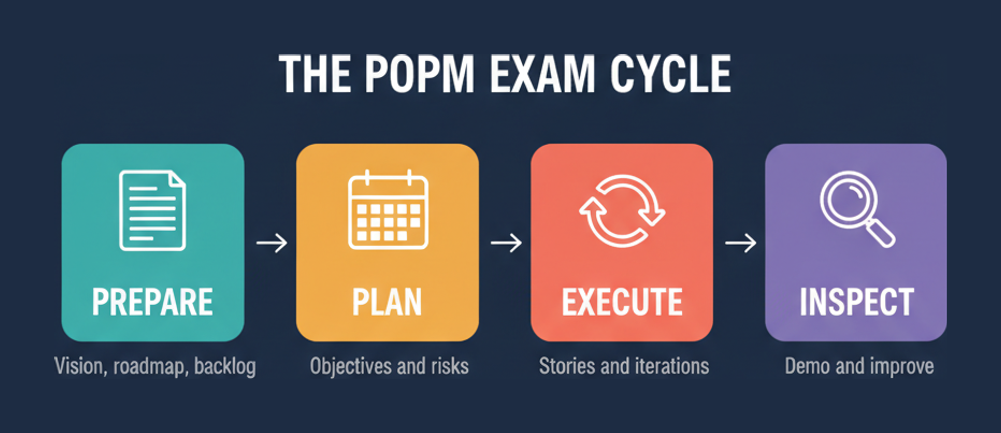
Read the six names in order and a shape appears. The first domain establishes who you are inside the framework. The next two prepare and then run the planning event. The fourth covers the fortnightly rhythm that follows it. The fifth covers the quarter as a whole. The sixth cuts across all of them.
That ordering is not decorative. Scaled Agile has built the exam around a single Program Increment, walked through from the moment someone starts drafting a vision to the moment the increment is inspected and adapted. Every objective attaches to a point in that cycle. If you can place yourself in the cycle, you can usually place the question.
| Domain | Weight | What it covers |
|---|---|---|
| Understanding Product Owner/Product Management Roles and Responsibilities | 12-14% | Applying SAFe to the two roles, the Lean-Agile mindset, value streams, and the responsibilities each role carries |
| PI Planning Preparation | 17-19% | Summarising PI Planning, the solution vision, forecasting through roadmaps, planning features, managing the ART backlog and Kanban |
| Leadership for PI Planning | 14-16% | Communicating the vision in the event, planning PI objectives, organising dependencies, analysing risks |
| Iteration Execution | 28-30% | Creating stories, planning an iteration, managing flow with the team Kanban, refining the backlog, the review and retrospective, supporting DevOps and Release on Demand |
| PI Execution | 10-12% | The PO Sync, the system demo, innovation through the increment, and Inspect and Adapt |
| Apply AI to Product Roles | 12-14% | AI basics and terminology, prompting, risks and responsible use, and augmenting the product roles with AI |
The weightings are published as ranges rather than fixed figures, which means the exact split varies between forms of the paper. Treat the midpoint as your planning number and the top of each range as your risk.
What Are the POPM Exam Details?
The POPM exam runs 90 minutes and carries 45 questions with a passing score of 82 percent. Items are either multiple choice with one correct answer or multiple select taking two or three. The first attempt is included in the course registration fee when it is taken within 30 days of course completion; each retake, or any attempt after that window, costs 50 US dollars.
| Field | Value |
|---|---|
| Exam name | SAFe Product Owner/Product Manager |
| Exam code | POPM |
| Questions | 45 |
| Duration | 90 minutes |
| Passing score | 82% |
| Format | Multiple choice (one answer) or multiple select (2-3 answers) |
| First attempt | Included in the course fee within 30 days of course completion |
| Retake or late attempt | $50 each |
Two of those numbers deserve more attention than they usually get. The first is the pass mark. At 82 percent you can afford to lose eight questions out of 45 and no more, which is unusually tight for a foundational credential and leaves no room for a domain you decided to skim. The second is the pace. Ninety minutes across 45 items gives you two minutes each, which sounds generous until you meet a multiple select item that asks you to pick two of five plausible options.
Scaled Agile sells the proctored exam separately from the course, and its own POPM credential page states plainly that the training certification course is not required, so an experienced product owner can sit the paper on the strength of practical work. Whether that is wise is a different question, and the weighting pattern below suggests it depends entirely on how much iteration level work you have actually done. Working through POPM sample questions before committing is the cheapest way to find out where you stand.
Why Does Iteration Execution Carry Nearly a Third of the Paper?
Iteration Execution is worth 28 to 30 percent of the POPM exam, more than twice the weight of PI Execution and roughly double any other single domain. It covers creating stories, planning an iteration, managing flow with the team Kanban, refining the team backlog, participating in the review and retrospective, and supporting DevOps and Release on Demand.
The reason is simple arithmetic about how a product owner spends a quarter. PI Planning happens once. The iteration cycle happens five or six times inside the same period, and everything a product owner does between planning events lives there. Scaled Agile has weighted the exam to match the calendar rather than the ceremony.
Story writing carries more marks than it looks
Creating stories is the first objective in the domain and the one candidates most often underestimate, usually because they have written hundreds of stories and assume the topic is settled. The exam is not asking whether you can write one. It is asking whether you can distinguish a story from an enabler, size it in a way that supports forecasting, and recognise when acceptance criteria have quietly become a specification.
Flow management is the technical half
Managing flow with the team Kanban and refining the backlog are the objectives where the domain gets genuinely difficult. You need to know what work in progress limits do to throughput, why a bottleneck moves when you relieve it, and how backlog refinement feeds the next iteration rather than the current one.
DevOps sits inside this domain, not beside it
Supporting DevOps and Release on Demand is the last objective in Iteration Execution, which surprises people who expect release topics to sit with PI Execution. The placement is deliberate. Release on Demand only works if the iteration produces something releasable, so the framework treats it as an iteration level responsibility rather than a quarterly one.
What Does the New AI Domain Actually Ask For?
Apply AI to Product Roles is worth 12 to 14 percent of the POPM exam and carries four objectives: understanding AI basics and terminology, understanding AI prompting, understanding risks and responsible AI use, and augmenting the product roles with AI. It is weighted the same as the roles and responsibilities domain, which makes it a full domain rather than an addendum.
The scope is narrower than the name suggests, and that is good news for anyone worried they need a machine learning background. Nothing in the objectives asks you to build, train or evaluate a model. The domain is about a product owner working alongside these tools competently and safely.
- Terminology means being able to use the vocabulary correctly in a planning conversation rather than defining it academically.
- Prompting is treated as a practical skill: framing a request so the output is usable for backlog, roadmap or research work.
- Risks and responsible use is the objective with the most examinable substance, covering where output cannot be trusted, what must not be pasted into a tool, and who remains accountable for a decision.
- Augmenting the product roles asks where in the existing responsibilities these tools genuinely help, and by implication where they do not.
Scaled Agile positions the current credential explicitly around integrating AI into product work, so this domain is not a temporary addition that will quietly disappear from the next revision. If your preparation material predates it, the material is out of date rather than merely incomplete.
How Much of the POPM Exam Is PI Planning?
PI Planning accounts for 31 to 35 percent of the POPM exam once its two domains are combined: PI Planning Preparation at 17 to 19 percent and Leadership for PI Planning at 14 to 16 percent. Split across preparation and facilitation, the planning event is the single largest theme on the paper, narrowly ahead of Iteration Execution.
Splitting one event into two domains is the clearest structural signal in the whole blueprint. Scaled Agile is separating the work you do beforehand from the work you do in the room, and testing them differently.
Preparation is about artefacts
The preparation domain covers summarising PI Planning, explaining the solution vision, forecasting work through roadmaps, planning features, and managing the ART backlog and Kanban. Every one of those produces something tangible before the event starts. A vision that has not been written cannot be communicated, and a backlog that has not been ordered cannot be planned against.
Leadership is about the room
The leadership domain covers communicating the vision during the event, planning PI objectives, organising and managing dependencies, and analysing risks. These are live activities under time pressure with multiple teams present. The exam tests whether you know what a good PI objective looks like, how dependencies get surfaced rather than discovered later, and what actually happens to a risk once it is raised. Scaled Agile documents the full event structure in its own PI Planning guidance, which is worth reading against the objectives rather than instead of them.
PI Execution, by contrast, is only 10 to 12 percent. Four objectives covering the PO Sync, the system demo, innovation and Inspect and Adapt. It is the lightest domain on the paper, which tells you Scaled Agile considers the quarter mostly decided by how well it was planned and how well the iterations ran.
Product Owner or Product Manager: Which Role Does This Credential Serve?
POPM certifies both roles with one exam, which is why the first domain is called Understanding Product Owner/Product Management Roles and Responsibilities. In SAFe the product owner works at team level with the team backlog and stories, while the product manager works at Agile Release Train level with the ART backlog and features. The exam expects you to know which responsibility belongs where.
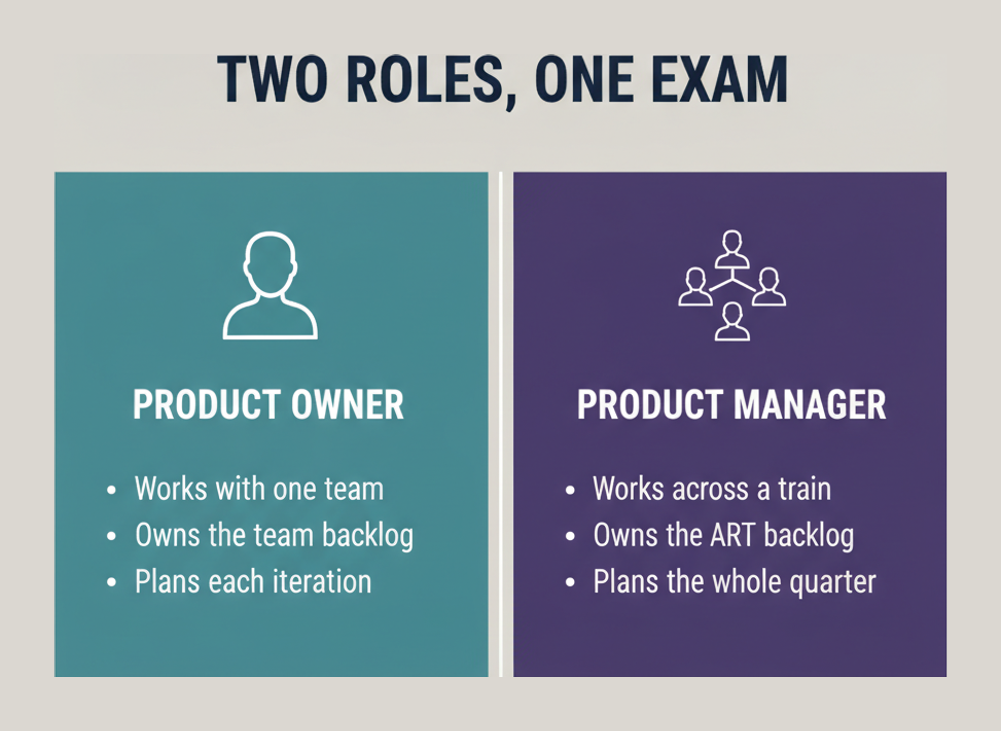
This is the distinction candidates most often lose marks on, because outside SAFe the two titles are frequently used interchangeably or merged into one job. Inside the framework they are separate roles operating at different altitudes on different artefacts.
| Dimension | Product Owner | Product Manager |
|---|---|---|
| Operates at | Agile team | Agile Release Train |
| Owns | Team backlog | ART backlog |
| Primary artefact | Stories | Features |
| Planning horizon | Iteration | Program Increment and roadmap |
| Main forum | Iteration planning, review, retrospective | PI Planning, system demo |
Both roles share the Lean-Agile mindset the first domain tests, and both are ultimately traceable back to the principles set out in the Agile Manifesto. What differs is scope. A question that mentions a team backlog is a product owner question; one that mentions features or a roadmap is usually a product manager question. Reading for that signal first resolves a surprising number of items.
What Does the Weighting Pattern Say About Study Order?
The weighting pattern points to a clear revision order for the POPM exam: Iteration Execution first at 28 to 30 percent, then the two PI Planning domains at a combined 31 to 35 percent, then the AI domain and roles domain at 12 to 14 percent each, and PI Execution last at 10 to 12 percent. Roughly six questions in ten come from Iteration Execution and PI Planning combined.
There is a second, less obvious reading. The three lightest domains, roles, AI and PI Execution, together account for between 34 and 40 percent of the paper, which is more than any single heavy domain. Skipping all three because they are individually small would cost you the exam outright at an 82 percent pass mark.
A more useful way to think about it is confidence per hour. Iteration Execution rewards study time because it is dense and practical. The roles domain rewards it because the distinctions are crisp and testable. The AI domain rewards it disproportionately right now, simply because most candidates arrive with material that does not cover it. PI Execution is the one place where a light pass is defensible, and even then only if you have actually sat through a system demo and an Inspect and Adapt event.
How Should You Prepare for the POPM Exam?
Preparation for the POPM exam works best in the order the framework itself runs, because the blueprint is organised as one Program Increment from vision to Inspect and Adapt. Working the domains in calendar order rather than weighting order builds a mental timeline that makes questions easier to place, then a second pass weighted by marks fixes the gaps.
- Read all six domain names and their weightings in one sitting before opening any study material, so you know from the start that Iteration Execution and PI Planning between them decide the result.
- Work the roles domain first and write down, in your own words, which artefacts belong to the product owner and which to the product manager, because that distinction reappears inside every later domain.
- Walk the two PI Planning domains as a single event, separating what you would prepare beforehand from what you would do in the room, and make sure you can state what a good PI objective looks like.
- Spend the largest block of time on Iteration Execution, covering story writing, iteration planning, team Kanban and flow, backlog refinement, the review and retrospective, and how Release on Demand depends on the iteration producing something releasable.
- Cover the AI domain deliberately rather than assuming general familiarity is enough, focusing on responsible use and on where these tools genuinely augment product work.
- Finish with PI Execution, rehearsing the PO Sync, the system demo and Inspect and Adapt as events you would run rather than definitions you would recite.
- Sit timed practice at 45 questions in 90 minutes until you are comfortably above 82 percent, paying attention to multiple select items where partial knowledge scores nothing.
The iSecPrep POPM exam resources collect the practice material for that final timed step in one place.
Where the POPM Credential Leads
POPM sits at the Foundational level of the SAFe programme and is aimed at people new to the framework rather than at experienced SAFe practitioners. It is the credential most organisations ask for when they move a product owner or business analyst onto an Agile Release Train, and it is usually the first SAFe qualification someone earns.
The practical value is less about the certificate than about the shared vocabulary. Once a train is running, the cost of one person using PI objectives to mean something different from everyone else is measured in a whole planning event. That is the problem this credential is bought to solve.
On compensation, the honest position is that the credential rarely moves a salary on its own. Product owner pay tracks seniority, domain and location far more than certification, and reported product owner salaries vary widely for exactly those reasons. What POPM does reliably is qualify you for roles that list it as a requirement, which in SAFe adopting organisations is a large share of them.
Frequently Asked Questions
How many questions are on the POPM exam?
Forty five questions in 90 minutes. That is two minutes per item, which is comfortable for single answer questions and tight for multiple select items asking you to choose two or three options from five.
What is the passing score for the SAFe Product Owner Product Manager certification?
82 percent. At 45 questions that leaves room to lose eight items and no more, which is why skipping a small domain is a poor strategy on this particular paper.
How much does the POPM exam cost?
The first attempt is included in the course registration fee if you sit it within 30 days of finishing the course. Every retake, and any attempt after that 30 day window closes, costs 50 US dollars.
Which domain is worth the most marks?
Iteration Execution, at 28 to 30 percent. It is the only single domain worth more than a quarter of the paper, and it covers story writing, iteration planning, team Kanban, backlog refinement, the review and retrospective, and Release on Demand.
Does the POPM exam really cover artificial intelligence?
Yes. Apply AI to Product Roles is a full domain worth 12 to 14 percent, covering AI basics and terminology, prompting, risks and responsible use, and augmenting the product roles. No model building is required.
Do you have to take the course before sitting the exam?
No. Scaled Agile states on its own credential page that the training certification course is not required, and the proctored exam can be purchased separately. The course does include the first attempt, which is why most candidates take it.
What is the difference between the product owner and product manager roles in SAFe?
The product owner works at team level, owning the team backlog and stories across an iteration. The product manager works at Agile Release Train level, owning the ART backlog and features across a Program Increment and roadmap.
What format are POPM questions in?
Multiple choice with one correct answer, or multiple select requiring two or three correct answers. There is no partial credit on multiple select items, so a half remembered answer scores the same as a wrong one.
Is POPM a beginner credential?
Scaled Agile positions it at Foundational level for people new to SAFe. That describes framework experience rather than product experience, so experienced product owners new to SAFe are exactly the intended audience.
How much of the exam is PI Planning?
Between 31 and 35 percent once both planning domains are counted: PI Planning Preparation at 17 to 19 percent and Leadership for PI Planning at 14 to 16 percent. It is the largest single theme on the paper.
Conclusion
The POPM blueprint is unusually honest about where a product owner’s time actually goes. Iteration Execution takes the largest share because iterations happen five or six times a quarter, the two PI Planning domains take the next largest because everything downstream depends on that event, and the newest domain reflects a role that has genuinely changed.
Two numbers should shape your revision. Eighty two percent means no domain is safe to skip, and 28 to 30 percent means Iteration Execution is where the paper is won. Build your study plan around the Program Increment rather than around a list of topics, then confirm you are clearing the pass mark under real time pressure. Sample questions in the exam’s own format are the fastest way to find out whether the plan is working before you pay for an attempt. If you are still choosing between this credential and the Scrum Master or Practitioner routes, the SAFe certification hub lays those tracks out side by side.


