21.67 percent. 8.33 percent. Those are two of the six domain weightings Cohesity publishes for COH150, and they are not rounded marketing figures.
They are fractions of a 60 question paper. Multiply them out and every domain lands on a whole number of questions: 13, 12, 6, 9, 5 and 15. That arithmetic turns a vague list of percentages into a study plan, because it tells you that cloud migration is worth five questions and deployment considerations is worth fifteen. The Cohesity Protection Associate Multicloud exam, code COH150, is a 90 minute sitting with a 58 percent pass mark, and it is the associate credential for running Cohesity across AWS, Azure and Google Cloud rather than inside your own racks. This walkthrough sets out where the questions sit, what separates CloudArchive from CloudTier and CloudSpin, and how the Cohesity multicloud certification differs from the DataProtect exam most people meet first.
What Does the Cohesity Multicloud Certification Test?
COH150 tests whether you can deploy, operate and monitor the Cohesity Data Cloud platform in and with public cloud environments. Six published domains cover cloud concepts, archiving, tiering, cloud-native backup, workload migration and deployment prerequisites. The scope is cloud behaviour specifically, not general backup administration, which the DataProtect exam handles.
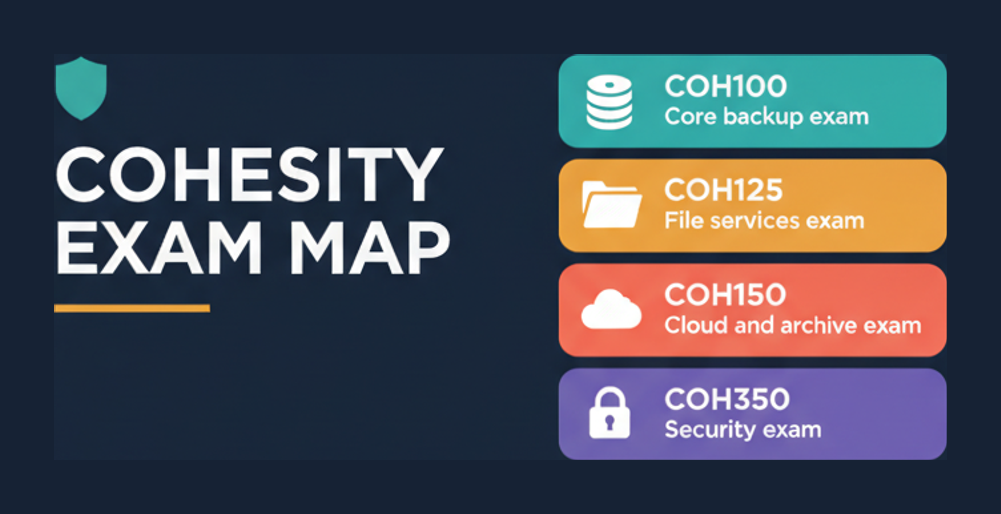
The distinction matters because the two exams share a vendor and a tier but almost no content. An engineer who protects virtual machines competently in a data centre still has to learn how a Cohesity cluster changes when it runs natively in a cloud provider, which external targets CloudArchive supports, and what has to exist in a subscription before any of it works.
Cohesity positions the credential inside the cloud resilience story it now sells against, and its own product leadership describes that estate in the same terms the syllabus uses.
“Our partnership with Google Cloud has delivered critical innovation for customers modernizing backup, disaster recovery, and cyber resilience across hybrid multi-cloud environments.”
Two of the six domains, cloud concepts and deployment considerations, are about judgement rather than clicks. They ask which delivery model suits a requirement, when archiving beats tiering, and what a public cloud subscription must already provide. The federal guidance on recovering from destructive events is a useful frame for that half of the paper, because clean recovery is the outcome every cloud feature in the syllabus exists to support.
What Are the COH150 Exam Details?
COH150 is 60 questions in 90 minutes with a 58 percent passing score and a 200 US dollar fee. There are no prerequisite exams. Registration runs through Cohesity, the exam is delivered in English, and the credential carries the full title Cohesity Certified Protection Associate Multicloud on the Cohesity Certified Associate track.
| Field | Value |
|---|---|
| Exam name | Cohesity Protection Associate Multicloud |
| Exam number | COH150 |
| Questions | 60 |
| Duration | 90 minutes |
| Passing score | 58% |
| Fee | $200 USD |
| Prerequisites | None |
| Registration | Cohesity |
| Published domains | 6, weighted, totalling 100% |
Ninety minutes for 60 questions gives you 90 seconds each, which is comfortable for recall and tight for anything that needs working out. Several objectives are explicitly scenario-shaped, including one that hands you a graphic and asks how Self-Service completes pre-provisioning steps and another that asks you to infer whether a policy will apply to a virtual machine. Those cost more than 90 seconds, so the recall questions have to cost less.
What happens after you pass
Cohesity issues a digital badge and the certification stays valid for two years. A failed attempt can be retaken once every 14 days, so a near miss is a fortnight of focused revision rather than a lost year. Cohesity asks for no coursework before booking but recommends six to nine months of hands-on time, and it is worth reading that recommendation as a warning about the scenario questions rather than a formality. All of this is published on the Cohesity Academy exam page.
How Many Questions Does Each COH150 Domain Carry?
Cohesity publishes six weightings that sum to 100 percent, and because the paper is exactly 60 questions each weighting converts to a whole number of items. Deployment considerations is the largest at 15 questions, cloud concepts follows at 13, and cloud migration is the smallest at 5. Those counts are arithmetic from the published percentages, not a separate Cohesity statement.
| Domain | Published weight | Questions out of 60 |
|---|---|---|
| Deployment Considerations | 25% | 15 |
| Cohesity Cloud Concepts | 21.67% | 13 |
| Archiving with Cohesity | 20% | 12 |
| Cloud-native backups with Cohesity | 15% | 9 |
| Tiering with Cohesity | 10% | 6 |
| Cloud migration with Cohesity | 8.33% | 5 |
Read the table as a budget. Deployment considerations and cloud concepts together account for 28 of the 60 questions, so almost half the paper is decided before you touch archiving, tiering or migration. A candidate who studies the features and skips the prerequisites has capped their score at roughly 53 percent, which is below the pass mark.
The bottom two rows are the ones to keep in proportion. Tiering and migration are 11 questions between them, and they are the topics engineers find most interesting, which is exactly why they absorb study time out of all proportion to their value. Working through COH150 scenario questions in the exam’s own format is the quickest way to see whether your effort is landing where the marks are.
Why Is Deployment Considerations the Largest Domain?
Deployment considerations carries 25 percent, or 15 questions, because it holds everything that has to be true before a cloud feature works at all. Its objectives cover the storage classes CloudArchive supports, the prerequisites for configuring CloudArchive with each public cloud provider, the requirements for running Cohesity natively in AWS, Azure and Google Cloud, cloud source registration, and which SaaS applications the platform can protect.
That is a deliberately unglamorous list, and it is the biggest single block of marks on the exam.
The hybrid question hiding in this domain
One objective asks you to identify the additional features available when Cohesity is deployed both on premises and in the cloud. It is easy to skim, and it is the domain’s most examinable idea. Several capabilities only exist once both halves are present, so a candidate who has only ever seen one deployment shape has a genuine blind spot rather than a gap in recall.
Registration is not configuration
Registering a cloud source and configuring an external target are separate operations with separate prerequisites, and the syllabus lists them separately. Confusing the two is the fastest way to lose marks in this domain, because the questions are precise about which one a given requirement calls for.
CloudArchive, CloudTier and CloudSpin: What Is the Difference?
The three features solve different problems. CloudArchive copies data to cloud storage for long term retention and recovery. CloudTier moves cold blocks off the cluster to free local capacity while keeping the data addressable. CloudSpin clones or moves virtual machines into a public cloud so they can run there. Together they account for 23 of the 60 questions.
| Feature | What it does | Why you would use it | Domain weight |
|---|---|---|---|
| CloudArchive | Writes copies to an external cloud target for retention | Long term retention and disaster recovery, with CloudRetrieve for the recovery path and CloudArchive Direct as a configuration option | 20% |
| CloudTier | Moves cold data blocks off local storage | Reclaiming cluster capacity without deleting anything or losing addressability | 10% |
| CloudSpin | Clones or moves virtual machines into a public cloud | Running a workload in the cloud, and spinning up development or test clones from a backup | 8.33% |
The examinable line runs between archiving and tiering, and the syllabus names it directly: one objective asks you to identify the difference. Archiving produces an additional copy for retention. Tiering relocates the only copy of cold blocks to reclaim space. Answer a tiering question with archiving logic and you will pick a plausible wrong option every time.
CloudSpin is the odd one out because it is not really a protection feature. It uses a backup as the source for a running machine, which is why the same objective set covers both disaster recovery and development clones. Cohesity’s own CloudArchive documentation is worth reading alongside the syllabus, because the external target options it lists are exactly what the deployment domain expects you to recognise.
All three sit on top of assumptions the exam does not stop to teach. Recovery point and recovery time objectives, the vocabulary of disaster recovery planning, run underneath every question about which feature suits a requirement.
How Does Cohesity Run Natively in AWS, Azure and Google Cloud?
The cloud-native backups domain carries 15 percent, or nine questions, and it treats a cloud-resident cluster as a different animal from an on premises one. Its objectives cover configuring Cohesity for native operation in AWS, Azure or Google Cloud, the ways cloud networking differs from data centre networking for that cluster, and which cloud-native backup operations are supported.
The networking objective is stated as a difference rather than as a topic, which is a hint about how it will be asked. You are not being tested on cloud networking in general. You are being tested on what changes for a Cohesity cluster when its network is defined by a provider rather than by your switches.
Supported operations matter just as much as configuration. Cloud-native protection is not simply the on premises feature set pointed at a different location, and questions in this domain reward knowing where the boundary sits. SaaS application protection is scoped in the deployment domain instead, which is worth noting because candidates often expect it here.
How Should You Prepare for the COH150 Exam?
Preparation should follow the weightings rather than the interest curve. Two domains hold 28 of the 60 questions and neither is feature-led, so the study order that matches the exam starts with prerequisites and concepts and reaches CloudSpin last. Cohesity recommends six to nine months of hands-on experience and sets no mandatory coursework.
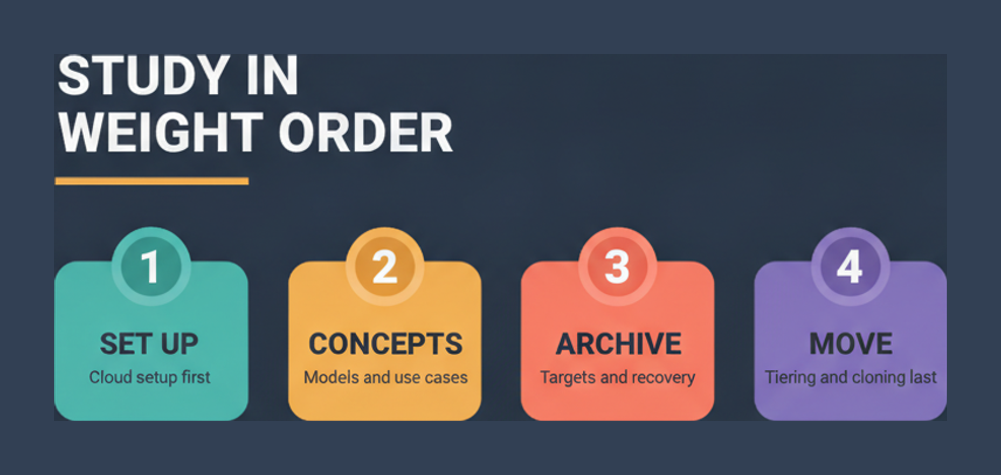
- Convert the six published weightings into question counts before planning anything, so you know deployment considerations is worth 15 questions and cloud migration is worth 5.
- Start with deployment considerations, learning the cloud storage classes CloudArchive supports and the prerequisites each public cloud provider imposes.
- Work through cloud concepts next, focusing on the delivery models, the archiving against tiering distinction, and the features that only appear in a hybrid deployment.
- Study archiving as a workflow rather than a feature, covering external targets, CloudRetrieve recovery, CloudArchive Direct configuration and the recovery options available to an organisation that relies on it.
- Separate tiering from archiving deliberately, because one relocates cold blocks to reclaim capacity and the other writes an extra copy for retention.
- Practise a cloud-native deployment in at least one provider, paying attention to how the cluster’s networking differs from an on premises install.
- Leave CloudSpin until last and treat it as two use cases, moving a workload to the cloud and cloning it for development or test.
- Sit timed practice at 90 seconds a question so the scenario items do not run you out of clock.
The Cohesity certification track is a useful map if you are planning more than one exam, because the associate tier feeds the specialist and expert credentials above it.
Should You Sit COH100 or COH150 First?
Neither exam requires the other, so the honest answer is that it depends on your estate. COH100 covers Cohesity DataProtect and the core backup and recovery workflow. COH150 covers cloud behaviour: archiving, tiering, cloud-native deployment and migration. Both sit at associate level on the same track and both carry no prerequisites.
Pick COH150 first if your Cohesity footprint already reaches into a public cloud, or if the work in front of you is an archive target, a capacity problem or a migration. Pick COH100 first if you are learning the platform itself, because the cloud exam assumes you already know what a protection job and a recovery look like even though it does not test them.
There is a practical argument for taking both in one study cycle. The two syllabi barely overlap, so the second exam adds new material rather than revision, and the shared platform knowledge carries across. Our COH100 exam breakdown sets out the DataProtect side in the same detail as this article covers the multicloud side.
Frequently Asked Questions
How many questions are on the COH150 exam?
COH150 has 60 questions and a 90 minute time limit, which works out at 90 seconds per question. Several objectives are scenario-shaped and will take longer, so the recall items need to be answered quickly.
What is the passing score for the Cohesity multicloud certification?
58 percent. Cohesity publishes the same figure on its own academy page as the NWExam syllabus page carries, and it applies to the single 90 minute sitting with no separately scored sections.
How much does COH150 cost?
200 US dollars per attempt. Registration goes through Cohesity rather than a third-party storefront, and a retake is permitted once every 14 days if the first attempt falls short.
Are there prerequisites for COH150?
None. Cohesity requires no prior exam or certification and no mandatory coursework, though it recommends six to nine months of on-the-job experience with the platform before booking.
How long does the Cohesity Protection Associate Multicloud certification last?
Two years. Cohesity states the expiration plainly on its certification page, and a digital badge is issued through Credly when you pass.
Which COH150 domain carries the most questions?
Deployment Considerations at 25 percent, which is 15 of the 60 questions. It covers cloud storage classes, provider prerequisites, cloud source registration, hybrid-only features and SaaS application protection.
What is the difference between CloudArchive and CloudTier?
CloudArchive writes an additional copy to an external cloud target for long term retention. CloudTier relocates cold data blocks off the cluster to reclaim local capacity while keeping them addressable. The syllabus asks you to distinguish them directly.
Does COH150 test SaaS application protection?
Yes, but inside the Deployment Considerations domain rather than the cloud-native backups domain. One objective asks you to identify which SaaS applications the Cohesity platform can protect.
Is COH150 harder than COH100?
They are peers rather than tiers, both at associate level with no prerequisites. COH150 is narrower and more cloud-specific, so it feels harder to an engineer who has only worked on premises and easier to one who has not.
In what language is COH150 delivered?
English only. Cohesity lists a single language on the exam page, alongside the 14 day retake window and the two year expiration.
Conclusion
The most useful fact about COH150 is the one hiding in its odd percentages. Six weightings, 60 questions, and every domain landing on a whole number of items: 15, 13, 12, 9, 6 and 5.
That arithmetic should drive the whole study plan. Deployment considerations and cloud concepts hold 28 of the 60 questions between them, and both are about prerequisites and judgement rather than features, so a candidate who starts with CloudSpin because it is the interesting one has already put their effort in the wrong place. Learn what has to exist in a subscription before anything works, get the archiving against tiering distinction clean enough to answer under time pressure, and leave migration until the end where its five questions belong. Cohesity recommends six to nine months of hands-on time, and the scenario objectives are the reason. Once the weightings are mapped, timed practice in the exam’s own question format is what turns a reading list into a pass.


