Read the ZDTE objectives end to end and one phrase appears more than any other. Given a scenario. Given a set of user groups. Given a network topology. Given a sample PAC file.
Almost nothing on this blueprint asks you to recall a fact. The Zscaler Digital Transformation Engineer exam, code ZDTE, hands you a situation and asks what you would do about it, across six weighted domains covering ZIA, ZPA, ZDX and the Client Connector. It runs 60 questions in 90 minutes at 300 US dollars, and the pass mark is 80 percent, which is the highest of any exam covered on this site this month. That combination of scenario phrasing and a high threshold is what makes it an engineer exam rather than an administrator one, and it changes what preparation has to look like.
What Does the Zscaler Digital Transformation Engineer Exam Test?
ZDTE tests advanced configuration of the Zscaler zero trust platform across six domains: architecture and design, implementation and deployment, operations and monitoring, troubleshooting and support, security and compliance, and automation and optimisation. Zscaler frames it around platform services, security services, data protection and the management and logging layer.
The underlying design question runs through every domain. Traffic that used to be inspected at a perimeter now has to reach a cloud service instead, and the exam is largely about how you get it there and prove it arrived.
“Legacy SASE was built in the post-pandemic rush, based on a firewall and VPN model for a network perimeter that no longer exists.”
That framing is not vendor-specific. The architecture it describes is set out in the NIST publication on zero trust architecture, and the Cloud Security Alliance maintains a broader body of zero trust research covering the same principles the Zscaler platform implements. Reading one of them first makes several ZDTE objectives read as consequences rather than as product trivia.
What Are the ZDTE Exam Details?
ZDTE is 60 questions in 90 minutes with an 80 percent passing score, priced at 300 US dollars per attempt and scheduled through Pearson VUE as an online proctored exam. Zscaler sets no strict prerequisites but recommends a minimum of one year on the platform, with hands-on time across ZIA, ZPA and ZDX.
| Field | Value |
|---|---|
| Exam name | Zscaler Digital Transformation Engineer |
| Exam code | ZDTE |
| Questions | 60 |
| Duration | 90 minutes |
| Passing score | 80% |
| Price | $300 USD, one credit per attempt |
| Delivery | Online proctored, Pearson VUE |
| Prerequisites | None strict; one year of platform experience recommended |
| Published domains | 6, weighted, totalling 100% |
An 80 percent threshold on a 60 question paper means 48 correct answers. Twelve wrong is the entire margin, and on an exam where most items are scenarios rather than recall, twelve is not many. That single figure is the strongest argument for lab time over reading.
What Zscaler recommends before booking
There are no mandatory prerequisites, but the vendor is unusually specific about preparation. Zscaler highly recommends completing the Zscaler for Users Engineer eLearning course and its hands-on lab, and it names ZIA, ZPA and ZDX individually when describing the year of experience it expects. Both recommendations are published on the Zscaler Academy page for the credential.
How Are the Six ZDTE Domains Weighted?
Architecture and design and implementation and deployment carry 22 percent each, so together they are 44 percent of the paper. Operations and monitoring takes 16 percent, troubleshooting and support 15 percent, security and compliance 14 percent, and automation and optimisation 11 percent. No domain dominates, and none is small enough to skip.
| Domain | Weight | What it is really about |
|---|---|---|
| Architecture and Design | 22% | Choosing forwarding methods, designing PAC deployments, sizing App Connectors, least privilege policy design |
| Implementation and Deployment | 22% | Locations and sublocations, URL and CloudApp filtering, DLP and DNS policies, App Segments, log streaming to a SIEM |
| Operations and Monitoring | 16% | Reading ZIA, ZPA and ZDX dashboards, interpreting audit logs, acting on insights and DLP incident reports |
| Troubleshooting and Support | 15% | Finding mismatched PAC logic and identifying where a block policy stopped legitimate access |
| Security and Compliance | 14% | Policy containment: configuring it, monitoring it, and taking corrective action |
| Automation and Optimization | 11% | Optimising PAC file logic, scoping API key permissions minimally, increasing efficiency through automation |
The flat distribution is itself informative. On an exam where the largest domain is 22 percent and the smallest is 11, there is no domain you can trade away and still clear 80 percent. Security and compliance is worth noticing for the opposite reason: it carries 14 percent of the paper on a single published objective about policy containment, which makes it unusually dense.
Because the whole blueprint is scenario-shaped, the most efficient calibration is to answer questions in that shape rather than to re-read the domain list. Working ZDTE sample questions shows quickly whether your platform habits match what the exam considers correct.
Why Do So Many ZDTE Objectives Start With a Scenario?
Almost every ZDTE objective is written as a situation plus a task. Given globally dispersed users, design a PAC deployment. Given a user’s location and bandwidth and the sizing chart, identify the right App Connector configuration. Given a critical service outage, identify how machine learning capabilities aid root cause analysis. The phrasing is a deliberate signal about how the questions are built.
Two consequences follow. First, memorising configuration steps will not carry you, because the exam supplies the requirement and expects you to select the design that meets it. Second, several objectives hand you an artefact to interpret: a dashboard graphic, an audit log, a PAC file, a DLP incident report, a script. Reading those under time pressure is a distinct skill from configuring the platform.
The objectives that are not scenarios
A handful begin “Identify the steps”, covering application discovery configuration, ZPA access policies with posture checks and conditional rules, and consolidating application segments into segment groups. These are the closest the exam comes to procedural recall, and they are worth learning precisely because they are the exception.
Which Zscaler Services Does the Exam Cover?
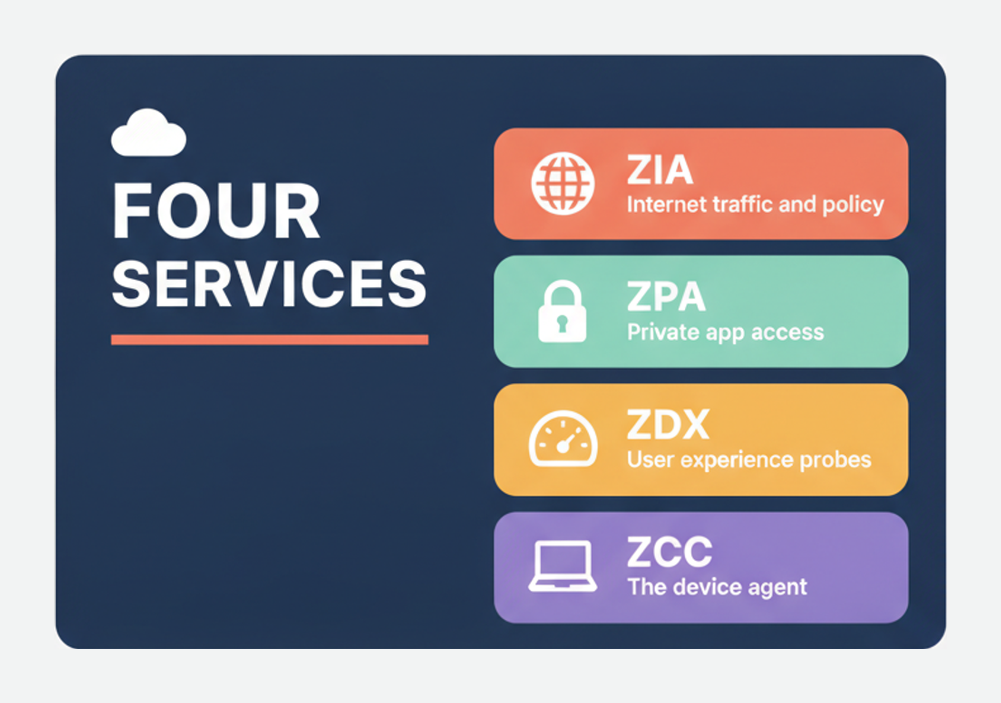
Four services run through the blueprint: Zscaler Internet Access, Zscaler Private Access, Zscaler Digital Experience and the Zscaler Client Connector. The operations domain requires you to interpret a dashboard from each of the first three, and the architecture domain asks you to choose between connectivity methods that span all four.
| Service | Where it appears in the blueprint | Typical exam task |
|---|---|---|
| ZIA | Architecture, implementation, operations, troubleshooting | Choose a forwarding method, build URL, CloudApp, firewall and DLP policy, read the dashboard, resolve an insight |
| ZPA | Architecture, implementation, operations, troubleshooting | Build App Segments and Segment Groups, deploy an App Connector, apply posture checks, find where access was blocked |
| ZDX | Architecture, implementation, operations | Place probes to isolate a slow application, set alert thresholds, read the dashboard |
| ZCC | Architecture, implementation, operations | Configure profile and update management, monitor connectivity and act on what it shows |
The ZDX material is the one candidates most often underestimate. Its objectives are about diagnosis rather than security: given a user complaining that an application is slow, work out whether the problem is the user’s own resources, the organisation’s network, or the application itself. That is a different mental model from policy work, and it appears in three of the six domains.
Log streaming sits slightly apart. Two objectives cover choosing which Zscaler log fields to send to a SIEM through the Nanolog Streaming Service and the Log Streaming Service, which is a data-selection question rather than a security one.
What Does ZDTE Expect You to Know About PAC Files?
PAC files appear in four separate places on this blueprint. Design a PAC deployment strategy for globally dispersed users. Identify a correct PAC file for a stated goal. Investigate a PAC file for mismatched logic when some users cannot reach an application. Optimise the logic of a supplied PAC file. Few other topics recur that often.
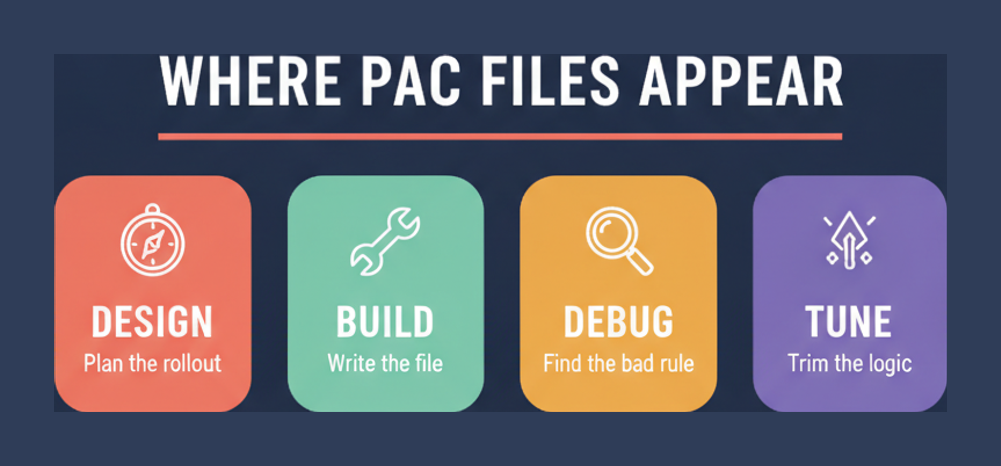
That repetition is the clearest study signal on the exam. A candidate who can read a proxy auto-configuration file line by line, spot an ordering problem, and rewrite it more efficiently has covered material worth marks in the architecture, implementation, troubleshooting and automation domains at once.
The troubleshooting framing matters as much as the syntax. The objective describes specific locations or user types failing to reach some internet applications, which is a symptom pattern rather than an error message. Working backwards from that symptom to a condition in the file is what the question is testing.
How Should You Prepare for the ZDTE Exam?
An 80 percent pass mark on a scenario-based paper rewards platform time rather than reading time. Zscaler recommends a year of hands-on experience and its own engineer-level eLearning with a lab, and the preparation order below follows the weightings while front-loading the topics that recur across several domains.
- Start with the two 22 percent domains together, because architecture decisions and the deployments that implement them are examined as the same skill in different words.
- Work PAC files until you can read one line by line, spot an ordering fault and rewrite it more efficiently, since they appear in four separate objectives.
- Build and break an App Segment, then a Segment Group, then an access policy with device posture checks, so the ZPA objectives that ask for steps are muscle memory.
- Spend real time in the ZDX dashboards, practising the diagnosis of whether a slow application is the user, the network or the application itself.
- Configure a DLP policy and a DNS security policy end to end, then read the resulting incident report as the operations domain expects.
- Decide which log fields you would stream to a SIEM for a given investigation, covering both the Nanolog Streaming Service and the Log Streaming Service.
- Scope an API key to the minimum permissions a specific script needs, which is the automation domain’s most concrete objective.
- Sit timed practice at 90 seconds a question and track how many you get wrong, because 12 is the entire margin at 80 percent.
Registration, the proctoring requirements and the recommended learning path all sit on the Zscaler exam registration page, and it is worth reading the notes there before booking a slot.
If you are mapping out more than one exam, the Zscaler certification track collects the platform’s credentials in one place.
Is ZDTE the Right Exam to Take After ZDTA?
For most engineers, yes, but not immediately. ZDTA covers administration of the platform and ZDTE covers advanced configuration and design of it. Zscaler sets no formal prerequisite between them, so the honest gate is the year of hands-on experience it recommends rather than the earlier certificate.
The difference shows up in the verbs. An administrator exam asks how to configure something. This one gives you a requirement and asks which configuration meets it, then asks you to find the fault when it does not. Someone who has passed the administrator exam but only ever worked in ZIA will find the ZPA and ZDX domains genuinely unfamiliar.
A useful self-test before booking: can you size an App Connector from a user’s location and bandwidth, and can you tell from a ZDX probe whether a slow application is the network’s fault? If either answer is no, more platform time is a better investment than an exam booking. Our ZDTA administrator exam guide covers the tier below in the same detail.
Frequently Asked Questions
How many questions are on the ZDTE exam?
60 questions in 90 minutes, which is 90 seconds each. Most items are scenario-based rather than recall, so the artefact-reading questions take longer and the straightforward ones have to be quicker.
What is the passing score for the Zscaler Digital Transformation Engineer exam?
80 percent, which on a 60 question paper means 48 correct answers. Twelve wrong is the whole margin, and that is the highest threshold of any exam covered here this month.
How much does ZDTE cost?
300 US dollars per attempt, priced by Zscaler as one credit. The exam is delivered online with a proctor rather than requiring a test centre appointment.
Are there prerequisites for ZDTE?
No strict prerequisites. Zscaler highly recommends completing its engineer-level eLearning courses and hands-on lab first, and expects a minimum of one year of experience across ZIA, ZPA and ZDX.
Which ZDTE domain carries the most weight?
Architecture and design and implementation and deployment tie at 22 percent each, so together they are 44 percent of the paper. Automation and optimisation is the smallest at 11 percent.
Does ZDTE cover ZDX as well as ZIA and ZPA?
Yes. ZDX appears in three of the six domains, covering probe placement, alert thresholds and dashboard interpretation, and it is the area administrators who work mainly in ZIA tend to underestimate.
How important are PAC files on the exam?
Very. PAC files appear in four separate objectives spanning design, implementation, troubleshooting and optimisation, which makes them the single highest-value topic on the blueprint.
What is the difference between ZDTA and ZDTE?
ZDTA covers platform administration. ZDTE covers advanced configuration and design, including sizing, least privilege policy design, log streaming and automation. There is no formal prerequisite between them.
Is the ZDTE exam proctored online?
Yes. Zscaler describes it as an online proctored exam and recommends the same year of platform experience regardless of where a candidate sits it.
Does the exam test automation and scripting?
Automation and optimisation is 11 percent of the paper. Its objectives cover optimising PAC file logic, scoping an API key to the minimum permissions a script needs, and identifying where automation improves efficiency.
Conclusion
Two numbers should shape how you approach this exam. Eighty percent, which allows twelve wrong answers out of sixty. And four, the number of separate objectives that involve a PAC file.
Everything else follows from the scenario phrasing. The blueprint hands you requirements and artefacts and asks for a decision, so preparation that consists of reading the objectives will leave you fluent in the vocabulary and unpractised at the task. Spend the time in the platform instead: design a forwarding strategy for dispersed users, size an App Connector from real numbers, build a segment and an access policy with posture checks, and use ZDX to decide whether a slow application is the network’s fault. Then work timed questions in the same shape and count the ones you get wrong, because twelve is the entire allowance and finding that out in practice is much cheaper than finding it out on the day.


