Most people meet TOGAF as two exams. OGEA-103 is the decision to sit them both in one afternoon.
The Open Group offers three ways into the TOGAF Enterprise Architecture Practitioner credential, and only one of them finishes in a single appointment. You can take OGEA-101 and come back later for OGEA-102. You can skip straight to OGEA-102 if you already hold the Foundation qualification. Or you can book OGEA-103, the combined Part 1 and Part 2 exam, which puts 48 multiple choice questions in front of you across 150 minutes at a 60 percent pass mark, for 610 US dollars through Pearson VUE. Choosing it is a genuine trade: one booking, one fee, one afternoon, against a paper that gives you no second chance to consolidate between halves. This guide covers what the TOGAF enterprise architect certification actually certifies, what sits in each half of the syllabus, and how to decide which route fits you.
What Does TOGAF Enterprise Architect Certification Actually Certify?
That you can apply the TOGAF standard to real architecture work, not just recall it. The credential is TOGAF Enterprise Architecture Practitioner, and it is awarded once a candidate has passed both a knowledge level and an application level assessment. OGEA-103 is the exam that covers both levels in a single sitting.
The distinction between the two levels runs through the whole certification. Part 1 asks whether you know what the Architecture Development Method is, what its phases are called, what a building block is and how governance is structured. Part 2 puts you inside a scenario and asks what an architect should do next. Passing only the first proves familiarity. Passing both proves you can use it.
That is why the role searches behind this credential so often mention architect rather than exam. Employers writing job specifications are not asking for a recall test result. They are asking for someone who can run a phase of the method with stakeholders in the room. Candidates weighing the commitment usually want to see the question style across both halves before booking, which the OGEA-103 practice exam makes straightforward.
Where the standard itself sits
TOGAF is a framework for developing and governing enterprise architecture, maintained by The Open Group. It is not the only way to describe an architecture, and it is worth knowing that the wider discipline has an international standard of its own in IEEE and ISO 42010, which defines how an architecture description handles stakeholders and their concerns. TOGAF operationalises that thinking into a method with phases, deliverables and governance.
What Are the OGEA-103 Exam Details?
OGEA-103 is 48 multiple choice questions in 150 minutes, with a 60 percent passing score and a fee of 610 US dollars. It is delivered through Pearson VUE, either at a test centre or under online proctoring, and it covers the Part 1 and Part 2 syllabus topics in one appointment.
| Field | Value |
|---|---|
| Exam name | The Open Group TOGAF Enterprise Architecture Combined Part 1 and Part 2 |
| Exam code | OGEA-103 |
| Questions | 48 |
| Duration | 150 minutes |
| Passing score | 60 percent |
| Fee | USD 610 |
| Format | Multiple choice |
| Delivery | Pearson VUE, test centre or online proctored |
| Syllabus topics | 16, eight in Part 1 and eight in Part 2 |
One hundred and fifty minutes for 48 questions works out at just over three minutes each, which sounds generous until you remember what Part 2 questions look like. Scenario questions carry a paragraph or more of context before the options begin, and the options themselves are frequently four full sentences describing four plausible courses of action. Reading time, not thinking time, is what consumes the window.
Sixty percent is the lowest pass mark of the three exams discussed here, and it is not as forgiving as it looks. On 48 questions it means roughly 29 correct answers, so nineteen can go wrong. The catch is that the hardest questions and the most time consuming questions are the same questions, so a candidate who mismanages the clock loses marks on items they would otherwise have answered.
One Sitting or Two: Which Route Should You Take?
There are three routes to TOGAF Enterprise Architecture Practitioner. Take OGEA-101 and then OGEA-102 as separate exams. Take OGEA-102 alone if you already hold the TOGAF Enterprise Architecture Foundation qualification. Or take OGEA-103, which combines Part 1 and Part 2 into a single appointment. The Open Group treats all three as equivalent outcomes.
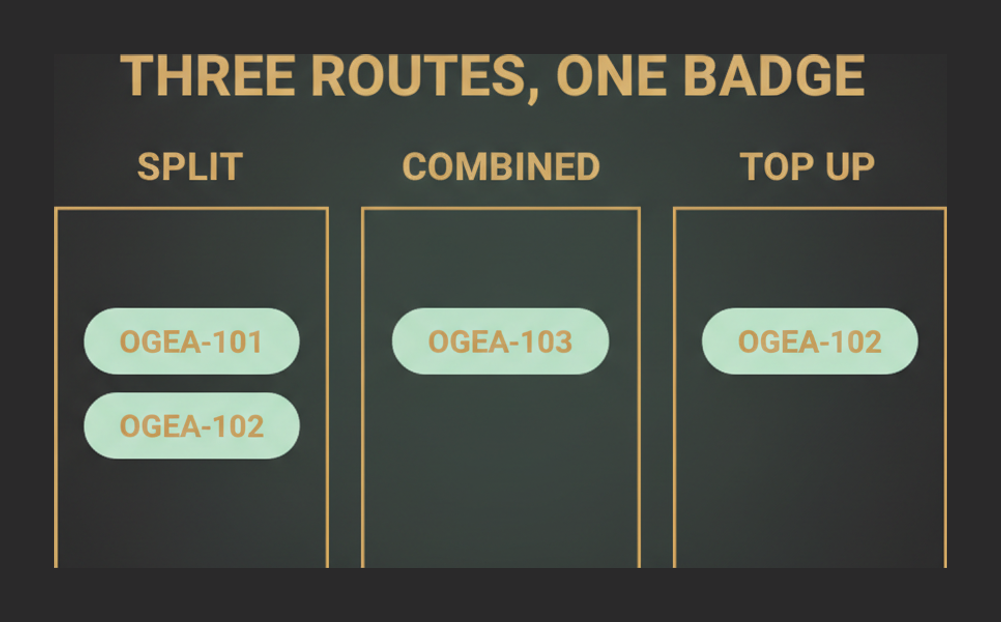
The split route has one clear advantage: you find out whether the knowledge level has landed before committing to the application level. Pass OGEA-101 and you hold the Foundation qualification immediately, which is a real credential on a CV even if you never go further. Fail, and you have lost one exam rather than half of a longer one.
The combined route wins on time and on momentum. Everything you revise for Part 1 is still fresh when Part 2 tests you on applying it, which matters because the two halves are not independent subjects. Phase A appears in both. So does the ADM. Sitting them months apart means relearning the vocabulary twice.
The practical rule
If you already work as an architect and the method is mostly a matter of learning TOGAF’s names for things you already do, take the combined exam. If enterprise architecture is new to you and the ADM is genuinely unfamiliar, split it, hold the Foundation qualification while you build experience, and come back for Part 2 when scenario questions feel answerable rather than guessable. The Open Group sets out all three routes on its certification portfolio page.
What Do the Eight Part 1 Topics Cover?
The knowledge half of the syllabus runs across eight topics: Concepts, Definitions, Introduction to the ADM, Introduction to ADM Techniques, Introduction to Applying the ADM, Introduction to Architecture Governance, Architecture Content, and the TOGAF Certification Program. Together they establish the vocabulary and the structure that Part 2 then asks you to use.
Concepts and Definitions do the groundwork. What an enterprise is in TOGAF’s sense, what architecture means here, what distinguishes a building block from a deliverable, what an architecture domain is. These read as dry list learning and they are, but every scenario question in Part 2 is written in this vocabulary, so imprecision here costs marks twice.
The three ADM topics are the centre of the half. Introduction to the ADM covers the phases and their order. ADM Techniques covers the supporting practices used across phases. Applying the ADM covers adapting the method rather than following it verbatim, which is the idea most candidates arrive with the weakest grip on.
- Architecture Governance introduces the structures that keep architecture decisions accountable
- Architecture Content covers the metamodel, artefacts and the repository that hold the work
- The TOGAF Certification Program topic is about the credential scheme itself and is the quickest to learn
Do not treat the certification program topic as filler. It is the one topic on the paper you can guarantee getting right with twenty minutes of reading, which is a free return on a 48 question exam.
Why Is Part 2 the Harder Half?
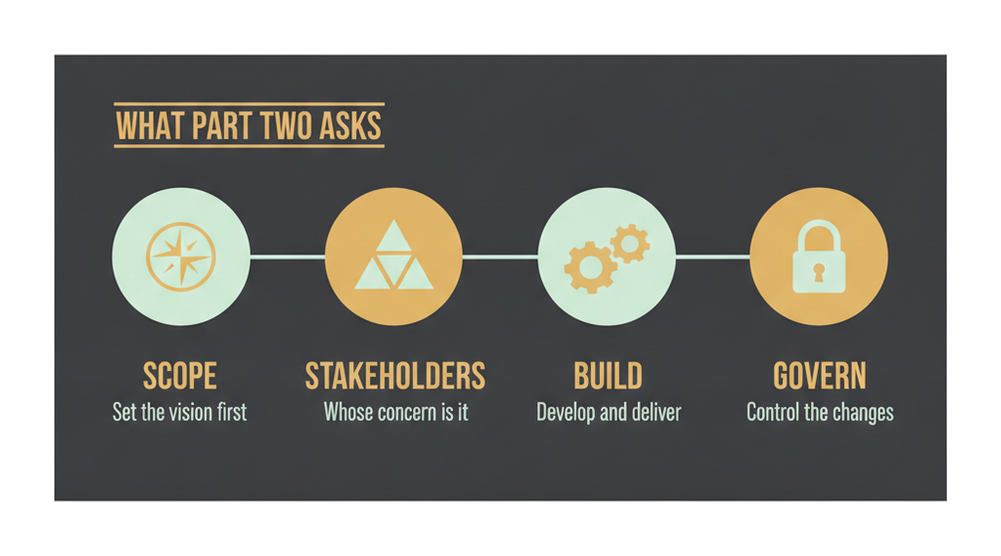
Because it stops asking what things are called and starts asking what you would do. The eight Part 2 topics are The Context for Enterprise Architecture, Stakeholder Management, Phase A as the Starting Point, Architecture development, Implementing the Architecture, Architecture Change Management, Requirements Management, and Supporting the ADM Work. Each is assessed through scenarios rather than recall.
Stakeholder Management is where experienced architects gain most and newcomers lose most. The topic covers identifying stakeholders, understanding their concerns and producing views that address them, and the right answer in a scenario often depends on recognising whose concern is actually being raised. That is a judgement learned at work far more easily than from a book.
Phase A as the starting point gets its own topic for a reason. A disproportionate number of architecture engagements go wrong at the beginning, in how the vision and scope are set, and the exam reflects that by treating Phase A as a subject rather than one phase among many.
What a Part 2 question actually looks like
You are given a situation: an organisation, a programme, a problem, and a stage in the method. You are then offered four courses of action, all of which are defensible, and asked which best applies the standard. There is rarely a wrong answer in the sense of a nonsense answer. There is a best answer, and it is best because it follows what the method says should happen at that point.
That structure is why reading speed matters so much. Four plausible four sentence options take real time to compare, and there are questions of that shape scattered through the whole 150 minutes.
What Does It Mean That No Topic Carries a Weighting?
It means you cannot plan by percentage. Unlike most certification blueprints, the OGEA-103 syllabus lists its sixteen topics without publishing a weighting against any of them, and it gives a single combined figure of 48 questions rather than saying how the paper divides between Part 1 and Part 2. No source readable here states that split, so no responsible guide can tell you it.
| Part 1 topics | Part 2 topics |
|---|---|
| Concepts | The Context for Enterprise Architecture |
| Definitions | Stakeholder Management |
| Introduction to the ADM | Phase A, the Starting Point |
| Introduction to ADM Techniques | Architecture development |
| Introduction to Applying the ADM | Implementing the Architecture |
| Introduction to Architecture Governance | Architecture Change Management |
| Architecture Content | Requirements Management |
| TOGAF Certification Program | Supporting the ADM Work |
The absence changes how you should study rather than how much. On a weighted exam you can rationally under prepare a 4 percent domain. Here you cannot, because any topic might carry more questions than you expect. The safe assumption is even coverage across all sixteen, with extra time going to the topics you personally find hardest rather than to the ones a table tells you are large.
There is an upside. Even coverage is exactly how the ADM works in practice, since the phases run in sequence and none of them is optional. Studying the method as a continuous cycle rather than as a set of weighted blocks happens to be both the safest exam strategy and the more useful one afterwards.
Who Benefits Most From This Credential?
Solution architects, technical architects and senior analysts who already influence how systems are designed across more than one team, and who need a shared vocabulary to do it. TOGAF Enterprise Architecture Practitioner is the credential most often named on enterprise architect job specifications, and the role commands salaries well above general senior engineering roles.
The strongest candidates are people already doing parts of the job without the title. If you have run a design authority, produced a target state and argued it with a programme board, Part 2 will feel like a description of your week. What you are buying is the method’s name for each of those activities and the confidence that your reasoning matches a recognised standard.
The credential is also useful defensively. Architecture decisions get challenged, and being able to point at a published method rather than at personal preference changes the tone of that conversation. Salary data for the enterprise architect role reflects how much organisations value someone who can hold that line.
It is a weaker fit for a developer or administrator with no cross team design responsibility. The method is about governing and directing architecture work, and without something to govern the content stays abstract. Anyone in that position is usually better served starting at the knowledge level, which our guide to TOGAF Foundation certification covers in detail.
Experience that genuinely helps
- Having produced a target architecture and defended it to people who disagreed
- Having sat on or reported to a design authority or architecture review board
- Having managed requirements across more than one delivery team
- Any exposure to formal change control on a live estate
How Should You Prepare for OGEA-103?
By learning the method as one continuous cycle and then practising judgement on top of it. Because no topic carries a published weighting, the efficient plan covers all sixteen evenly and then spends its remaining time on scenario practice, which is where the combined exam is won or lost.
- Read the ADM phases end to end in order first, before touching any topic in detail, so that every later piece of study has somewhere to attach itself.
- Learn the Concepts and Definitions vocabulary deliberately, because every scenario question in the second half is written in that language and a vague grasp of it costs marks twice.
- Work through ADM Techniques and Architecture Content next, since those two supply the artefacts and practices that scenario answers keep referring to.
- Spend twenty minutes on the TOGAF Certification Program topic and bank it, as it is the one part of the syllabus you can be certain of answering correctly.
- Move to Part 2 and study Stakeholder Management before anything else in that half, because identifying whose concern is in play is what most scenario questions actually turn on.
- Practise full scenario questions under time, reading each option completely before choosing, since the real constraint in the exam is reading speed rather than knowledge.
- Finish by rehearsing Phase A situations specifically, as the syllabus singles it out as a topic of its own and getting the start of an engagement right is what the rest of the method depends on.
Reading the Part 2 material once more the evening before is worth more than a final pass over definitions. The recall content stays put; judgement does not, and the scenarios reward a mind that has recently been thinking in the method’s terms. Candidates who took the split route usually say the same thing about Part 2 in isolation, and our OGEA-102 preparation notes cover the same half as a standalone exam.
Frequently Asked Questions
How many questions are on the OGEA-103 exam?
Forty eight multiple choice questions across 150 minutes, covering both the Part 1 and Part 2 syllabus topics in a single sitting. The paper is delivered through Pearson VUE.
What is the OGEA-103 exam cost?
USD 610. That is one fee for the combined sitting, covering both halves of the TOGAF Enterprise Architecture Practitioner assessment rather than two separate exam bookings.
What is the passing score for OGEA-103?
Sixty percent, which works out at roughly 29 correct answers from 48. There is no published breakdown of how the questions divide between Part 1 and Part 2 material.
Can I take Part 1 and Part 2 separately instead?
Yes. OGEA-101 covers Part 1 and OGEA-102 covers Part 2, and passing both gives the same credential. If you already hold the TOGAF Enterprise Architecture Foundation qualification, you need only OGEA-102.
Does TOGAF certification expire?
The Open Group publishes its certification terms in downloadable documents rather than on its readable web pages, so no expiry period is stated here. Check the current certification policy on The Open Group site before assuming either way.
How are the syllabus topics weighted?
They are not. The published syllabus lists eight Part 1 topics and eight Part 2 topics with no percentage against any of them, so an even coverage plan is the only safe approach.
Which half of OGEA-103 is harder?
Part 2. It presents scenarios with several defensible courses of action and asks which best applies the method, where Part 1 mostly tests whether you know the vocabulary and the structure.
Do I need TOGAF Foundation before taking OGEA-103?
No. The combined exam covers the Foundation level material itself, which is why it exists. Holding Foundation already is what makes the shorter OGEA-102 route available instead.
Is the exam available at home?
Yes. The Open Group offers online proctored exams alongside Pearson VUE test centre delivery, so the combined sitting can be taken remotely where that option is available in your region.
Conclusion
OGEA-103 is the one sitting route into TOGAF Enterprise Architecture Practitioner: 48 questions, 150 minutes, 60 percent to pass, 610 US dollars, and sixteen syllabus topics split evenly between a knowledge half and an application half. No topic carries a published weighting and the question split between the parts is not published either, so even coverage is the only defensible plan. Part 2 is the harder half, and it is harder because judgement rather than recall is what it measures.
The route decision comes down to experience. Architects who already do the work benefit from sitting both halves while the vocabulary is fresh. Anyone newer to the discipline gains more from splitting it, banking the Foundation qualification and returning for Part 2 later. Whichever route you choose, working through full scenario questions under time is the step that tells you whether you are ready.


