Most people book this one expecting an application security exam. It is not one. HCL-ASoC-AST-2024 is a product exam that happens to be about application security, and the difference decides everything about how you should prepare for it.
The AppScan on Cloud certification is HCLSoftware’s entry credential for people who run scans on its hosted platform: 50 questions, 75 minutes, a 70 percent pass mark, and seven topic areas so unevenly weighted that one of them is worth more than the other six combined.
Table of Contents
- What is the AppScan on Cloud certification?
- Why is this a product exam rather than a security theory exam?
- How is HCL-ASoC-AST-2024 delivered and scored?
- Where do the marks actually sit?
- What is inside the 62 percent Features topic?
- Which scan types sit behind those features?
- The six small topics are not filler
- Who is the Associate Security Tester credential written for?
- How should you prepare for the AppScan on Cloud exam?
- Frequently Asked Questions
- Conclusion
What is the AppScan on Cloud certification?
The AppScan on Cloud certification is HCLSoftware’s associate-level credential for its hosted application security testing platform, carrying the exam code HCL-ASoC-AST-2024 and the full title HCLSoftware Certified HCL AppScan on Cloud (ASoC) Associate Security Tester 2024. It verifies that you can administer the service, configure and run scans, and work the results, across seven weighted topic areas in a 50 question exam.
HCL positions it as a starting point rather than a destination. Its own wording describes the credential as the first step in an AppScan on Cloud journey for a security engineer or practitioner, which is a useful signal: the exam is pitched at someone who already has the platform open in a browser tab, not at someone deciding whether application security matters.
Everything published about the exam comes from a small number of places. HCL states the format on its AppScan on Cloud exam page, and the topic weightings are published on the money site’s syllabus page rather than by the vendor. That gap matters more than it sounds, because the weightings are the single most useful thing a candidate can know about this paper.
Why is this a product exam rather than a security theory exam?
Every one of the seven topic areas begins with the words “AppScan on Cloud”. Admin Management, Dashboard, Features, Organization, Policy, Results and Support are all named after parts of the product interface, not after security concepts. There is no domain called threat modelling, no domain called secure coding, and no domain called vulnerability classes.
That is a deliberate design and it changes the study plan completely. A candidate who spends three weeks revising injection flaws and broken access control will walk in prepared for the wrong exam. The paper asks where a setting lives, what a particular scan type produces, how an issue moves through its states, and which report answers a given question.
The practical test of readiness is simple. If you can perform a task in the product without looking it up, you can probably answer a question about it. If you can only describe the security idea behind the task, you probably cannot. Working through the exam-style sets on CertFun’s AppScan on Cloud practice exam is the quickest way to find out which of the two you are, because the question style makes the product-first framing obvious within a dozen items.
None of this makes the credential shallow. Application security knowledge is what lets you interpret what the platform returns. It simply is not what the 50 questions are scored on.
How is HCL-ASoC-AST-2024 delivered and scored?
HCL-ASoC-AST-2024 is 50 questions in 75 minutes, priced at $150 USD, with a 70 percent pass mark. HCL delivers it through Pearson VUE, either at a test centre or as an online proctored sitting, and the items are multiple choice or multiple response rather than multiple choice alone. Passing issues a Credly badge naming you an ASoC Associate Security Tester.
| Field | Value |
|---|---|
| Credential name | HCLSoftware Certified HCL AppScan on Cloud (ASoC) Associate Security Tester 2024 |
| Exam code | HCL-ASoC-AST-2024 |
| Questions | 50 |
| Question style | Multiple choice or multiple response |
| Duration | 75 minutes |
| Passing score | 70 percent |
| Price | $150 USD |
| Delivery | Pearson VUE test centre or online proctored |
| Topic areas | 7 |
| Prerequisite | None published |
Two of those numbers deserve a second look together. Seventy percent of 50 questions means 35 correct answers, so the margin is 15 items. That is a comfortable-sounding allowance until you notice how much of the paper is drawn from a single topic, because a weak area there cannot be offset anywhere else.
The multiple-response detail is worth planning around too. Items that ask for several correct options are usually scored as a unit, so a partially correct answer earns nothing. In a 75 minute paper that averages 90 seconds a question, the multi-select items are where the time goes.
Where do the marks actually sit?
One topic, AppScan on Cloud Features, carries 62 percent of the exam. The remaining six topics share 38 percent between them, and four of those six are worth 8 percent or less. On a 50 question paper that is roughly 31 questions in one topic area and about three questions each in the smallest ones.
| Topic | What it covers | Weight | Approximate questions |
|---|---|---|---|
| AppScan on Cloud Features | API Scan, Application, AppScan on Cloud Control, Integration, Issues, Reports, Results, Scan | 62% | 31 |
| AppScan on Cloud Admin Management | Access Management | 8% | 4 |
| AppScan on Cloud Dashboard | Metrics | 8% | 4 |
| AppScan on Cloud Results | Issues in Detail | 8% | 4 |
| AppScan on Cloud Support | Environment | 6% | 3 |
| AppScan on Cloud Organization | Organization Management | 4% | 2 |
| AppScan on Cloud Policy | Policy Settings | 4% | 2 |
A distribution this lopsided is rare and it is genuinely helpful. It tells you that a candidate who knows the Features topic thoroughly and has a working familiarity with the rest is already close to the pass mark, and that a candidate who has split study time evenly across seven topics has spread themselves the wrong way.
It also sets the failure mode. Miss a third of the Features questions and you have lost about 10 marks out of a 15 mark allowance before touching anything else. There is no route to 35 correct answers that avoids that topic.
What is inside the 62 percent Features topic?
The Features topic is not one subject. The syllabus lists eight separate areas under it: API Scan, Application, AppScan on Cloud Control, Integration, Issues, Reports, Results and Scan. Together they describe the whole working cycle of the platform, from defining what gets tested through to what comes out of the other end, which is why the topic swallows most of the paper.
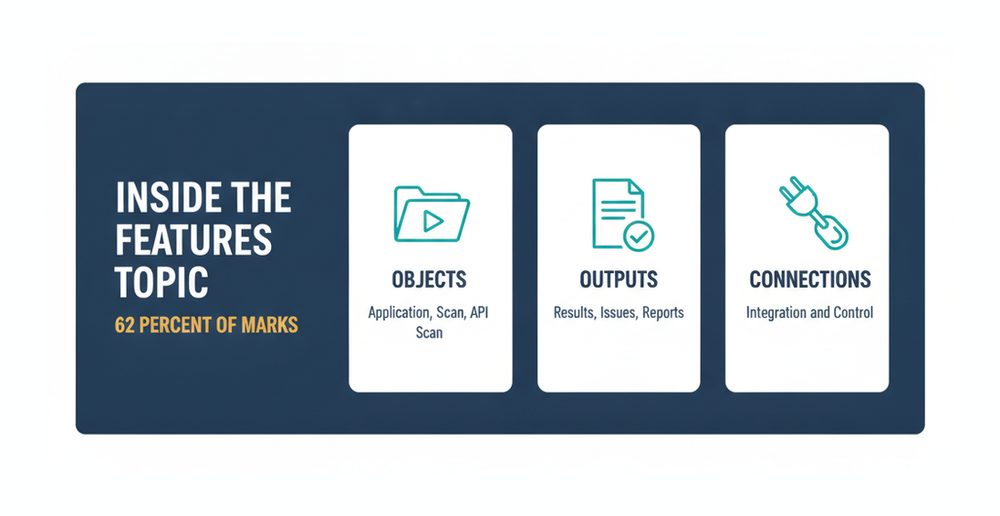
The objects you configure
Application and Scan are the two structural objects. An application is the container that scans, issues and reports belong to, and how you organise applications determines how everything downstream can be filtered and reported on. Scan covers the configuration of a test run: what it targets, how it authenticates, and what scope it is allowed to touch.
API Scan is called out separately from Scan, which is a signal about where the product has invested. Testing an API is a different exercise from crawling a web interface: there is no user journey to follow, so the definition file and the request set have to stand in for one.
The things that come out
Issues, Results and Reports are three distinct areas even though they sound like one. Results is what a scan produced. Issues is the working list those results become, with states and ownership. Reports is the presentation layer that turns either of them into something an auditor or a development manager will read.
Confusing those three is a common way to lose marks, because questions frequently hinge on which of them a described task belongs to. Generating evidence for a compliance review, reassigning a finding to a developer, and inspecting what a scan actually did are three different operations in three different places.
The connections outward
Integration and AppScan on Cloud Control cover how the platform reaches the rest of the toolchain. This is where the exam meets the way application security testing is really used, because a scanner that only runs when somebody remembers to click it does not change much. Build pipeline integration and programmatic control are the mechanism by which scanning becomes routine rather than occasional.
Which scan types sit behind those features?
AppScan on Cloud is the software-as-a-service delivery of HCL’s application security testing family, and the Features topic is written around what that platform can test. Understanding the scan types is what makes the Results and Issues areas make sense, because each type produces findings with a different shape and a different confidence profile.
Dynamic testing exercises a running application from the outside and finds what is exploitable in the deployed state. Static analysis reads the source and finds patterns that may never be reachable at runtime. Interactive testing instruments the application so the two views inform each other. Composition analysis looks at what the application depends on rather than what its own code does.
Those differences drive the triage work the exam asks about. A dynamic finding usually arrives with reproduction evidence attached. A static finding usually arrives with a code location and a question about reachability. A dependency finding may be entirely correct and still not matter, if the vulnerable path is never called. Static findings are usually labelled against the CWE weakness catalogue, which is why two results describing the same line of code can still belong to different weakness classes.
The vulnerability categories themselves are the common industry taxonomy rather than anything proprietary. The OWASP Top Ten project is the reference most teams read scanner output against, and while the exam does not test it directly, knowing the categories is what lets you tell a serious finding from a noisy one when a question describes a result rather than naming it.
The product side is documented on HCL’s AppScan on Cloud product page, which is the clearest statement of what the hosted service does relative to the rest of the AppScan line.
The six small topics are not filler
Thirty eight percent split across six topics works out at roughly 19 questions, which is more than a third of the paper and more than the pass margin. They are small individually and substantial collectively, so the sensible plan is to make each one cheap to learn rather than to skip them.
- Admin Management at 8 percent is access management: who can see and do what.
- Dashboard at 8 percent is metrics, meaning the aggregate view rather than any individual scan.
- Results at 8 percent is issues in detail, the close reading of a single finding rather than the list.
- Support at 6 percent is the environment itself, which is the topic most candidates have never deliberately looked at.
- Organization at 4 percent is organisation management, the tenant level above applications.
- Policy at 4 percent is policy settings, which govern what a scan is permitted to do.
Each of these is a small enough surface to cover in an evening in the product. Organization and Policy in particular are two or three questions each, and both are settings screens rather than concepts, which makes them the highest return per hour of anything on the syllabus.
The pattern is one that turns up across vendor platform credentials: a large operational topic surrounded by small administrative ones. The same shape appears in HCL’s endpoint line, where the BigFix Platform 11 credential similarly rewards time spent in the console over time spent reading about it.
Who is the Associate Security Tester credential written for?
HCL writes this exam for people who already use AppScan on Cloud: security testers, application security engineers, and the platform administrators who run scanning for a development organisation. The vendor frames it as the associate tier of a longer path for a security engineer or practitioner, which places it below the deeper AppScan credentials rather than alongside them.
It is a poor fit for two groups. Someone with no access to the platform will struggle, because almost every question is about a place in the product. Someone looking for a portable application security qualification will find the value is tied to organisations that run this specific tool, which is the normal trade of a product credential rather than a flaw in this one.
It is a strong fit for a third group that is easy to overlook: the person who inherited the scanning platform. Plenty of teams have somebody who was handed AppScan on Cloud along with three other tools and learned it by necessity. This exam is a structured way to find out which parts of it they never touched, and the $150 price makes that a cheap audit.
For anyone building a broader HCLSoftware profile, the vendor’s other platform credentials share this design philosophy. The HCL endpoint management route follows the same console-first logic, so experience preparing for one transfers to the other as a study method even though the subject matter does not overlap.
How should you prepare for the AppScan on Cloud exam?
Preparation for HCL-ASoC-AST-2024 should follow the weightings rather than the syllabus order. Give the Features topic the majority of your time, because it is the majority of the paper, and treat the six small topics as short, targeted sweeps through settings screens you can cover in an evening each.
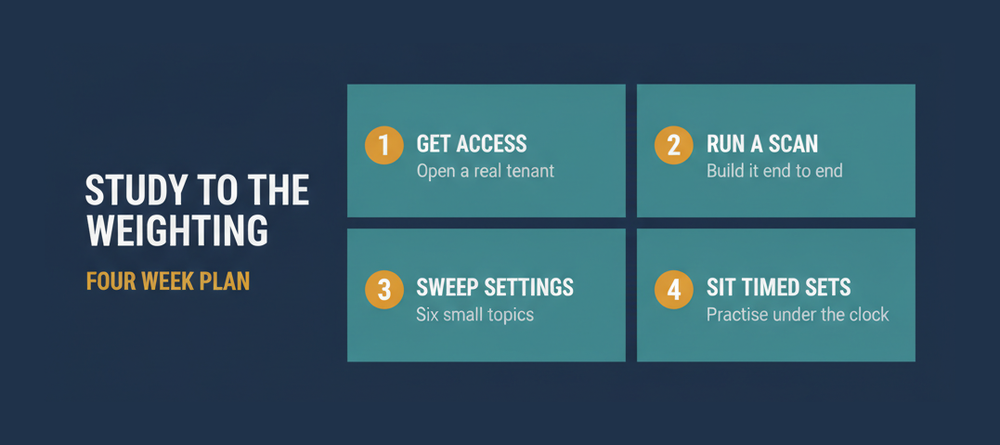
- Confirm you have working access to an AppScan on Cloud tenant, because every topic on this exam is a place in the product and reading about it is a poor substitute for opening it.
- Work through the Features topic first and in order, configuring an application, running a standard scan and an API scan, and following what each produces all the way to a report.
- Separate Results, Issues and Reports deliberately, performing one task in each so that the distinction between what a scan produced, what it became, and how it is presented is experiential rather than remembered.
- Set up an integration and use the programmatic control surface, since these are the parts of the Features topic that candidates who only use the web interface tend to have never touched.
- Sweep the six small topics one evening at a time, visiting access management, the metrics dashboard, organisation management, policy settings and the environment or support screens in the product itself.
- Take HCL’s self-paced AppScan on Cloud training on HCLSoftware U if you have a subscription, since the vendor recommends it without requiring it and it maps closely to the topic list.
- Finish with timed sets of 50 questions in 75 minutes, paying particular attention to multiple-response items, which are usually scored as a unit and are where the clock is lost.
Two to four weeks is a realistic window for someone who already administers the platform. Someone new to it should budget longer and spend the extra time in the product rather than on additional reading, because the recall the exam wants is the kind that comes from having done the task.
Frequently Asked Questions
How many questions are on the HCL-ASoC-AST-2024 exam?
Fifty questions in 75 minutes. HCL states on its own exam page that the items are multiple choice or multiple response, so some questions require more than one selection.
What is the passing score for the AppScan on Cloud certification?
Seventy percent, which on a 50 question paper means 35 correct answers and a margin of 15. HCL publishes the same figure as the money site’s syllabus page, so the two sources agree.
How much does the AppScan on Cloud exam cost?
$150 USD. It is scheduled through Pearson VUE and can be sat either at a test centre or as an online proctored exam.
Which topic carries the most marks?
AppScan on Cloud Features, at 62 percent. That is roughly 31 of the 50 questions, and it covers API Scan, Application, AppScan on Cloud Control, Integration, Issues, Reports, Results and Scan.
Is there a prerequisite for the ASoC Associate Security Tester exam?
No prerequisite certification is published. HCL recommends its self-paced AppScan on Cloud training but does not require it, and there is no stated experience minimum.
Does the exam test OWASP vulnerability classes directly?
Not as a topic. Every one of the seven topic areas is named after a part of the product rather than a security concept. Vulnerability knowledge helps you interpret results, but it is not what the questions are scored on.
What does passing actually give you?
A Credly badge naming you an HCLSoftware Certified HCL AppScan on Cloud (ASoC) Associate Security Tester 2024. HCL describes the credential as the opening step of a longer certification path rather than a terminal qualification.
How long should I study for it?
Two to four weeks is realistic if you already administer the platform. If you do not have tenant access, the honest answer is that the exam will be difficult at any study length, because the questions are about locations and behaviours in the product.
Are the topic weightings published by HCL?
No. HCL publishes the format, price and delivery details but not the section weights. The percentages come from the money site’s syllabus page, which is the only place they appear.
Is the 2024 version still the current exam?
Yes. HCL is still scheduling the 2024 badge on its own exam page, and no later version of the code appears in the vendor’s course listing or on the badge itself.
Conclusion
The AppScan on Cloud certification is a narrow, honest, inexpensive product exam: 50 questions, 75 minutes, $150, and a 70 percent bar. Its defining feature is the weighting. One topic holds 62 percent of the marks, and the other six share what is left, which makes the study plan almost self-writing.
Spend most of your time in the Features topic, working an application from configuration through scan to issue to report, and use single evenings to sweep the small administrative topics that are cheap to learn and still worth 19 questions between them. Book it when you can complete those tasks without looking anything up, and treat it as the first credential in an application security tooling path rather than the last.


