A deployment pipeline that ships to production several times a day never pauses for a security review, and the GIAC Cloud Security Automation certification is built entirely on that fact. Its answer is not slower releases. Its answer is controls that run at pipeline speed.
The cloud security automation certification, exam code GCSA, is GIAC’s practitioner credential for engineers who secure cloud native systems through automation rather than through gates. It runs to 75 questions in 120 minutes at a 66 percent pass mark, and it publishes eighteen objectives without a single weighting attached to any of them.
Table of Contents
- What does the cloud security automation certification cover?
- Why does GCSA publish no domain weightings?
- How is the GCSA exam delivered and scored?
- Container orchestration runs through five of the eighteen objectives
- What does the pipeline half of the syllabus expect?
- Who is this credential actually for?
- Is SEC540 required to pass GCSA?
- How should you prepare when nothing is weighted?
- Frequently Asked Questions
- Conclusion
What does the cloud security automation certification cover?
The cloud security automation certification, GCSA, validates that an engineer can build security into a cloud native delivery pipeline instead of bolting it on afterwards. It spans DevOps and DevSecOps fundamentals, infrastructure as code, container and Kubernetes security, secrets handling, supply chain integrity, policy as code, and continuous compliance across eighteen published objectives.
The credential sits in GIAC’s Practitioner tier, which is the band for hands-on role certifications rather than leadership or applied-knowledge credentials. That placement matters when you are reading the objectives, because almost every one of them is written as something the candidate can do rather than something the candidate can define.
Read the objective wording closely and the pattern is consistent. The candidate can construct rules. The candidate can use the kubectl command line interface. The candidate can apply policy as code controls. Only two of the eighteen objectives ask you to explain or summarise anything; the rest describe actions.
GIAC’s own framing of the credential comes from the co-author of the aligned course.
“The GIAC Cloud Security Automation (GCSA) certification covers cloud services and modern DevSecOps practices that are used to build and deploy systems and applications more securely. The certification shows that you not only know how to speak the language of modern cloud and DevSecOps principles but can put them into practice in an automated and repeatable manner.”
Why does GCSA publish no domain weightings?
GIAC lists eighteen certification objectives for GCSA and attaches a percentage to none of them. That is a deliberate house style across GIAC credentials rather than an omission on one exam, and it changes how you plan: there is no largest domain to anchor a study schedule on, and no smallest one you can safely under-prepare.
Most certification study plans are built by arithmetic. You take the weightings, multiply by the question count, and spend your hours in proportion. With GCSA that method has nothing to work with. Eighteen objectives across 75 questions averages roughly four questions each, and the only honest planning assumption is that every objective is examinable.
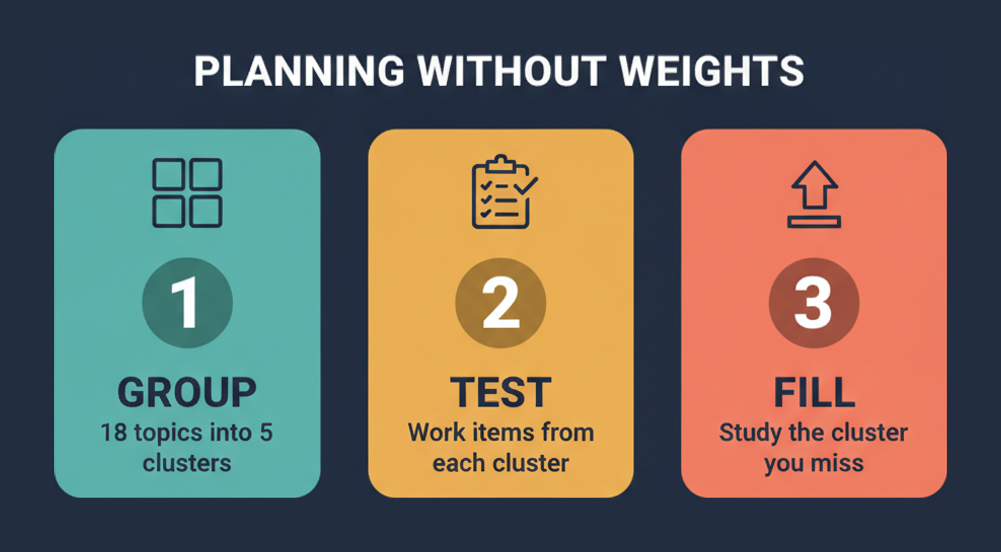
That sounds harsher than it is. In practice the eighteen objectives cluster into a small number of genuinely different skill areas, and grouping them is the substitute for weighting them.
| Cluster | Objectives it contains | Count |
|---|---|---|
| Container orchestration and workloads | Architecture and fundamentals, risks and access control, runtime security, workload security, container lifecycle security | 5 |
| Pipeline and delivery security | Understanding the DevOps workflow, securing the DevOps workflow, software supply chain security, configuration management | 4 |
| Policy, compliance and remediation | Policy enforcement, cloud compliance as code, automated cloud remediation | 3 |
| Microservices and edge | Microservices architecture and deployment, microservice API gateways, edge identity and authentication | 3 |
| Infrastructure, secrets and visibility | Deploying cloud infrastructure as code, managing secrets, cloud native observability | 3 |
Grouped that way, one thing is immediately clear. Container orchestration is the single biggest cluster by objective count, and no reading of the syllabus makes it optional.
Because the syllabus will not tell you where the marks sit, the fastest way to find your own weak cluster is to work items and watch where you hesitate. The GCSA sample questions published on the money site are drawn across the clusters rather than concentrated in one, which makes an uneven profile show up quickly.
How is the GCSA exam delivered and scored?
GCSA is a single proctored exam of 75 questions with a 120 minute limit and a 66 percent minimum passing score, priced at $999 USD. That works out at 96 seconds per question and 50 correct answers to pass, leaving a margin of 25. The exam is web based and must be proctored, either remotely or at a test centre.
| Field | Value |
|---|---|
| Credential name | GIAC Cloud Security Automation |
| Exam code | GCSA |
| Tier | Practitioner Certification |
| Questions | 75 |
| Duration | 120 minutes |
| Passing score | 66 percent |
| Price | $999 USD |
| Objectives | 18, none weighted |
| Proctoring | Remote through ProctorU, or onsite through Pearson VUE |
| Aligned training | SEC540 |
| Renewal | 36 CPE credits over four years |
Where the 66 percent figure comes from
The pass mark is not a round number somebody chose. GIAC sets it through a psychometric standard-setting study, and 66 percent applies to exam versions released from 29 June 2024 onward. Older material quoting a different figure is describing a retired version, which is worth knowing if you are reading study notes written a few years ago.
The 120 day window most candidates miss
Once your attempt is activated in your GIAC account you have 120 days to complete it. That is generous compared with most vendors, but it is a deadline rather than an open invitation, and it starts at activation rather than at the moment you feel ready. Plan the purchase around the study, not the other way round.
Container orchestration runs through five of the eighteen objectives
Five GCSA objectives are about containers and the platform that schedules them: architecture and fundamentals of container orchestration, risks and access control, runtime security, workload security, and container lifecycle security. No other topic on the syllabus is named five times, which makes Kubernetes the practical centre of gravity of the exam.
These five are not repetitions of one another. They ask for different things, and a candidate who is comfortable with one can be exposed on the next.
- Architecture and fundamentals expects you to identify core components and drive them with kubectl, which is the only objective on the whole syllabus that names a specific command line tool.
- Risks, authentication and access control covers the security controls the platform itself provides, role based access control among them, plus the known attack paths against a cluster.
- Runtime security is narrower than it sounds: it is about admission controllers rejecting misconfigured or malicious workloads before they run.
- Workload security targets a specific documented weakness, namely how pods authenticate to cloud services, and the OIDC-based workload identity pattern that fixes it.
- Container lifecycle security steps outside the cluster to image hardening and scanning.
The workload identity objective is the one that catches people. It sits at the join between two identity systems, the cluster’s and the cloud provider’s, and reading the Kubernetes security concepts without also understanding how the provider issues credentials leaves half the picture missing.
There is a useful sibling comparison here. GIAC’s cloud security line also includes a fundamentals-level credential aimed at securing cloud services themselves rather than the delivery pipeline around them, and the cloud security essentials credential covers that ground at a lower technical bar. Candidates who find the Kubernetes cluster is genuinely new territory often take that route first.
What does the pipeline half of the syllabus expect?
Four objectives cover the delivery pipeline itself: understanding the DevOps workflow, securing it, software supply chain security, and configuration management. Together they ask whether you can put controls inside the build and release process rather than in front of it, and whether you can prove what went into a release afterwards.
Controls inside the pipeline, not in front of it
Securing the DevOps workflow names the pre-commit and pre-merge phases specifically, which tells you where GIAC thinks the controls belong. It also names AI-augmented controls as part of workflow hardening, a recent addition that reflects how quickly review tooling has changed.
Configuration management is framed around trusted machine images rather than around any single tool. The objective is the security benefit of building hardened gold images and then having the pipeline consume them, so the reasoning transfers whether your shop uses one image builder or another.
Proving what shipped
Software supply chain security asks for the standard steps that secure a container image supply chain, and names artifact signing and SBOM vulnerability scanning as examples. Frameworks such as the SLSA supply chain levels give that objective a vocabulary, and candidates who have worked through a real signing and attestation setup tend to find this the easiest cluster on the paper.
Policy enforcement rounds the cluster out and is worth reading twice. It is the only objective that names application security posture management platforms, and it is specific about what they do: ingest findings from several pipeline sources, deduplicate them, and gate a deployment on the result.
Who is this credential actually for?
GIAC names a deliberately wide audience for GCSA: developers, software architects, operations engineers, system administrators, security analysts and engineers, consultants, auditors, and risk managers. In practice that breadth means the exam is approached from two very different starting points, and which one you come from decides your study plan more than anything else.
Engineers arriving from the build side usually know pipelines, infrastructure as code and container tooling, and are weakest on the controls: admission policy, compliance as code, posture management and the auditing story. Engineers arriving from the security side know the controls and are weakest on the plumbing that carries them.
| Starting point | Usually already comfortable | Where the gap tends to sit |
|---|---|---|
| Platform or DevOps engineer | Pipelines, infrastructure as code, Kubernetes operation, image builds | Admission control, policy as code, compliance automation, posture management |
| Cloud or application security engineer | Threat models, secrets handling, supply chain risk, identity | kubectl fluency, cluster internals, microservice deployment patterns, observability |
| Auditor or risk manager | Compliance frameworks, evidence and reporting | Almost the entire hands-on half; this is the hardest route in |
For the auditor and risk manager profile, GIAC’s own audience list is more optimistic than the objective wording. Eighteen objectives written as things a candidate can do is a high bar for anyone who does not build systems, and that group should expect a longer runway than the other two.
Is SEC540 required to pass GCSA?
No. GIAC does not require any training course as a condition of sitting GCSA, and the certification can be attempted on the strength of experience alone. SEC540, Cloud Native Security and DevSecOps Automation, is the aligned course and the objectives track it closely, but the requirement is competence rather than attendance.
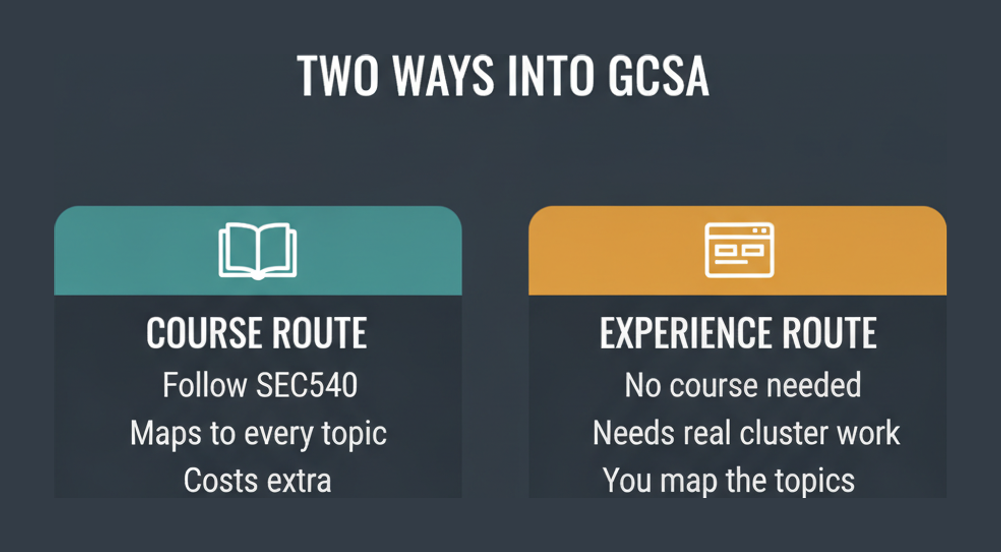
That said, the alignment is tight enough to matter when you are budgeting. The eighteen objectives read as a course outline because they largely are one, so a candidate who skips the course is taking on the job of mapping each objective to their own material.
Practical experience is the strongest substitute, and it needs to be the right kind. Running workloads on a managed Kubernetes service is directly relevant; managing a cloud account without any container or pipeline exposure is not. If you can look at the five orchestration objectives and recall doing each of those things, the aligned SANS course becomes an accelerator rather than a prerequisite.
One more piece of context for anyone weighing the price. GIAC operates as an ANAB-accredited ISO/IEC 17024 personnel certification body, which is the accreditation standard that governs how certification bodies run exams and set pass marks. It is part of why the pass mark comes from a standard-setting study rather than from a product decision.
How should you prepare when nothing is weighted?
Replace weighting with coverage. Because GCSA gives you no percentages, the planning unit is the objective rather than the domain, and the goal is to reach a defensible level on all eighteen rather than an excellent level on a few. The sequence below works outward from the biggest cluster.
- Work the five container orchestration objectives first, since they are the largest cluster and every later topic assumes you can read a cluster.
- Get genuinely fluent with kubectl, because it is the only tool named anywhere in the eighteen objectives and fluency with it shortens every practical question.
- Follow one pod’s identity all the way out to a cloud service using OIDC-based workload identity, which turns the workload security objective from a definition into something you have seen fail.
- Build a pipeline that produces a signed image and an SBOM, then break the signature deliberately and watch what the gate does.
- Write policy as code that rejects a real misconfiguration, then extend the same rule into automated remediation, since policy enforcement and automated cloud remediation are separate objectives that share one skill.
- Instrument a microservice for metrics, logs and traces, because cloud native observability is easy to skim and hard to answer from theory.
- Put an API gateway and network policy in front of that service so microsegmentation and edge authentication stop being abstractions.
- Finish with timed sets of 75 questions in 120 minutes, checking that no single cluster is dragging your score below the 66 percent line.
A candidate coming from the security rather than the build side should reverse the first two blocks and start with the pipeline, since that is the shorter climb from where they already stand. For a sense of how the broader GIAC cloud track fits together before committing, the public cloud security exam covers adjacent ground from a provider-first angle.
Frequently Asked Questions
How many questions are on the GCSA exam?
GCSA has 75 questions and a 120 minute limit, which is roughly 96 seconds per question. It is delivered as a single proctored exam rather than split into parts.
What is the passing score for GCSA?
66 percent, which means 50 correct answers out of 75. GIAC set that figure through a psychometric standard-setting study, and it applies to exam versions released on or after 29 June 2024.
How much does the cloud security automation certification cost?
$999 USD for the certification attempt. Training is a separate cost and is not required, so the exam fee is the only mandatory spend.
Does GCSA publish domain weightings?
No. GIAC publishes eighteen certification objectives for GCSA with no percentage attached to any of them. Planning has to be built on covering every objective rather than on concentrating effort where the marks sit.
How much Kubernetes knowledge does GCSA need?
A working amount. Five of the eighteen objectives name container orchestration or containers directly, covering cluster components, access control, admission controllers, workload identity and image hardening. kubectl is the only tool the syllabus names.
Is SEC540 required before taking GCSA?
No course is required. SEC540 is the aligned training and the objectives track it closely, but GIAC lets candidates sit the exam on experience alone. Relevant experience means containers and pipelines, not general cloud administration.
How long do you have to sit the exam after buying it?
120 days from the date your attempt is activated in your GIAC account. The clock starts at activation rather than at purchase or at the point you feel prepared.
How is GCSA proctored?
Every GIAC exam is web based and must be proctored. There are two routes: remote proctoring through ProctorU, or onsite proctoring at a Pearson VUE test centre.
How long does the certification stay valid?
GIAC certifications are kept active by earning 36 CPE credits over four years. Credits can come from SANS training, conferences, published writing and other approved industry activity.
Is GCSA the same thing as GCSA Guardicore?
No, and the acronym collision causes real confusion. GCSA here is the GIAC Cloud Security Automation certification. The same letters are used elsewhere as a product abbreviation and have nothing to do with this credential.
Conclusion
GCSA is unusual among cloud security credentials in two ways that reinforce each other. It is written almost entirely in the language of doing rather than knowing, and it refuses to tell you where the marks are. Taken together, those mean the exam rewards breadth of genuine practice and punishes the selective revision that carries people through weighted papers.
The practical route in is to stop looking for a shortcut through the eighteen objectives and instead group them, find which of the five clusters you cannot demonstrate, and build that one first. Container orchestration is where most candidates find their gap, and it is also the cluster that makes the rest of the syllabus legible.
When you are ready to test that coverage rather than read about it, working exam-style items across all five clusters is the quickest way to see which one is still costing you marks.


