Most entry-level AI certifications still teach the subject as it looked in 2019: regression, classification, a neural network diagram and a closing slide about ethics. Huawei’s associate paper names DeepSeek in its first domain and gives its largest block of marks to foundation models. That is not where an associate syllabus usually goes.
The HCIA-AI certification, exam code H13-311, is 60 questions in 90 minutes with a 600 out of 1000 pass mark and a 200 USD fee, scheduled through Pearson VUE. Six domains run from an AI overview to cutting-edge applications, and deep learning with foundation models carries 30 percent of them.
Table of Contents
- What does the HCIA-AI credential cover?
- What are the H13-311 exam facts?
- What does the V4.0 syllabus signal?
- How are the six domains weighted?
- Inside the 30 percent domain
- What does the development framework domain expect?
- HCIA-AI or HCIA-AI Solution?
- Who should take this exam?
- How should you prepare?
- Frequently Asked Questions
- Conclusion
What does the HCIA-AI credential cover?
HCIA-AI is the associate tier of Huawei’s artificial intelligence track, and it certifies conceptual breadth rather than engineering depth. The syllabus moves from what AI is and where it is used, through machine learning and deep learning, into the frameworks used to build models, the business process around an AI project, and the applications at the edge of the field.
The emphasis is unusual for an entry-level paper. Rather than spending most of its weight on classical algorithms, it puts 30 percent on deep learning and foundation models and another 20 percent on development frameworks, which means half the exam is about how modern models are built and trained rather than about statistics.
What it does not do is make you an AI engineer, and it does not pretend to. Associate credentials across every vendor certify that you can hold a technically literate conversation and follow an implementation, and this one is honest about sitting at that level while choosing unusually current material to do it with.
What are the H13-311 exam facts?
H13-311 is 60 questions in 90 minutes, scored out of 1000 with 600 required to pass, at a fee of 200 USD and scheduled through Pearson VUE. That works out at 90 seconds per question, and the scaled scoring means the raw number of correct answers needed is not published.
| Field | Value |
|---|---|
| Credential | Huawei Certified ICT Associate, AI |
| Exam code | H13-311 |
| Questions | 60 |
| Duration | 90 minutes |
| Passing score | 600 out of 1000 |
| Fee | 200 USD |
| Scheduling | Pearson VUE |
| Training version | HCIA-AI V4.0 |
A word about where those numbers come from, because it matters. Huawei’s certification portal is a JavaScript application that serves no readable specification to anything but a browser, so none of these figures can be confirmed against the vendor in the way a Cisco or CompTIA figure can. They are the exam catalogue’s, they are internally consistent with the published syllabus, and you should confirm the fee and the booking terms at registration.
For the same reason, this guide states no validity period, no prerequisite and no retake rule: Huawei publishes none that can be read, and a figure nobody publishes is not one worth repeating. The most reliable readiness check is the paper itself, and an H13-311 practice test will tell you more about your gaps than any specification table.
What does the V4.0 syllabus signal?
The current blueprint is keyed to HCIA-AI V4.0 training material, and its content dates it precisely. The AI Overview domain includes an overview of DeepSeek and its influence on AI development, and the largest domain is titled Basics of Deep Learning and Foundation Models rather than simply deep learning.
Both choices tell you the syllabus was rewritten after large language models became the centre of the field rather than a specialism within it. An associate paper that names a specific recent model is taking a deliberate risk: model names age badly, and Huawei has accepted that in exchange for currency.
The practical consequence is about study material rather than about theory. Older HCIA-AI guides, and there are many, describe a version where deep learning was one domain among several and foundation models were not mentioned. They will teach you most of the machine learning content correctly and leave you short exactly where the weighting is heaviest.
How to tell which version you are reading
Check whether the material mentions foundation models at all. If the deep learning section stops at convolutional and recurrent networks and never reaches transformers or pretraining, it predates this blueprint. The transformer architecture those models are built on was set out in the 2017 attention paper, and any current AI syllabus has to reach it.
How are the six domains weighted?
The six domains are AI Overview at 10 percent, Machine Learning Overview at 20 percent, Basics of Deep Learning and Foundation Models at 30 percent, AI Development Framework at 20 percent, AI Business Process Overview at 15 percent and Cutting-edge AI applications at 5 percent. One domain carries nearly a third of the paper and one carries a twentieth.
| Domain | Weight | Roughly how many of 60 questions |
|---|---|---|
| AI Overview | 10% | 6 |
| Machine Learning Overview | 20% | 12 |
| Basics of Deep Learning and Foundation Models | 30% | 18 |
| AI Development Framework | 20% | 12 |
| AI Business Process Overview | 15% | 9 |
| Cutting-edge AI applications | 5% | 3 |
Read the bottom row before the top one. Cutting-edge AI applications is worth about three questions, which is the clearest signal in the whole blueprint that the exam is not testing novelty for its own sake. The marks are in the middle: models, frameworks and the process of getting a model into a business.
Inside the 30 percent domain
Basics of Deep Learning and Foundation Models is the domain to organise your preparation around. It starts from the perceptron and works up through network architectures to the pretrained models that dominate current practice, which means it asks you to understand both the mechanics underneath and the vocabulary on top.
The conceptual chain is what carries the marks. A perceptron makes one linear decision; layers of them make a network that can represent non-linear relationships; training adjusts weights by propagating error backwards; and a foundation model is that idea scaled up and pretrained on enough data that it can be adapted to tasks it was never specifically trained for. Candidates who can trace that chain answer most of this domain correctly.
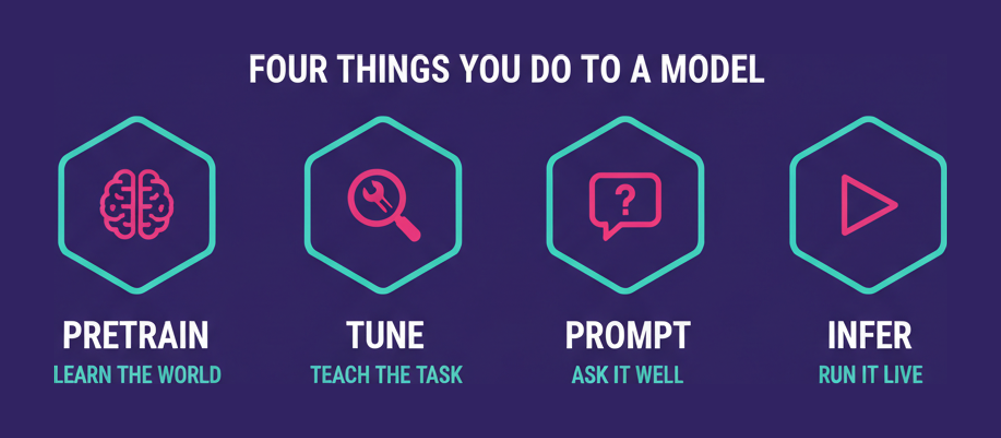
Where people lose marks is the vocabulary of adaptation rather than the architecture itself. Pretraining, fine-tuning, prompting and inference describe different activities at different costs, and an exam question that asks which one fits a described situation is really asking whether you know what each stage does to a model.
What does the development framework domain expect?
AI Development Framework is 20 percent of the paper and covers how models are actually built in code: computational graphs, tensors, the training loop and the libraries that provide them. Huawei’s own MindSpore framework features here, as you would expect from a vendor exam, alongside the general concepts that transfer to any framework.
The good news for anyone arriving from another ecosystem is that the concepts move across intact. A tensor is a tensor, automatic differentiation works the same way, and a training loop looks familiar whether it is written against the PyTorch project or against Huawei’s MindSpore. What you need is the ability to recognise the same idea under a different name.
AI Business Process Overview, at 15 percent, is the domain that surprises engineers. It covers how an AI project runs, from problem definition and data collection through model deployment and monitoring, and its questions are about sequence and responsibility rather than about code. It is also the easiest domain to gain marks in quickly, because the material is short and rarely revised.
HCIA-AI or HCIA-AI Solution?
Huawei runs two associate AI credentials, and they are not tiers of each other. HCIA-AI is H13-311 and HCIA-AI Solution is H13-313. Both are 60 questions in 90 minutes, both score 600 out of 1000, and both cost 200 USD, so the choice is entirely about content rather than about difficulty or commitment.
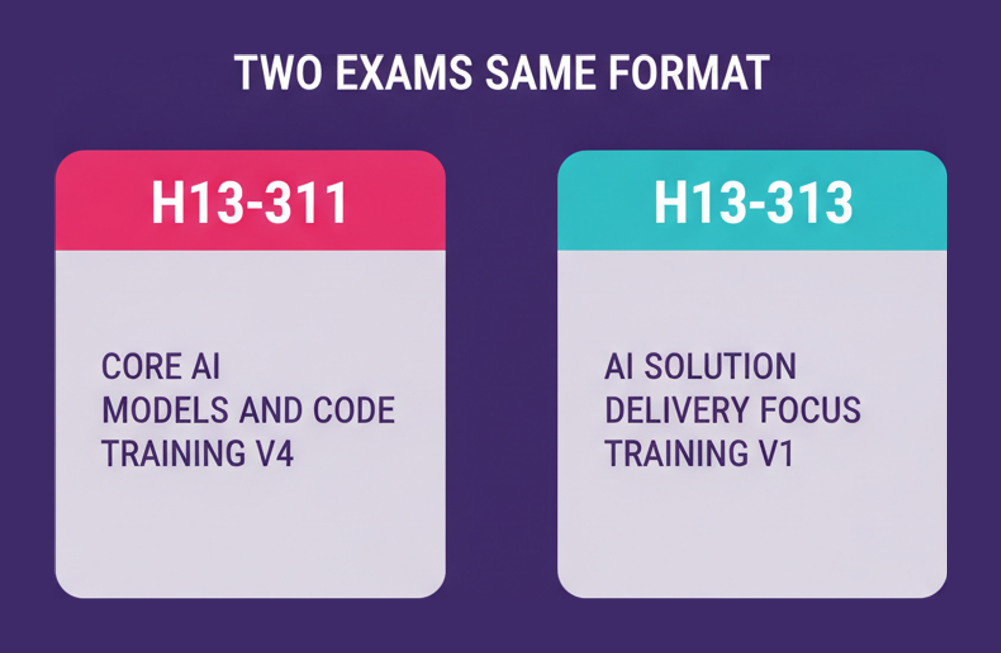
The split is roughly technology against application. H13-311 spends its weight on the models and the frameworks; H13-313 is keyed to its own separate training material and distributes its marks differently across a solution-focused blueprint. If your work is understanding how models are built, take the first. If it is positioning and delivering AI solutions, read the second blueprint before choosing.
Huawei’s wider scheme follows the same associate, professional and expert ladder used across its tracks, and the expert-level big data credential shows how much deeper the demands become higher up, which is useful context when deciding whether the associate tier is a destination or a starting point.
Who should take this exam?
HCIA-AI suits ICT professionals adding AI literacy, students and career changers who want a structured syllabus rather than a course list, pre-sales and solution staff who must discuss AI credibly, and engineers inside Huawei-aligned organisations where the certification carries internal weight. No prerequisite is published.
It is a weak fit for two groups. Practising machine learning engineers will find the depth well below their working level, and would be better served by a professional-tier paper. Anyone who needs a credential recognised primarily in North American hiring will find Huawei’s scheme carries more weight in other markets, which is a positioning question rather than a quality one.
If your interest is infrastructure rather than models, the same vendor’s other associate tracks may fit better, and the Huawei storage certification route covers a track where the day-to-day work looks nothing like an AI syllabus.
How should you prepare?
Study from V4.0 material, weight your time toward deep learning and frameworks, and treat the business process domain as free marks. Ninety minutes for 60 questions is comfortable, so the constraint is coverage rather than speed, and the commonest failure is a candidate strong on classical machine learning who never reached foundation models.
- Confirm your study material is V4.0 by checking whether it covers foundation models at all.
- Give the deep learning domain the largest share of your time, since it alone is 18 of the 60 questions.
- Learn the adaptation vocabulary deliberately: pretraining, fine-tuning, prompting and inference.
- Build one small model end to end in any framework, so the tensor and training-loop questions describe something you have actually done.
- Read the business process domain once and revise it twice. It is 15 percent of the paper for very little study effort.
- Sit a full timed set before booking, and use it to find which of the six domains you have skipped rather than to confirm the one you enjoy.
Do not over-invest in the cutting-edge applications domain. At 5 percent it is worth about three questions, and the material moves faster than any exam can track, so a general awareness of current applications is enough.
Frequently Asked Questions
How many questions are on the H13-311 exam?
Sixty questions in 90 minutes, which allows 90 seconds each.
What is the passing score for HCIA-AI?
Six hundred out of 1000. The scoring is scaled, so the number of correct answers that represents is not published.
How much does the HCIA-AI certification cost?
Two hundred US dollars, scheduled through Pearson VUE. Confirm the current fee at registration, since Huawei does not publish it in a form that can be checked independently.
Which version of the syllabus is current?
The blueprint is keyed to HCIA-AI V4.0 training material, and it includes foundation models and an overview of DeepSeek. Material that does not mention foundation models predates it.
Are there prerequisites for HCIA-AI?
None are published. It is an associate-tier credential and is designed as an entry point.
Which domain carries the most marks?
Basics of Deep Learning and Foundation Models at 30 percent, roughly 18 of the 60 questions.
What is the difference between HCIA-AI and HCIA-AI Solution?
They are separate exams, H13-311 and H13-313, with the same format and price but different blueprints. The first concentrates on models and frameworks, the second on solution delivery.
Does the exam require programming?
Not directly. The framework domain expects you to recognise tensors, computational graphs and training loops rather than to write code under exam conditions.
How long is the certification valid?
Huawei does not publish a validity period where it can be read, so this guide does not state one. Check your certification record after passing.
Is MindSpore knowledge essential?
It appears in the framework domain as the vendor’s own framework, but the concepts tested transfer across frameworks, so experience in another library is useful preparation rather than a handicap.
Conclusion
HCIA-AI is a current associate credential wearing a conventional name. Sixty questions, 90 minutes, 600 out of 1000 to pass, 200 USD, and a blueprint that puts nearly a third of its marks on deep learning and foundation models rather than on classical algorithms.
The version question decides most outcomes. Study V4.0 material, confirm it reaches foundation models, and give that domain the time its weighting deserves. The business process domain is the cheapest 15 percent on the paper, and cutting-edge applications is worth three questions and no more.
Treat the published figures as the catalogue’s rather than the vendor’s, because Huawei’s portal cannot be read from outside a browser, and confirm the fee and terms when you book. Then build one small model end to end, so the framework questions describe something your hands have already done.


