Every enterprise Linux certification covers the same ground: boot, packages, storage, networking, SELinux, logging. One of them also expects you to patch a running kernel without rebooting the machine, because the vendor behind it sells the technology that does it. That single topic is the clearest signal that this exam is not interchangeable with the others.
The Oracle Linux 8 system administrator certification is earned by passing 1Z0-106, a 90 minute multiple choice paper of 60 questions at a 60 percent pass mark, priced at 245 USD. Twenty one topic areas run from the boot process to the Linux auditing system, and Oracle publishes no weighting for any of them.
Table of Contents
- What makes this exam different from other Linux credentials?
- What are the 1Z0-106 exam facts?
- How do you plan for a syllabus with no weightings?
- What do the core administration topics cover?
- Why does Ksplice have its own topic area?
- How much security does the syllabus expect?
- Control groups and container services
- Who should take this exam?
- How should you prepare?
- Frequently Asked Questions
- Conclusion
What makes this exam different from other Linux credentials?
Two things: the syllabus includes Oracle Ksplice, which no other vendor’s Linux exam covers, and the format is multiple choice rather than performance based. Everything else on the topic list would be recognisable to anyone who has prepared for a general enterprise Linux credential.
That combination produces a specific kind of paper. A performance based exam proves you can complete tasks under time pressure on a live system. A multiple choice exam at this level proves something narrower and still useful: that you know which mechanism applies, what a configuration does, and where the system keeps the answer when something breaks.
The distinction matters when you are choosing between credentials rather than collecting them. If your estate runs Oracle Linux, this exam covers the distribution you actually administer, including the parts Oracle adds on top of the common base. If it does not, a vendor neutral credential will serve you better, and the performance based Red Hat route is the obvious comparison at a similar level.
What are the 1Z0-106 exam facts?
1Z0-106 runs 90 minutes with 60 multiple choice questions and a 60 percent pass mark, which is 36 correct answers. It costs 245 USD, though Oracle prices vary by country, and passing grants the Oracle Certified Professional, Oracle Linux 8 System Administrator credential.
| Field | Value |
|---|---|
| Exam | Oracle Linux 8 Advanced System Administration |
| Code | 1Z0-106 |
| Questions | 60 |
| Duration | 90 minutes |
| Passing score | 60 percent, so 36 of 60 |
| Format | Multiple choice |
| Price | 245 USD, varies by country |
| Credential earned | Oracle Certified Professional, Oracle Linux 8 System Administrator |
| Topic areas | 21, with no published weightings |
A word on where those figures come from. Oracle’s certification portal returns an error to anything but a browser, and its learning site serves an application shell with no readable specification inside it, so none of this can be checked against the vendor the way a CompTIA or Cisco figure can. These are the exam catalogue’s numbers, they are internally consistent, and you should confirm the price at registration since Oracle localises it.
For the same reason this guide states no validity period and no retake rule: Oracle publishes neither where it can be read. Ninety seconds per question is comfortable, so the practical constraint is breadth rather than speed, and a 1Z0-106 practice test is the quickest way to find which of the 21 areas you have never touched.
How do you plan for a syllabus with no weightings?
You plan by objective count and by how much of the working day each area occupies, because Oracle publishes no percentages for this exam. Twenty one areas across 60 questions averages under three questions each, which tells you immediately that depth in one favourite area cannot carry the paper.
That average is the most useful planning number available. It means no single area can be worth revising exhaustively, and it means an area you skip entirely costs you roughly three questions, or five percent of the mark, which is most of the margin between 60 percent and a fail.
The sensible approach is coverage first, depth second. Work the whole list once, mark every area where you could not explain the mechanism to a colleague, and spend your remaining time only on those. Candidates who fail this paper usually do so by knowing six areas extremely well and four not at all.
What do the core administration topics cover?
The first half of the syllabus is conventional enterprise Linux administration: the boot process and GRUB 2, kernel boot parameters, systemd, system configuration through /etc/sysconfig, the /proc and /sys filesystems, sysctl, time synchronisation with chrony, NTP and PTP, package management, task automation, users and groups, filesystems and swap, storage devices, networking and OpenSSH.
Two details in that list are worth pausing on, because they are where multiple choice questions tend to live. The first is the difference between a runtime kernel parameter set through sysctl and a boot parameter set in GRUB, which is a distinction the exam can test cleanly without a lab. The second is time: chrony, NTP and PTP are named separately, and the exam expects you to know which one a situation calls for rather than merely that time synchronisation exists.
The behaviour of systemd runs underneath much of this material. Units, targets, dependencies and the journal appear across the boot, service, logging and troubleshooting areas, so a candidate fluent in systemd picks up marks in four separate topic areas rather than one. The kernel side of the same material is documented at the kernel project, which is worth reading once for boot parameters if that ground is unfamiliar.
Why does Ksplice have its own topic area?
Because it solves a problem every other distribution answers with a reboot. Ksplice applies kernel and userspace patches to a running system, so a security fix can be applied without a maintenance window, and it is Oracle technology rather than part of the common Linux base.
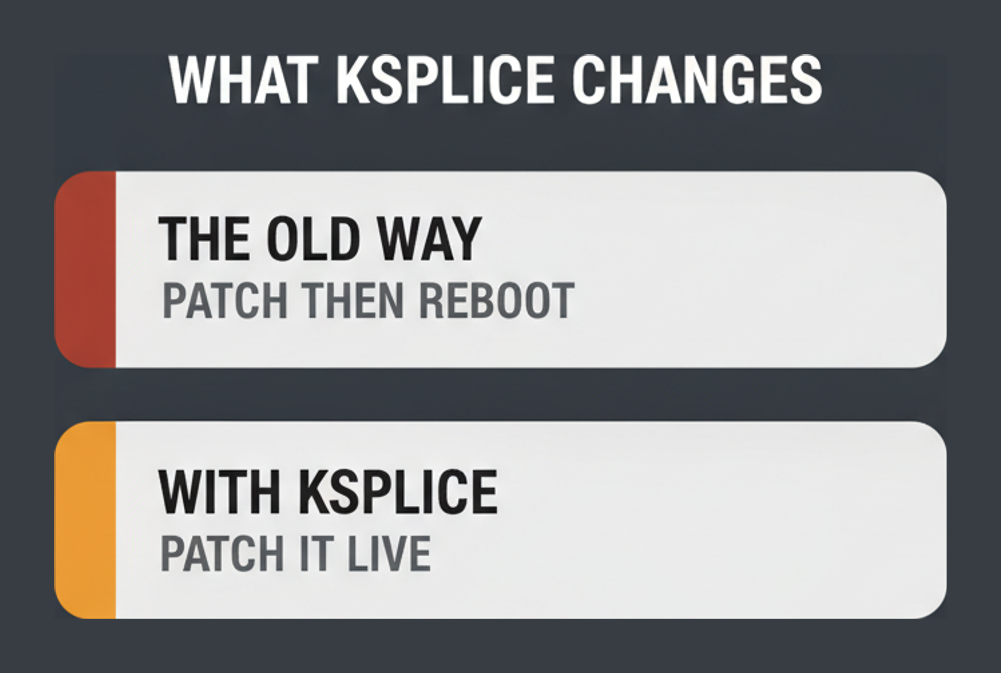
That is why it earns a topic area of its own on this syllabus and appears on no competing vendor’s Linux exam. If you administer Oracle Linux in an environment with uptime commitments, it is also the feature most likely to justify the certification to a manager, because the operational saving is concrete.
For the exam, the examinable ground is what Ksplice does, when it applies, how it is managed, and what its limits are. The vendor documents the service on the Ksplice site, and it is one of the few areas where a candidate cannot fall back on general Linux experience, because there is no general equivalent to fall back on.
How much security does the syllabus expect?
Three of the 21 areas are security mechanisms that administrators commonly work around rather than with: Security Enhanced Linux, pluggable authentication modules, and the Linux auditing system. Each gets its own heading, which is a fair signal of how the exam treats them.
SELinux is the one candidates most often under-prepare, because in practice many estates run it permissive and move on. The exam is not interested in that pragmatism. It expects the modes, contexts, booleans and the relationship between a denial and a policy, which is knowledge you can only fake for about two questions. The project’s own material at the SELinux project repository is the authoritative reference.
PAM rewards a different habit. It is a stack, and almost every PAM question is really about order and control flags, so drawing one real stack out and tracing a login through it converts the whole area from memorisation into something you can reason about. The audit system rounds the group off: what it records, where it writes, and how to ask it a question after the fact.
Control groups and container services
Control groups and container services appear as two separate areas late in the syllabus, and together they are the part of the list that dates the exam most clearly to a modern estate. Cgroups govern how resources are allocated and capped; container services cover running containers on the host rather than orchestrating them across a cluster.
Keep the scope in mind while revising. This is host level container administration, not orchestration: nothing here is asking about clusters, schedulers or service meshes. The examinable material is what the host provides, how a container consumes it, and how cgroups bound that consumption.
Advanced storage administration and file sharing sit alongside them and follow the same pattern. The topics are broad, the depth is moderate, and the questions reward someone who has configured the thing once rather than someone who has read about it twice.
Who should take this exam?
It suits administrators running Oracle Linux in production, engineers supporting Oracle Database or Exadata estates where the operating system is part of the stack they own, and sysadmins whose employer is an Oracle shop and wants a credential that matches. Oracle publishes no prerequisite, though the word advanced in the title is accurate.
It is a weak fit for two groups. Anyone whose estate is Red Hat, Ubuntu or SUSE gains little from a distribution specific paper, especially one covering a feature they do not run. And anyone who wants to prove practical ability under exam conditions will find a multiple choice format less persuasive to a technical interviewer than a performance based one.
There is one more group worth naming: candidates who already hold an Oracle credential on the database side and want the operating system underneath it. That is a coherent pairing, and the Oracle Database SQL route covers the other half of the same estate.
How should you prepare?
Cover all 21 areas before deepening any of them, get hands on an Oracle Linux 8 system, and treat Ksplice and SELinux as the two areas where general Linux experience will not carry you. With roughly three questions per area, the exam punishes gaps far more than it rewards specialism.
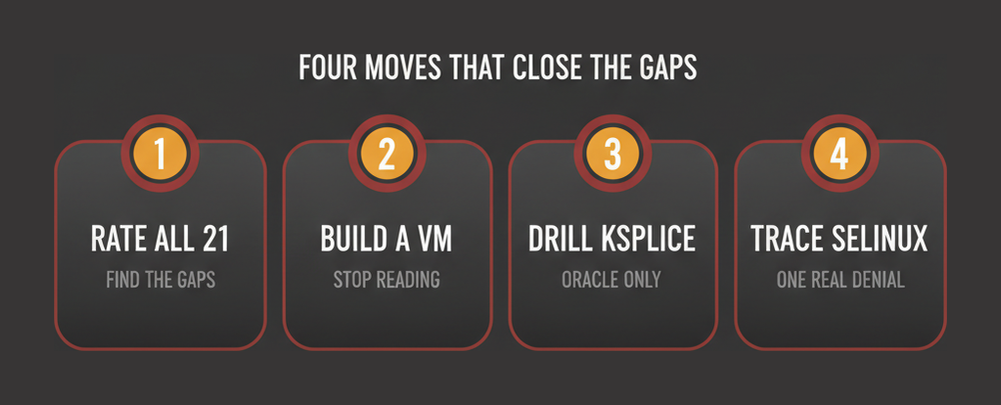
- List the 21 topic areas and rate your confidence in each one honestly. The list itself is the study plan.
- Build an Oracle Linux 8 virtual machine and work through the areas you rated lowest, in order.
- Spend a dedicated session on Ksplice, which is the one area with no equivalent elsewhere.
- Trace one real PAM stack and one real SELinux denial end to end, rather than reading about either.
- Practise distinguishing the mechanisms that look alike: sysctl against boot parameters, chrony against NTP and PTP, cgroups against container limits.
- Sit a full timed set and use the result to find the areas you skipped rather than to confirm the ones you enjoy.
An earlier walkthrough of this same paper is still useful on tactics rather than content, and that 1Z0-106 preparation guide predates the current catalogue figures, so read it for method and take the numbers from here.
One practical note on the format: because the paper is multiple choice, elimination is a legitimate technique in a way it never is on a performance based exam. Knowing that two of four answers are impossible is worth a mark, and at a 60 percent threshold those marks decide results.
Frequently Asked Questions
How many questions are on the 1Z0-106 exam?
Sixty multiple choice questions in 90 minutes, which is about 90 seconds each.
What is the passing score for 1Z0-106?
Sixty percent, which works out at 36 correct answers from 60.
How much does the exam cost?
Two hundred and forty five US dollars, and Oracle varies pricing by country, so confirm the local figure when you book.
What credential does passing it earn?
Oracle Certified Professional, Oracle Linux 8 System Administrator.
Are the topic areas weighted?
No. Oracle publishes no weightings for this exam, so plan by objective rather than by percentage. Twenty one areas across 60 questions averages just under three questions each.
Is the exam hands on?
No. It is multiple choice, which is the main format difference between this credential and the performance based Red Hat route at a similar level.
What is Ksplice and why is it on the syllabus?
Ksplice applies kernel patches to a running system without a reboot. It is Oracle technology, it has its own topic area, and no competing vendor’s Linux exam covers it.
Are there prerequisites?
None are published, although the syllabus assumes real administration experience rather than first exposure to Linux.
How long is the certification valid?
Oracle does not publish a validity period where it can be read, so this guide does not state one. Check your certification record after passing.
Does it cover Oracle Linux 9?
No. The release is named in the exam title, and this paper covers Oracle Linux 8.
Conclusion
1Z0-106 is a breadth exam for people who run Oracle Linux specifically. Sixty multiple choice questions, 90 minutes, 60 percent to pass, 245 USD, and 21 topic areas that Oracle declines to weight.
Plan for coverage rather than depth, because under three questions per area means a skipped topic costs about as much as the margin you have to spare. Give Ksplice and SELinux their own sessions, since neither yields to general Linux experience, and build the virtual machine rather than reading about the commands.
Treat the published figures as the catalogue’s rather than the vendor’s, because Oracle’s own pages cannot be read from outside a browser, and confirm the price when you book. Then work the topic list in order of your own weakness, which is the only prioritisation this syllabus offers.


