Most Scrum Masters who book PSM-AI Essentials revise the wrong thing. They expect Scrum.org’s Professional Scrum Master AI Essentials assessment to quiz them on neural networks, model training and the vocabulary of machine learning, so they spend their evenings on how the technology works.
Only one of the four syllabus topics is AI theory. The other three ask whether you can use a generative AI tool inside a Scrum Team without leaking data, trusting a confident wrong answer, or quietly taking a decision away from the people who own it. That is a judgement test, and at an 85 percent pass mark on 40 questions, you can afford only six mistakes.
Table of Contents
- What does the PSM-AI Essentials exam look like on the day?
- Which four topics does the syllabus name?
- Why is most of the paper about judgement?
- What does AI Security and Ethics expect you to know?
- How is effective prompting tested?
- PSM-AI Essentials, PSM I or PSPO-AI Essentials?
- How should you prepare for PSM-AI Essentials?
- Frequently Asked Questions
- Conclusion
What does the PSM-AI Essentials exam look like on the day?
The PSM-AI Essentials exam is 40 multiple choice questions in 60 minutes, with an 85 percent passing score and a fee of 200 USD. The syllabus lists four topics and publishes no weightings for any of them, so you cannot plan by percentage. You plan by topic, and you plan for a very small error budget.
| Field | Value |
|---|---|
| Exam name | Scrum.org Professional Scrum Master AI Essentials |
| Exam code | PSM-AI Essentials (also written PSM-AIE) |
| Questions | 40 |
| Duration | 60 minutes |
| Passing score | 85 percent |
| Fee | 200 USD |
| Format | Multiple choice |
| Topics | 4, with no published weightings |
Two numbers in that table matter more than the rest. First, 85 percent of 40 is 34, so the whole attempt tolerates six wrong answers. Second, 60 minutes for 40 questions gives you 90 seconds each, which is generous. Time is rarely what beats a candidate here. Accuracy is.
That combination changes how you should use the clock. With 90 seconds per question you can read every option twice, and you should, because the wrong answers on this paper tend to sound reasonable. A careless pick costs you a sixth of your allowance.
Which four topics does the syllabus name?
The PSM-AI Essentials syllabus names four topics: AI Theory and Primer, AI Security and Ethics, AI for Scrum Masters, and Effective AI Prompting. None is weighted. Only the first is about how AI works; the other three are about how a Scrum Master uses it responsibly with a team.
AI Theory and Primer
This is the foundation layer: what generative AI is, what a large language model does with a prompt, and why its output is a prediction rather than a looked-up fact. You need enough to explain the tool to a team, not enough to build one.
AI Security and Ethics
Data handling, privacy, bias and transparency. This topic asks what can go wrong when a team starts pasting work into an AI tool, and what a Scrum Master should do before it does.
AI for Scrum Masters
The accountability topic. It covers where AI can genuinely help a Scrum Master, such as summarising retrospective input or drafting options, and where using it would undermine self-management or transparency.
Effective AI Prompting
Writing prompts that return something useful. It is also the only topic on the Scrum Master paper with no counterpart on the Product Owner equivalent, which makes it the clearest difference between the two AI Essentials exams.
The fastest way to see how these topics turn into questions is to work a set of PSM-AI Essentials sample questions before you study anything else. Almost every item is a short scenario with a Scrum Master in it, followed by four plausible responses.
Why is most of the paper about judgement?
Because the credential is about the Scrum Master accountability, not about AI engineering. Published sample questions for PSM-AI Essentials almost all describe a Scrum Master facing a choice with an AI tool, and the correct answer is usually the one that keeps people in charge of decisions, data and quality.
That framing is older than any AI tool. The first value of the Agile Manifesto, written in 2001, is individuals and interactions over processes and tools. An AI assistant is a tool, and the exam keeps asking whether you remember that.
The patterns repeat across the sample items:
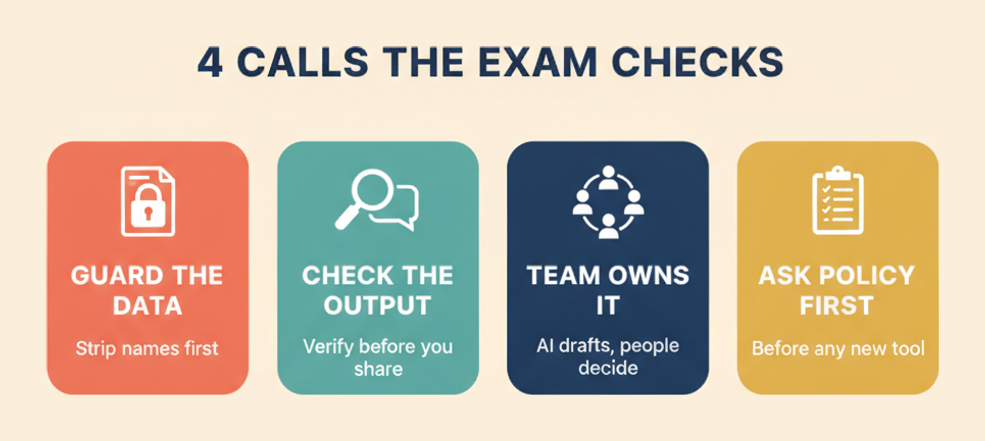
- Anything typed into a public AI tool may be stored, logged or reused, so treat it as shared.
- Personal identifiers should be stripped or pseudonymised before data leaves the team.
- A generative model can produce output that is plausible and wrong, so someone must check it.
- AI may draft a Definition of Done, but the Developers agree on it and own it.
- A new tool gets checked against the organisation’s acceptable use and data policies first.
Each of those answers protects something the Scrum Guide already assigns to a person. Self-management belongs to the team, the Definition of Done belongs to the Developers, and transparency belongs to everyone. The Scrum Master’s job is to keep it that way while the tools change.
“The Scrum Master is accountable for the Scrum Team’s effectiveness. They do this by enabling the Scrum Team to improve its practices, within the Scrum framework.”
Read the wrong options in any sample item and you will see the same shortcut offered again and again: let the tool decide, adopt its output as-is, or skip the team. Spotting that shortcut is most of the skill.
What does AI Security and Ethics expect you to know?
AI Security and Ethics expects a PSM-AI Essentials candidate to recognise the everyday risks of using generative AI at work: sensitive data leaving the organisation, output that is confidently wrong, recommendations nobody can explain, and tools adopted without checking policy. It is practical awareness, not security engineering.
The risks worth naming
The security community has already catalogued these. The OWASP LLM Top 10 for 2025 lists prompt injection first, sensitive information disclosure second and misinformation ninth. You will not be asked to defend against prompt injection in code, but you should recognise why confidential sprint data should not go into a public chatbot, and why a polished answer still needs checking.
Ethics is mostly transparency
One sample item asks what concern arises when an AI tool ranks backlog risks and gives no reasoning. The answer is transparency and explainability. In Scrum terms, a decision nobody can inspect cannot be adapted, so an unexplained AI recommendation is a transparency problem before it is anything else.
Frameworks behind the topic
For organisational context, the NIST AI framework is a useful reference. It was released on 26 January 2023 for voluntary use, and NIST added a Generative AI Profile, NIST AI 600-1, on 26 July 2024. You do not need to memorise it; it simply shows that the risks this topic names are the same ones organisations are formally managing.
How is effective prompting tested?
Effective prompting in PSM-AI Essentials is tested through short before-and-after scenarios. A vague prompt returns a generic answer, and you choose the revision that fixes it. The winning revision nearly always adds context, a clear goal, a specific task or an explicit output format, never a louder request or a bigger model.
The sample items make the principle concrete. “Give me some retrospective ideas” is too vague to help. “Help with the team” is worse. The better option in each case states the situation and names the task, such as asking for three ways to help a team surface impediments in the Daily Scrum.
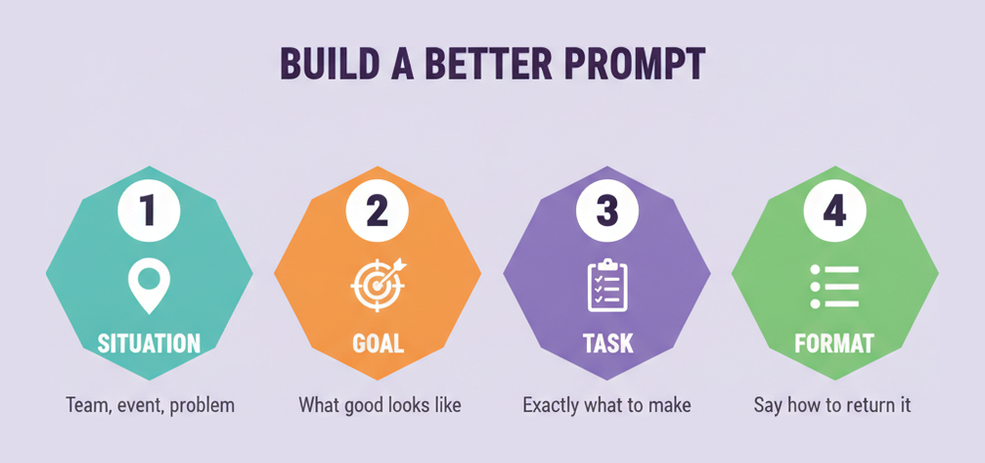
A useful prompt for this exam has four parts, and each one fixes a different failure:
- Situation, so the tool knows the team, the event and the problem.
- Goal, so it knows what a good result would achieve.
- Task, so it knows exactly what to produce and how much of it.
- Format, so the answer arrives as five bullet points rather than dense prose.
Watch for the distractors. Answers that repeat the same prompt until something better appears, ask for the longest possible response, or simply demand a better model are the traps. None of them clarifies the task, which is the only thing that reliably improves the output.
PSM-AI Essentials, PSM I or PSPO-AI Essentials?
PSM-AI Essentials, PSM I and PSPO-AI Essentials share the same 200 USD fee, the same 60 minutes and the same 85 percent bar. They differ in length and focus: PSM I tests the Scrum framework across 80 questions, while the two AI Essentials exams each have 40 questions on applying AI within one accountability.
| Exam | Questions | Time per question | Topics | Focus |
|---|---|---|---|---|
| PSM I | 80 | 45 seconds | Scrum framework, people and teams, managing products | How Scrum works |
| PSM-AI Essentials | 40 | 90 seconds | AI Theory and Primer, AI Security and Ethics, AI for Scrum Masters, Effective AI Prompting | AI in the Scrum Master accountability |
| PSPO-AI Essentials | 40 | 90 seconds | AI Theory and Primer, AI Security and Ethics, AI Product Ownership | AI in the Product Owner accountability |
The practical difference is pace. PSM I gives you 45 seconds a question, so it rewards fast recall of the Scrum Guide. PSM-AI Essentials doubles that time and spends it on scenarios where two answers look sensible, so it rewards careful reading.
If you are choosing between the two AI Essentials exams, pick by accountability. The Scrum Master version is the only one with a prompting topic, while the Product Owner version replaces it with product ownership. A Scrum Master who still wants to strengthen the framework basics first can start with this site’s guide to PSM I preparation, since the AI questions assume you already know who owns what in Scrum.
How should you prepare for PSM-AI Essentials?
Prepare for PSM-AI Essentials by using AI tools on real Scrum Master work and checking every result, not by studying machine learning. Refresh the Scrum Guide accountabilities, practise rewriting weak prompts, learn the common data and accuracy risks, then work scenario questions until the tempting shortcut answers stop tempting you.
- Reread the Scrum Guide sections on accountabilities, the Definition of Done and transparency, because most correct answers defend one of them.
- Spend one short session on AI theory so you can explain why a model can sound certain and still be wrong.
- Use an approved AI tool on a real task, such as grouping retrospective notes into themes, and check the output yourself before sharing it.
- Rewrite three vague prompts from your own work by adding situation, goal, task and format, and compare the answers.
- Read your organisation’s acceptable use and data policies so the policy questions feel familiar.
- Work scenario questions and, for every miss, name the shortcut the wrong answer offered.
The prompting and retrospective work overlaps heavily with facilitation. If that is a weak area, the site’s PSF Skills guide covers the facilitation side of the Scrum Master role in more depth.
Book the attempt when you are consistently above 34 out of 40 in practice, not when you first scrape past it. With only six misses allowed, a comfortable margin matters more than speed.
Frequently Asked Questions
How many questions are on the PSM-AI Essentials exam?
Forty multiple choice questions in 60 minutes, which works out at 90 seconds per question.
What is the passing score for PSM-AI Essentials?
Eighty five percent. On 40 questions that means 34 correct answers, so you can miss six.
How much does PSM-AI Essentials cost?
The listed fee is 200 USD, the same as PSM I and PSPO-AI Essentials.
What are the four PSM-AI Essentials topics?
AI Theory and Primer, AI Security and Ethics, AI for Scrum Masters, and Effective AI Prompting. No weightings are published for any of them.
Is PSM-AI Essentials a technical AI exam?
No. Only one topic covers AI theory. The rest test how a Scrum Master uses AI tools with a team while protecting data, quality and ownership.
Do I need PSM I before PSM-AI Essentials?
The syllabus page lists no prerequisite. Check the current rules on Scrum.org before booking, and note that the questions assume you already know Scrum accountabilities well.
How is PSM-AI Essentials different from PSPO-AI Essentials?
Both have 40 questions, 60 minutes and an 85 percent pass mark. The Scrum Master exam includes Effective AI Prompting, while the Product Owner exam has an AI Product Ownership topic instead.
Does PSM-AI Essentials expire?
The syllabus page publishes no validity period or renewal rule, so confirm it on Scrum.org rather than relying on second-hand claims.
What is the best way to practise for PSM-AI Essentials?
Use AI on real Scrum Master tasks, check every output, practise rewriting vague prompts, and work scenario questions until you can name why each wrong option is wrong.
Conclusion
PSM-AI Essentials is 40 questions in 60 minutes at an 85 percent pass mark, and the pass mark is the real difficulty. Six misses is not much room on a paper built from reasonable-sounding options.
The candidates who struggle are usually the ones who prepared for a technology exam. The syllabus spends one topic on how AI works and three on how a Scrum Master uses it: keeping data safe, checking output, protecting team ownership and writing prompts that ask for something specific.
Prepare in that proportion. Use the tools on real work, verify what they give you, and practise on scenarios until the shortcut answers stand out. When your practice scores sit comfortably above 34, you are ready to book.


