
It is easy to read Agentic Automation Professional as the Associate exam with the difficulty turned up. The syllabus for UiAAP, the UiPath Certified Professional Agentic Automation Professional exam, says otherwise.
Building an agent and writing its prompt are the smaller part of the paper. Of the 84 objectives UiPath lists across 14 topics, 30 sit in just two: agentic evaluations and orchestration with UiPath Maestro. Five topics do not appear at Associate level at all, including agent management, the AI Trust Layer and coded agents. Put plainly, the agentic automation professional certification asks whether you can prove an agent works, place it inside a governed process, and keep it under control once it runs.
This article sets out the exam facts, shows exactly where the Professional tier departs from the Associate, and explains the five new topics. It also covers the question many candidates now ask, which is where the newer Builder Professional credential fits, and it ends with a preparation sequence built around the official resources.
Table of Contents
- What are the UiAAP exam facts?
- How is the Professional tier different from the Associate?
- Which topics are new at Professional level?
- Why do evaluations and Maestro carry so many objectives?
- Where does the Builder Professional certification fit?
- How should you prepare for UiAAP?
- Frequently Asked Questions
- Conclusion
What are the UiAAP exam facts?
The UiAAP exam has 60 questions in 120 minutes, a 70 percent passing score and a fee of 300 USD. Pearson VUE delivers it at a test centre or online with a proctor. UiPath registers it under the exam number UiPath-AAPv1, and the credential stays valid for 3 years from the date you earn it.
| Field | Value |
|---|---|
| Credential | UiPath Certified Professional Agentic Automation Professional |
| Exam code | UiAAP (listed by UiPath and Pearson VUE as UiPath-AAPv1) |
| Certification track | Agentic Automation |
| Questions | 60 |
| Duration | 120 minutes |
| Passing score | 70 percent |
| Fee | 300 USD |
| Format | Multiple choice, plus drag and drop or sequencing items |
| Delivery | Pearson VUE, test centre or online proctored |
| Languages | English and Japanese |
| Product version | UiPath 2025.10 and later |
| Validity | 3 years |
| Topics | 14, with no published weightings |
Two pieces of arithmetic follow from those figures. First, 70 percent of 60 is 42, so you can miss 18 questions and still pass. Second, 120 minutes across 60 questions gives you 2 minutes each. That is a comfortable pace for a recall question and a tight one for a scenario that asks you to read a process, a prompt and an evaluation result before you answer.
The format line matters as well. Sequencing items ask you to put steps in the right order, which rewards people who have actually configured an index or an escalation. Reading about the steps is rarely enough to order them correctly.
UiPath does not weight the 14 topics, so you cannot plan by percentage. The only reliable guide to depth is the objective list itself, which UiPath publishes in the official exam description. The rest of this article uses that list, because it is where the two tiers visibly separate.
How is the Professional tier different from the Associate?
UiAAP doubles the Associate fee, adds 30 minutes, and keeps the same 60 questions and 70 percent pass mark. The larger change is scope. The Associate syllabus lists 32 objectives across 10 topics, while the Professional syllabus lists 84 across 14, and UiPath aims it at the people who deliver agentic solutions.
| Field | Associate (UiAAA) | Professional (UiAAP) |
|---|---|---|
| UiPath exam number | UiPath-AAAv1 | UiPath-AAPv1 |
| Fee | 150 USD | 300 USD |
| Duration | 90 minutes | 120 minutes |
| Questions | 60 | 60 |
| Time per question | 90 seconds | 2 minutes |
| Passing score | 70 percent | 70 percent |
| Topics | 10 | 14 |
| Objectives listed | 32 | 84 |
| Validity | 3 years | 3 years |
Same topics, different verbs
Nine topic names carry over from one tier to the next, which is why the two exams look alike at first glance. The objectives under them do not. Associate objectives mostly ask you to define, describe and differentiate. Professional objectives ask you to configure, implement, monitor and troubleshoot. Context Grounding shows the shift clearly: 2 objectives at Associate level, 8 at Professional, including index update strategy and threshold tuning.
A narrower audience
UiPath describes the Associate as suited to both technical and non-technical roles, from business analysts to project managers. The Professional exam names four groups only: automation developers, solution architects, technical leads, and Center of Excellence members who deliver agentic automation. The candidate UiPath has in mind can design, build, orchestrate and govern a solution independently.
Do you need the Associate first?
The Associate exam description states that it has no prerequisite. The Professional exam description names no prerequisite exam either. Even so, the Professional syllabus assumes everything the Associate teaches, so most candidates will want that ground covered before they book.
The quickest way to feel the difference is to read a set of UiAAP sample questions next to the syllabus. They ask how to find the root cause of a failed evaluation, what a low trajectory score means when the final answer looks fine, and what an inclusive gateway does in a Maestro flow. None of those can be answered from a definition.
Which topics are new at Professional level?
Five topics appear on the UiAAP syllabus that the Associate syllabus does not list: Agent management, AI Trust Layer, Coded Agents, Conversational Agents and UI Agent. Together they hold 13 objectives. They move the exam past building a single agent and into governing, monitoring and extending agents across a whole tenant.
Agent management
This is the largest of the five, with 7 objectives. You apply governance policies that enable, disable or control agent functionality, and you assign them at tenant, group or user level. You also use agent scores to track performance, analyse trace data, and monitor usage, unit consumption and incidents. Simulations of agent tools and Context Grounding sit here too.
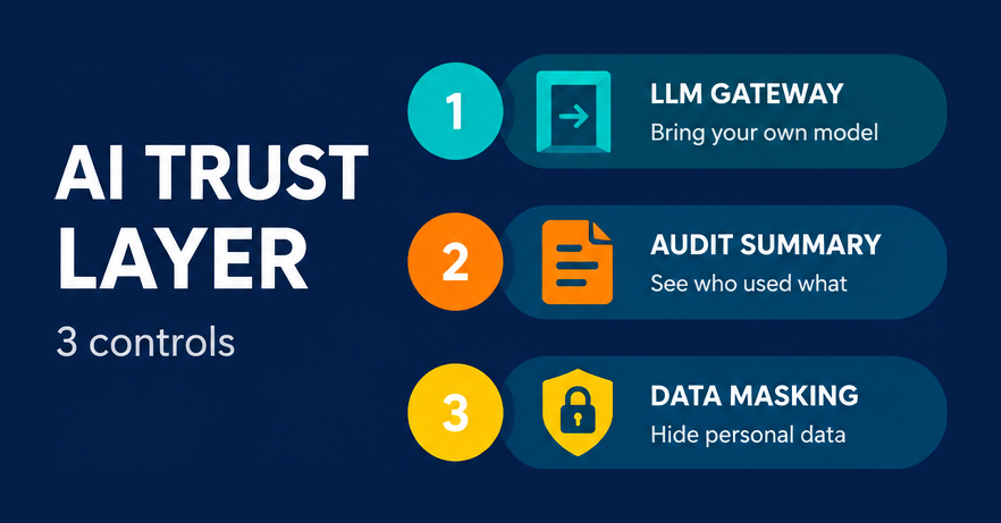
AI Trust Layer
Three objectives cover the controls that sit between an agent and a language model:
- Bringing your own model through the LLM gateway
- Using the audit and usage summary
- Masking personal data in flight before it reaches a model
Coded, conversational and UI agents
Each of these three topics has a single objective, and the syllabus gives no more detail than the name. Coded Agents covers agents written in code. Conversational Agents covers chat based agents. UI Agent refers to ScreenPlay. With so little published, the UiPath Agents documentation is the safest place to learn what each one does.
New objectives inside familiar topics
Some of the sharpest additions hide under topic names you already know. UiPath Platform components and integrations grows from 4 objectives to 11. The new ones include building API workflows as reusable agent tools, exposing existing agents for reuse inside new agents, using agent tool guardrails, and integrating MCP assets as tools. MCP is an open standard for connecting models to tools and data, and the Model Context Protocol specification explains the client and server roles behind it.
Why do evaluations and Maestro carry so many objectives?
Agentic evaluations and agentic orchestration with UiPath Maestro hold 14 and 16 objectives on the UiAAP syllabus, 30 of 84 in total. UiPath publishes no topic weightings, so these counts show breadth of content and not a share of questions. Even so, no other pair of topics asks you to know as much.
| Topic | Associate objectives | Professional objectives |
|---|---|---|
| Agentic AI and agentic automation concepts | 6 | 3 |
| Agentic discovery and blueprint design | 8, split over two topics | 8 |
| Context Grounding | 2 | 8 |
| Escalations | 2 | 3 |
| Agentic evaluations | 2 | 14 |
| Agent management | Not listed | 7 |
| Prompt engineering | 4 | 6 |
| UiPath Platform components and integrations | 4 | 11 |
| Agentic orchestration with UiPath Maestro | 3 | 16 |
| AI Trust Layer | Not listed | 3 |
| Autopilot for everyone | 1 | 2 |
| Coded Agents | Not listed | 1 |
| Conversational Agents | Not listed | 1 |
| UI Agent | Not listed | 1 |
Notice the first row. The concepts topic shrinks from 6 objectives to 3, because the Professional exam stops asking what machine learning and large language models are. It assumes you know.
What the evaluation objectives cover
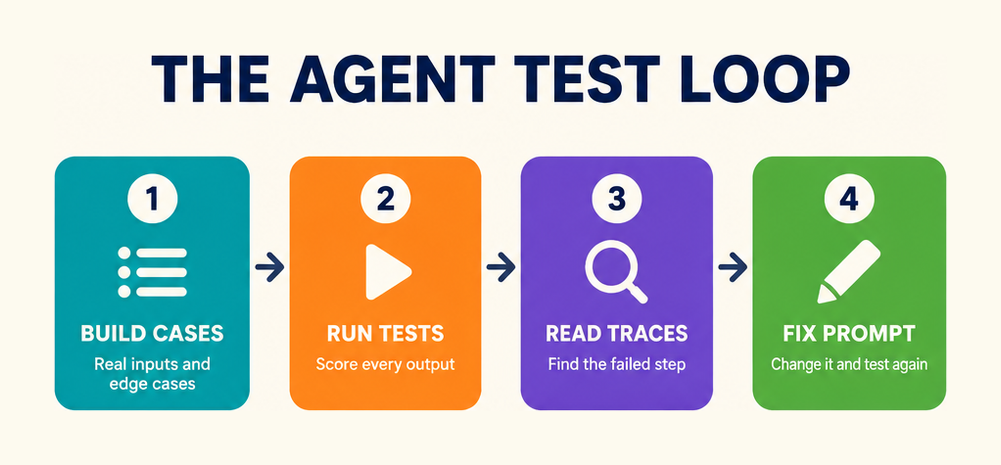
At Associate level you define evaluations and tell deterministic ones from model graded ones. At Professional level you run the whole cycle. You design datasets that reflect real complexity, write input and output pairs, add edge cases and failure scenarios, and choose between strict and flexible assertions. Then you execute the set, interpret the scores, read execution traces for the failures, and improve the prompt.
UiPath has been open about why this matters to it.
“We are targeting 95%+ agent accuracy with every launch.”
Developers share the concern behind that target. In the Stack Overflow Developer Survey for 2025, 87 percent of respondents agreed that they are concerned about the accuracy of information from AI agents, and 81 percent agreed that they have security and privacy concerns. Evaluations, guardrails and escalations are the practical answer, which explains their place on the syllabus.
What the Maestro objectives cover
The Associate touches Maestro in 3 objectives: model a process in BPMN and configure service tasks. The Professional list runs to 16. It adds send and receive tasks for connectors and webhooks, global, local and task level variables, and input and output mapping between tasks and agents. It also covers chaining several agents in one process, asynchronous completion events, user tasks with assignees, SLAs and expiry rules, control flow, and instance management.
Where does the Builder Professional certification fit?
Agentic Automation Builder Professional is a separate UiPath credential that launched on 22 September 2026 under the exam number UiPath-AABPv1. It sits in the same Agentic Automation track as UiAAP, runs 120 minutes with a 70 percent pass mark, and costs 150 USD. UiPath has published no statement that it replaces Agentic Automation Professional.
| Field | Agentic Automation Professional | Builder Professional |
|---|---|---|
| UiPath exam number | UiPath-AAPv1 | UiPath-AABPv1 |
| Available since | 1 April 2026 | 22 September 2026 |
| Fee | 300 USD | 150 USD |
| Duration | 120 minutes | 120 minutes |
| Passing score | 70 percent | 70 percent |
| Validity | 3 years | 3 years |
| Structure | 14 topics | 7 numbered domains |
| Product version | 2025.10 and later | Latest versions |
What Builder Professional adds
The Builder exam reaches into areas UiAAP does not name. It has a full domain on deterministic automation, which covers variables, control flow, UI automation and exception handling. It has another on UiPath for Coding Agents. Its agent domain includes building Python agents, and its orchestration domain includes case management. UiPath also states an experience level for it: at least 6 months of building automations on the platform.
That deterministic domain overlaps with the developer track. If classic workflow skills are your weak point, this site’s UiADP preparation guide covers the same foundations in more depth.
What UiAAP keeps to itself
UiAAP stays closer to the agent itself. Its objectives go deeper on Context Grounding indexes, on evaluation datasets and assertions, and on the detail of Maestro tasks. Both credentials are currently listed side by side on the UiPath Academy certification page. Because the Builder exam is so new, check that listing on the day you book. If UiPath changes the status of either exam, that page is where it will show first.
How should you prepare for UiAAP?
Prepare for UiAAP by working outward from the official exam description. UiPath names three resources: the Agentic Automation Training learning plan on UiPath Academy, the product documentation, and a free practice test. Candidates on the UiPath forum report that the learning plan covers Associate level material, so the documentation has to fill the gap.
- Download the exam description, and mark every objective you cannot already carry out in a tenant.
- Complete the Agentic Automation Training learning plan, and treat it as the base layer.
- Read the product documentation for the five topics the Associate syllabus does not list.
- Build one agent in Studio Web with a tool, a Context Grounding index and an escalation.
- Write an evaluation set for that agent, run it, and trace every failure back to its cause.
- Model a small Maestro process that calls the agent, routes a user task to a person, and returns the data.
- Take the free practice test, and review each missed question against the objective it came from.
Steps 4 to 6 are where the exam is won. Sequencing questions and scenario questions both reward people who have watched an evaluation fail and worked out why. One forum member who passed in the first week after launch described a shorter version of the same order: the Associate training, then the exam description, then the practice test.
Booking and retakes
You schedule through the Pearson VUE UiPath page, and you choose between a test centre and an online appointment. If you fail the first attempt, UiPath asks you to wait two weeks before the second. After that, the wait is one month between attempts, and each attempt carries the full fee.
If you are still deciding which UiPath credential suits your role, the overview of UiPath certification paths on this site sets the agentic exams beside the developer, analyst and architect tracks.
Frequently Asked Questions
How many questions are on the UiAAP exam?
The UiAAP exam has 60 questions to answer in 120 minutes, which works out at 2 minutes per question. The format is multiple choice with drag and drop or sequencing items.
What is the passing score for UiAAP?
The passing score is 70 percent. On 60 questions that means 42 correct answers, so you can miss 18 and still pass.
How much does the Agentic Automation Professional exam cost?
The exam fee is 300 USD, which is double the 150 USD fee for the Agentic Automation Associate exam. Each retake carries the full fee again.
Is UiAAP the same exam as UiPath-AAPv1?
Yes. UiAAP is the short code used for the credential, while UiPath and Pearson VUE list the exam as UiPath-AAPv1, the UiPath Agentic Automation Professional Exam. Look for that number when you book.
Do I need the Associate certification before UiAAP?
The Professional exam description names no prerequisite exam. The syllabus does assume Associate level knowledge, so covering that material first is sensible even though UiPath does not list it as a requirement.
Which topics are new in the Professional exam?
Five topics are not on the Associate syllabus: Agent management, AI Trust Layer, Coded Agents, Conversational Agents and UI Agent. Together they list 13 objectives.
How long is the UiAAP certification valid?
The credential is valid for 3 years from the date you earn it. UiPath expects certified professionals to recertify every three years to keep pace with platform changes.
In which languages can I take the UiAAP exam?
UiPath offers the Agentic Automation Professional exam in English and in Japanese. You can sit it at a Pearson VUE test centre or online with a proctor.
Has Builder Professional replaced Agentic Automation Professional?
UiPath has published no statement saying so. Builder Professional launched on 22 September 2026 as a separate credential in the same track, and both are listed on the UiPath Academy certification page. Check that page before you book.
Conclusion
UiAAP is 60 questions in 120 minutes at a 70 percent pass mark, for a fee of 300 USD. Those numbers look close to the Associate exam, and that closeness is what misleads people.
The real distance is in the objective list: 84 against 32, five topics the Associate never mentions, and 30 objectives on evaluations and Maestro alone. The exam is about proving, orchestrating and governing agents, with building them as the starting point.
So prepare in that order. Build one agent, test it until you understand its failures, and place it in a Maestro process with a person in the loop. Then check which agentic credentials UiPath lists on the day you book, and choose the one that matches the work you do.


