CSSA, PCSSA and CPSSA are three abbreviations for one credential. Search data shows people still typing the oldest of them far more often than the current one, which means many candidates start their research on pages describing an exam Pega withdrew years ago. The Pega Senior System Architect exam you can book today is PEGACPSSA25V1: 60 questions, 90 minutes, a 70 percent pass mark, and a topic list that no longer contains mobile or reporting at all.
This article sorts out the names first, then sets out the current exam facts, where the credential sits between System Architect and Lead System Architect, what each of the six topics asks for, what changed since the version 8 exam, which of the three live versions to sit, and a preparation order weighted to the 30 percent topic.
Table of Contents
- Is it CSSA, PCSSA or CPSSA?
- What does the PEGACPSSA25V1 exam look like?
- Where does Senior System Architect sit in the Pega certification path?
- Which six topics does the Pega Senior System Architect exam cover?
- What changed since the version 8 exam?
- Which version should you sit: ’23, ’24 or ’25?
- How should you prepare for the CPSSA exam?
- Frequently Asked Questions
- Conclusion
Is it CSSA, PCSSA or CPSSA?
The current name is Certified Pega Senior System Architect, abbreviated CPSSA, and the current exam code is PEGACPSSA25V1. PCSSA is the abbreviation Pega used on its version 8 exam, which it lists as retired on April 30, 2021. CSSA is the older short form that candidates still search for, and it leads to the same credential.
The word order is the easiest way to date a page. Pega’s version 8 exam page reads Pega Certified Senior System Architect, hence PCSSA. Its current pages put Certified first: Certified Pega Senior System Architect, hence CPSSA. The exam code follows the name, so PEGAPCSSA80V1_2019 belongs to the old order and PEGACPSSA25V1 to the new one.
This matters for more than tidiness. A study guide headed CSSA or PCSSA is very likely describing a different topic list, and as the comparison later in this article shows, the version 8 exam spread its questions across nine topics where the current exam has six. Before you trust any resource, find the exam code it was written for.
The two digits in the code are the platform release. PEGACPSSA25V1 applies to Pega Platform ’25, and Pega’s own description of it is that the certification validates the ability to design and build for reusability across multiple lines of business, with best practices, debugging, performance tuning, system maintenance and security or access requirements all inside its scope.
What does the PEGACPSSA25V1 exam look like?
The Certified Pega Senior System Architect ’25 exam has 60 questions, runs for 1 hour 30 minutes and needs a score of 70 percent to pass. It is offered in English and Japanese, is proctored by Pearson VUE at a test centre or online, and costs US$190 according to the ProcessExam syllabus page.
| Field | Value |
|---|---|
| Exam name | Certified Pega Senior System Architect |
| Abbreviation | CPSSA |
| Exam code | PEGACPSSA25V1 |
| Applies to | Pega Platform ’25 |
| Number of questions | 60 |
| Duration | 90 minutes |
| Passing score | 70% |
| Exam fee | US$190 |
| Format | Multiple choice questions |
| Languages | English, Japanese |
| Level | Intermediate |
| Delivery | Pearson VUE test centre or online proctored |
| Retirement date | None listed |
The duration, pass mark, fee and format come from the ProcessExam syllabus page. The question count, languages, level, platform release and retirement status come from the official CPSSA exam page on Pega Academy, which agrees with the syllabus page on every field the two share. Pega’s page does not display a price, so confirm the fee in your own currency when you book.
What the numbers mean in the room
Sixty questions in 90 minutes is 90 seconds a question. A 70 percent pass mark is 42 correct answers out of 60, so you can miss 18. That margin is narrower than it was one level down, where the System Architect exam asks for 65 percent, and the questions here assume you already build on the platform. To gauge the wording before you plan your study time, try a set of CPSSA sample questions and note which topics slow you down.
Booking
Pega does not run the exam itself. You create a Pearson VUE account if you do not have one, register through the Pearson VUE Pega page, and choose between a test centre and online proctored delivery, which Pega describes as a quiet, uninterrupted room at home or in the office watched by webcam.
Where does Senior System Architect sit in the Pega certification path?
Certified Pega Senior System Architect is the second of three levels in Pega’s System Architect path. It sits above Certified Pega System Architect, which is a stated prerequisite, and below Pega Certified Lead System Architect, which in turn requires the Senior System Architect certification before you can earn it.
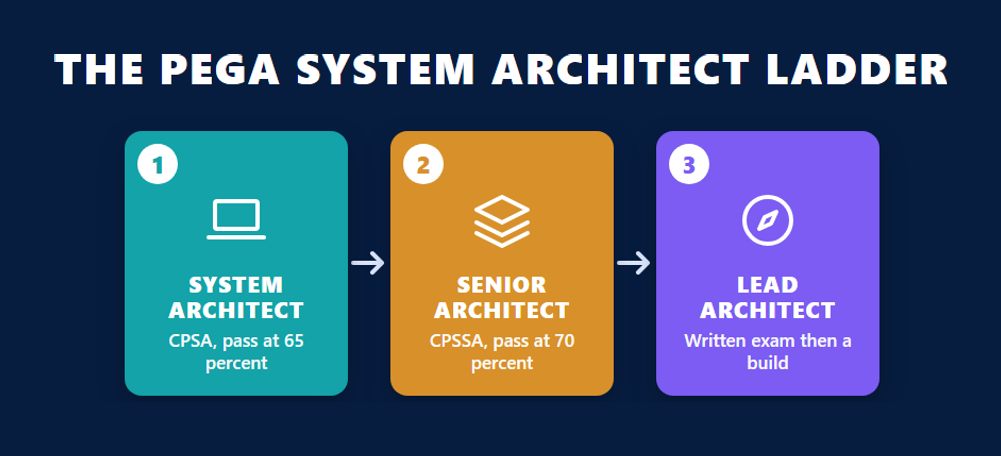
| Point of comparison | System Architect (CPSA) ’25 | Senior System Architect (CPSSA) ’25 |
|---|---|---|
| Exam code | PEGACPSA25V1 | PEGACPSSA25V1 |
| Level | Beginner | Intermediate |
| Questions | 60 | 60 |
| Duration | 1 hour 30 minutes | 1 hour 30 minutes |
| Passing score | 65% | 70% |
| Number of topics | 8 | 6 |
| Largest topic | Case Management, 25% | Application Development, 30% |
| Languages | English, Japanese, Spanish, French, German, Portuguese-Brazilian | English, Japanese |
| Prerequisite certification | None stated | Certified Pega System Architect |
Same length, same question count, a higher bar and a different centre of gravity. The System Architect exam is weighted towards case management and carries small topics for Insights, DevOps and Pega GenAI. The Senior exam drops those and moves the weight to application structure: class hierarchy, rule resolution, rulesets and reuse. Pega describes the senior certification as being for Certified Pega System Architects who want to increase their Pega skills.
The step after: Lead System Architect
Pega calls Lead System Architect the top level of certification, and it is a different kind of assessment. Candidates pass a written Architecture Exam and then a hands on Application Exam in which they design and build an application on Pega Platform. The architecture exam on its own awards no certificate. The whole ladder, including the decisioning, robotics and business architect tracks, is laid out on Pega’s page of Pega certification paths.
Which six topics does the Pega Senior System Architect exam cover?
The Pega Senior System Architect exam covers six topics: Application Development at 30 percent, Case Management and Data and Integration at 20 percent each, System Administration at 15 percent, Security at 10 percent and User Experience at 5 percent. On a 60 question exam that is roughly 18, 12, 12, 9, 6 and 3 questions.
| Exam topic | Weight | Listed objectives |
|---|---|---|
| Application Development | 30% | 12 |
| Case Management | 20% | 5 |
| Data and Integration | 20% | 5 |
| User Experience | 5% | 5 |
| System Administration | 15% | 6 |
| Security | 10% | 4 |
Topic names, objectives and weights are taken from the ProcessExam syllabus page and match Pega’s exam page line for line. One gap is worth knowing about: the syllabus page shows no weight beside User Experience, and the 5 percent in the table is the figure Pega displays.
Application Development (30%)
Twelve objectives, and nearly a third of the exam. They fall into three groups. The first is structure: define the class hierarchy, describe the purpose of modular architecture and enterprise reuse, and create an application with the New Application wizard. The second is rule behaviour: describe the rule resolution process and adjust rule availability, identify how circumstancing affects application behaviour, and circumstance rules on a single variable or multiple variables.
The third group is what runs and what ships. You differentiate between a queue processor and a job scheduler, identify the role and elements of activities in case processing, and automate actions when a property value changes. Then come versioning and delivery: the role and impacts of application versioning, ruleset skimming, configuring and validating application rulesets, and migrating an application with product rules.
Case Management (20%)
Five objectives, all about cases that more than one person or process touches. Differentiate between work groups, work queues and organizational structures. Configure parallel processing for cases. Manage concurrent case access and locking strategies. Configure flow action pre and post processing. Extend service level agreement configurations.
Data and Integration (20%)
Validate data against a pattern, identify use cases for keyed data pages, exchange data with other applications, address integration errors in connectors, and configure a field value rule. The connector error objective rewards people who have watched an integration fail in a real environment and had to decide what the case does next.
User Experience (5%)
The smallest topic is the newest in content. It asks you to configure custom portals for different customer requirements, use Pega Web Embed to place Pega applications inside existing client websites, explain how Constellation SDKs use Constellation DX components to bring Constellation into alternative design systems, group fields in views, and initiate request and response calls between a Constellation application and Constellation DX API REST endpoints. Pega’s Constellation SDK documentation is the primary source for the third of those.
System Administration (15%)
Six objectives in two halves. Performance: measure system performance with the performance related tools, debug system performance, and review log files while distinguishing system events from performance events. Settings: explain why Application Settings need configuring to integrate external systems, describe the Application Settings configuration, and add resource settings for an integration.
Security (10%)
Four objectives: distinguish between role based, attribute based and client based access control, organize and manage case attachments, secure data with data encryption, and track and audit changes to data. If attribute based access control is new to you as a concept, the NIST guide to ABAC explains the model independently of any product, which makes Pega’s implementation easier to place.
What changed since the version 8 exam?
The version 8 exam, PEGAPCSSA80V1_2019, divided its questions across nine topics, and the current PEGACPSSA25V1 exam uses six. Reporting, Mobility, Deployments, Data Modeling, Information Exchange and User Interface no longer exist as topic names, and Application Development has grown from 20 percent to 30 percent. Question count, duration and pass mark are unchanged.
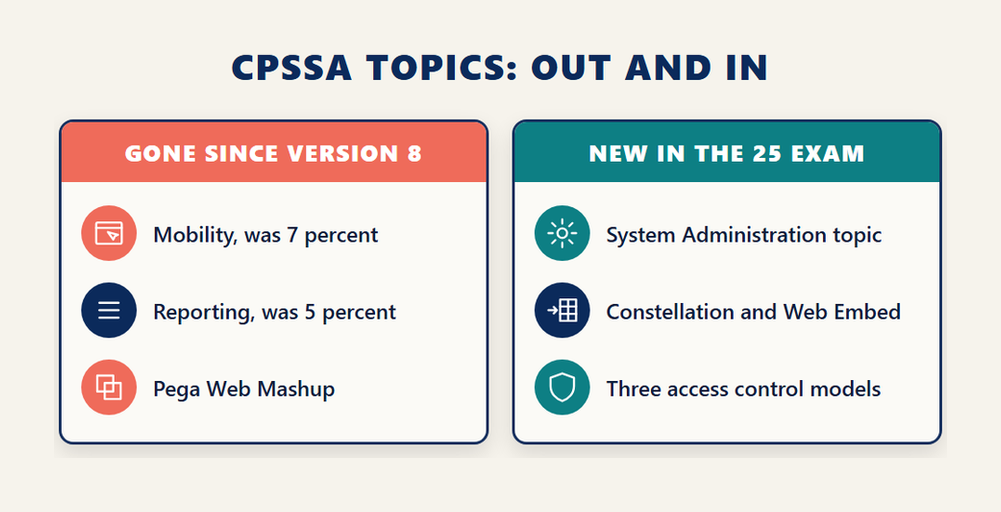
| Point of comparison | Version 8 (PEGAPCSSA80V1_2019) | ’25 (PEGACPSSA25V1) |
|---|---|---|
| Status | Retired April 30, 2021 | Current, no retirement date listed |
| Questions, duration, pass mark | 60, 1 hour 30 minutes, 70% | 60, 1 hour 30 minutes, 70% |
| Number of topics | 9 | 6 |
| Application Development | 20% | 30% |
| Case Management | 18% | 20% |
| Security | 3% | 10% |
| Integration | Information Exchange, 18% | Data and Integration, 20% |
| Interface | User Interface, 14% | User Experience, 5% |
| Topics with no successor of the same name | Reporting 5%, Mobility 7%, Deployments 13%, Data Modeling 2% | System Administration, 15%, is new as a topic |
Three shifts stand out. Security has more than tripled, from 3 percent to 10, and now names three access control models where the old list had a single line on access control. Mobility has gone entirely: the version 8 list had mobile apps and offline processing, and the current one has neither. And the interface topic has shrunk from 14 percent to 5 while changing its vocabulary from Pega Web Mashup to Pega Web Embed and Constellation.
Some content moved without disappearing. Ruleset configuration and application migration sat under Deployments in version 8 and now sit inside Application Development. Log file review and performance analysis were Application Development items and are now the core of System Administration. A candidate using old material will therefore meet familiar subjects in the wrong proportions, and will be missing Constellation completely.
The foundation level went through its own shift between releases, which this site covered in its System Architect exam breakdown. Read the two together and the direction of the whole track is clear.
Which version should you sit: ’23, ’24 or ’25?
Pega Academy currently lists three Senior System Architect exams side by side: PEGACPSSA23V1, PEGACPSSA24V1 and PEGACPSSA25V1. Each has 60 questions and none shows a retirement date. Sit the version that matches the platform release you work on, and choose ’25 if you have no constraint, because it is the newest.
The reasoning is practical. The exam asks about behaviour you configure, and features such as Constellation have moved between releases. If your project runs on an earlier release and your training environment matches it, the matching exam tests what you actually see. If you are learning from scratch on current Pega Academy material, the ’25 exam is the natural pair.
Two cautions. First, a newer platform release usually brings a newer exam, and older codes do eventually receive retirement dates, as the version 8 exam did, so check the exam page again before you pay. Second, practice material is tied to a code. Search demand for PEGACPSSA23V1 questions is still higher than for the ’25 code, which tells you how much of what circulates was written two releases ago.
How should you prepare for the CPSSA exam?
Prepare for the CPSSA exam by working through Pega’s Senior System Architect mission in a live environment, then revising by exam weight: Application Development first, the two 20 percent topics next, System Administration and Security after that, and User Experience last. Finish with timed sets of 60 questions in 90 minutes.
- Confirm that your Certified Pega System Architect certification is in place, because Pega states it as the prerequisite for the senior credential.
- Complete the Senior System Architect mission on Pega Academy for the platform release that matches your exam code, doing every challenge in the exercise environment.
- Study Application Development until you can trace rule resolution by hand for a circumstanced rule across two ruleset versions.
- Build one case type that uses parallel processing, a locking strategy and flow action pre and post processing, then break its connector and handle the error.
- Review a real log file and a performance tool readout, and configure Application Settings for one external integration.
- Compare role based, attribute based and client based access control on the same case, then cover the five User Experience objectives.
- Sit two timed sets of 60 questions in 90 minutes and revise any topic where you score below 70 percent.
Why the mission comes before any question set
Pega describes the Senior System Architect mission as building on the System Architect mission and focusing on the tasks a Senior System Architect performs, going beyond low code configuration in App Studio. That last phrase describes the exam well. Many objectives start with configure, circumstance, migrate or debug, and those verbs are learned by doing them. The mission page has a release selector, so set it to the release in your exam code before you begin.
Spend your hours where the questions are
With roughly 18 questions, Application Development alone can use up your entire margin of 18 wrong answers. User Experience, at about three questions, cannot decide the result by itself. Candidates coming from a project that is heavy on interface work tend to over prepare the 5 percent topic and under prepare rule resolution and rulesets. An older page on this site lists CPSSA exam resources if you want more reading once the mission is done.
Frequently Asked Questions
What does CSSA stand for in Pega?
CSSA is the older short form for Pega’s Senior System Architect certification. Pega’s version 8 exam used the abbreviation PCSSA, and the current credential is Certified Pega Senior System Architect, or CPSSA, with the exam code PEGACPSSA25V1.
How many questions are on the Pega Senior System Architect exam?
The PEGACPSSA25V1 exam has 60 questions and lasts 1 hour 30 minutes, which is 90 seconds a question.
What is the passing score for the CPSSA exam?
The passing score is 70 percent, which is 42 correct answers out of 60.
How much does the Pega CSSA certification cost?
The exam fee is US$190 according to the ProcessExam syllabus page. Pega’s exam page does not display a price, so check the amount in your currency when you register with Pearson VUE.
Is there a prerequisite for Certified Pega Senior System Architect?
Yes. Pega states that you must be a Certified Pega System Architect to earn the Senior System Architect certification.
Which topic carries the most weight on the CPSSA exam?
Application Development at 30 percent. Case Management and Data and Integration follow at 20 percent each, then System Administration at 15, Security at 10 and User Experience at 5.
Can you take the Pega Senior System Architect exam online?
Yes. Pearson VUE proctors the exam, and you can take it at a test centre or through online proctored delivery in a quiet room with a webcam.
What languages is the CPSSA exam available in?
Pega lists English and Japanese for PEGACPSSA25V1.
What comes after Certified Pega Senior System Architect?
Pega Certified Lead System Architect, which Pega calls its top level of certification. It requires the Senior System Architect certification and has two parts, a written Architecture Exam and a hands on Application Exam.
Conclusion
Whatever abbreviation brought you here, the exam is PEGACPSSA25V1: 60 questions, 90 minutes, 70 percent to pass, English or Japanese, booked through Pearson VUE, and open only to people who already hold the Certified Pega System Architect certification.
Its six topics are weighted towards how an application is structured and shipped. Application Development is 30 percent, case management and integration take 20 each, and the interface topic that once filled 14 percent of the version 8 exam is now 5 percent and speaks Constellation.
Check the code on every resource you use, match the exam version to the platform release you work on, complete the Senior System Architect mission in a live environment, and put most of your revision into rule resolution, circumstancing and rulesets. Then book the exam.


