
Palo Alto Networks prices its certification exams by rung: $150 for the foundational tier, $200 for professional, $250 for specialist and $300 for architect. On the network security track, the $200 rung holds exactly one exam, the Network Security Professional, known by its short code NetSec-Pro. It is the first point on that ladder where the questions stop being about cybersecurity in general and start being about the Palo Alto platform itself, from PA-Series firewalls to Prisma Access and Strata Cloud Manager.
That breadth is the thing most candidates underestimate. The exam is pitched at entry-level configuration, yet it reaches across firewalls, SASE, six cloud-delivered security services, identity trust, post-quantum risk and AI security. This article explains where the credential sits on the Palo Alto certification path, how the six domains are weighted, what the newer objectives actually ask, what the exam costs, what happens after a failed attempt, and a preparation order that follows the weighting rather than the product catalogue.
Table of Contents
- What Is the Palo Alto Network Security Professional Certification?
- Where Does NetSec-Pro Sit on the Palo Alto Certification Path?
- How Are the Six NetSec-Pro Domains Weighted?
- Why Does Platform Solutions, Services, and Tools Carry 30 Percent?
- Which Firewalls and SASE Products Does the Exam Cover?
- What Do Infrastructure Management and Connectivity Questions Ask?
- Who Is the Network Security Professional Exam Built For?
- What Does NetSec-Pro Cost, and What Happens After a Fail?
- How Should You Prepare for the NetSec-Pro Exam?
- What Comes After the Network Security Professional Certification?
- Frequently Asked Questions
- Conclusion
What Is the Palo Alto Network Security Professional Certification?
The Palo Alto Networks Certified Network Security Professional, exam code NetSec-Pro, validates that you understand every product and service in the Palo Alto network security solution and can use, maintain and configure them at an entry level. The exam has 75 multiple choice questions in 90 minutes, costs $200, and the pass mark is 860 on a scale of 300 to 1000.
Palo Alto files the credential at the Professional level on its Network Security platform. Its own NetSec-Pro credential page describes it as covering the use cases of each product and how they apply to an organisation, plus basic installation and deployment. In other words, the exam tests whether you know what each part of the platform is for and how it is kept running, not whether you can architect a global rollout.
| Exam detail | Palo Alto Network Security Professional |
|---|---|
| Exam code | NetSec-Pro |
| Level | Professional |
| Questions | 75, multiple choice |
| Duration | 90 minutes |
| Passing score | 860 on a scale of 300 to 1000 |
| Fee | $200 USD (price may vary by country) |
| Language | English |
| Delivery | Pearson Professional Assessments |
| Validity | Two years |
Ninety minutes for 75 questions works out to about 72 seconds per question. That pace leaves little room to puzzle over a product you have never seen, which is why breadth of familiarity matters more here than depth on any single feature.
Where Does NetSec-Pro Sit on the Palo Alto Certification Path?
NetSec-Pro is the professional rung of the network security track, above the foundational Cybersecurity Apprentice and Cybersecurity Practitioner exams and below the specialist exams such as Network Security Analyst and Next-Generation Firewall Engineer. Above those sits the Network Security Architect. Each rung has its own fee, and passing a higher exam in the same track extends the lower ones you still hold.
Palo Alto’s certification FAQ publishes the fee for every tier, which makes the ladder easy to read.
| Tier | Fee | Network security track exams |
|---|---|---|
| Foundational | $150 | Cybersecurity Apprentice, Cybersecurity Practitioner |
| Professional | $200 | Network Security Professional |
| Specialist | $250 | Network Security Analyst, Next-Generation Firewall Engineer, SD-WAN Engineer, Security Service Edge Engineer |
| Architect | $300 | Network Security Architect |
The structure has a practical consequence. The specialist exams each go deep on one product area, while NetSec-Pro is the only exam on the track that spans all of them at once. If you are not yet sure whether your career will lean towards firewalls, SD-WAN or service edge, this is the exam that shows you the whole map before you commit to one road.
Before you book, it helps to check your readiness against timed questions, and the NetSec-Pro practice test mirrors the 75 question, 90 minute format so you can find out how your pacing holds up across all six domains.
How Are the Six NetSec-Pro Domains Weighted?
The NetSec-Pro blueprint has six domains. Platform Solutions, Services, and Tools carries 30 percent, Network Security Fundamentals and Infrastructure Management and CDSS carry 17 percent each, NGFW and SASE Solution Functionality and Connectivity and Security carry 13 percent each, and NGFW and SASE Solution Maintenance and Configuration carries 10 percent.
| Domain | Weight | Objectives |
|---|---|---|
| Network Security Fundamentals | 17% | 4 |
| NGFW and SASE Solution Functionality | 13% | 4 |
| Platform Solutions, Services, and Tools | 30% | 6 |
| NGFW and SASE Solution Maintenance and Configuration | 10% | 2 |
| Infrastructure Management and CDSS | 17% | 4 |
| Connectivity and Security | 13% | 2 |
Two patterns stand out. First, almost every objective starts with the verb “explain”, “identify” or “describe”. The exam wants you to know why a feature exists and when it applies, which suits candidates who have administered the products and can reason about them, rather than those who have memorised menu paths.
Second, the domains overlap on purpose. Security policy, monitoring and logging appear in domain 2, domain 3, domain 4 and domain 5, each time from a different angle: what the function does, how effective it is, how it is configured and how it is maintained. Studying the policy model once, properly, pays off in four places.
What Network Security Fundamentals Covers
The 17 percent fundamentals domain is about how traffic is inspected. It asks you to explain application layer inspection across Strata and SASE products, the slow path and fast path a packet can take, the decryption options (SSL Forward Proxy, SSL Inbound Inspection, SSH Proxy and no decrypt), and hardening methods such as Content-ID, User-ID, Device-ID, zones and Zero Trust. Knowing which decryption mode suits outbound browsing and which suits a published server is a typical distinction.
Why Does Platform Solutions, Services, and Tools Carry 30 Percent?
Platform Solutions, Services, and Tools carries 30 percent of NetSec-Pro because it holds the most ground: the security efficacy of the firewalls and Prisma SASE, six Cloud-Delivered Security Services, AIOps and best practice assessment, Next-Generation Trust Security, quantum security risks and AI security risks. Nearly a third of the exam sits in this one domain.
The Six Cloud-Delivered Security Services
Objective 3.2 names the CDSS components one by one, which makes it the most concrete list in the whole blueprint:
- Internet of things (IoT) security
- Enterprise Data Loss Prevention (DLP)
- SaaS Security
- PAN-OS SD-WAN
- Premium GlobalProtect
- Advanced WildFire, Advanced Threat Prevention, Advanced URL Filtering and Advanced DNS
For each one, be ready to say what problem it solves and where it plugs in. A question might describe an unmanaged medical device on the network, a file being uploaded to an unsanctioned cloud app, or a phishing domain registered an hour ago, and ask which service addresses it.
Trust, Quantum and AI Objectives
Objectives 3.4 to 3.6 reach beyond classic firewall topics, and they are where many candidates have the least hands-on experience. Objective 3.4 asks how Next-Generation Trust Security supports identity governance, trust relationships and adaptive security decisions. Objective 3.5 covers quantum security risks such as harvest now, decrypt later attacks, along with post-quantum readiness and hybrid cryptography. Objective 3.6 covers AI-related risks, from sensitive data exposure to AI-enabled threats.
The quantum objective rewards some background reading outside the vendor. The NIST post-quantum cryptography project explains why encrypted traffic captured today could be decrypted later, which is the whole reasoning behind the harvest now, decrypt later threat the exam names. Palo Alto’s own network security leadership frames it bluntly:
“The quantum threat to encryption is no longer theoretical; it’s an inevitability that demands action now.”
You will not be asked to do cryptographic maths. You will be asked to recognise the risk and identify which platform capabilities address it.
Which Firewalls and SASE Products Does the Exam Cover?
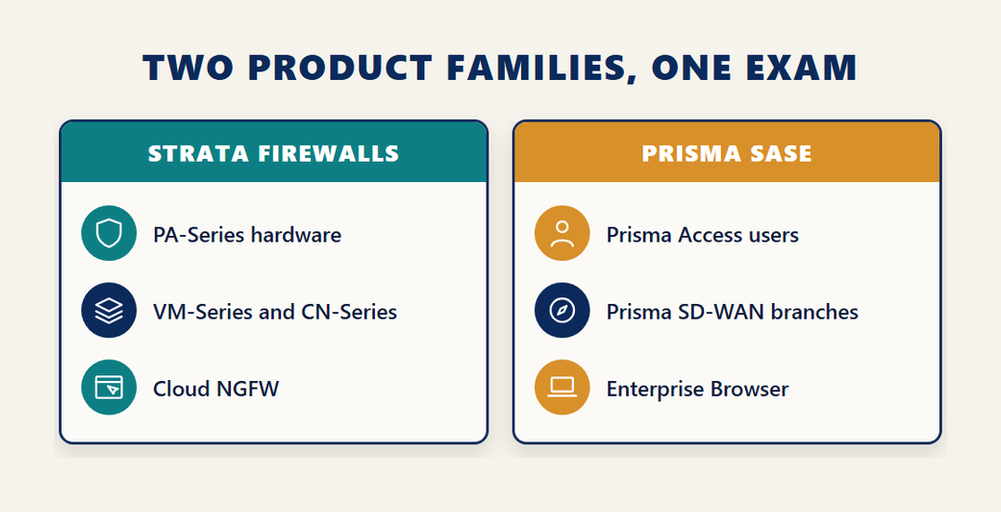
NetSec-Pro covers two product families. On the Strata side it names PA-Series hardware, VM-Series and CN-Series firewalls and Cloud NGFWs. On the Prisma SASE side it names Prisma Access and Prisma SD-WAN, with Enterprise Browser listed in the target audience. Panorama and Strata Cloud Manager manage both. Domains 2 and 4 together weigh 23 percent of the exam.
Functionality: What Each Product Does
Domain 2, at 13 percent, is about function. For the firewalls that means perimeter and core security, zone security and segmentation, high availability, security and NAT policy, and monitoring and logging. For Prisma SD-WAN it means WAN optimisation, path and NAT policies and zone-based firewalls. For Prisma Access it means remote user and remote network configuration and both public and private application access. The fourth objective asks how Panorama and Strata Cloud Manager manage the Strata and SASE estate.
Maintenance: Keeping It Running
Domain 4, at 10 percent, is the smallest, and it is about upkeep. It covers the configuration and maintenance of hardware, VM-Series, CN-Series and Cloud NGFW firewalls (policies, profiles, updates and upgrades) and the same tasks on Prisma Access, plus monitoring and logging. Expect questions about what has to happen, and in what order, when content or software updates are rolled out.
What Do Infrastructure Management and Connectivity Questions Ask?
Infrastructure Management and CDSS, at 17 percent, asks how security policies, profiles and updates keep the cloud-delivered services working, including IoT security, Enterprise DLP and SaaS Security, and how Strata Cloud Manager and Panorama add devices and report. Connectivity and Security, at 13 percent, asks how on-premises, cloud and hybrid networks and remote users stay connected and protected.
Domain 5 is where the CDSS list from domain 3 turns practical. Its objectives ask about Device-IDs and logging in IoT security, data encryption and access control in DLP and SaaS Security, and new device addition, reporting and configuration management in Strata Cloud Manager and Panorama.
Domain 6 has only two objectives, but both are broad. The first covers segmentation, policies, monitoring and certificates across on-premises, cloud and hybrid networks. The second covers the components that keep remote users connected and secure, including remote access, segmentation, security policy tuning and certificates. Certificates appear in both, so make sure you can explain where they are used in decryption and in remote access.
Who Is the Network Security Professional Exam Built For?
The Network Security Professional exam is built for networking and security staff who install, deploy, operate or administer Palo Alto firewalls, cloud-delivered security services, NGTS components, SASE products and Strata Cloud Manager, and for those who keep data centres, branches, remote users, connected devices and data handling secure. It assumes basic, not expert, product knowledge.
The datasheet lists the skills it expects in plain terms: basic knowledge of securing networks of all sizes, configuration of Strata and Prisma SASE products for security outcomes, basic knowledge of management options such as Panorama and Strata Cloud Manager, and basic knowledge of best practices. No prerequisite certification is listed.
That makes the exam a sensible second step for someone who has the vendor-neutral fundamentals and now works on a Palo Alto estate. If you are newer to security altogether, the foundational rung is a gentler start, and our explainer on the Cybersecurity Practitioner exam covers that tier and how it leads into this one.
Palo Alto also states that every exam is delivered in English worldwide, and candidates testing in non-English speaking countries receive a 30 minute time extension by default. If that applies to you, your 90 minutes become 120.
What Does NetSec-Pro Cost, and What Happens After a Fail?
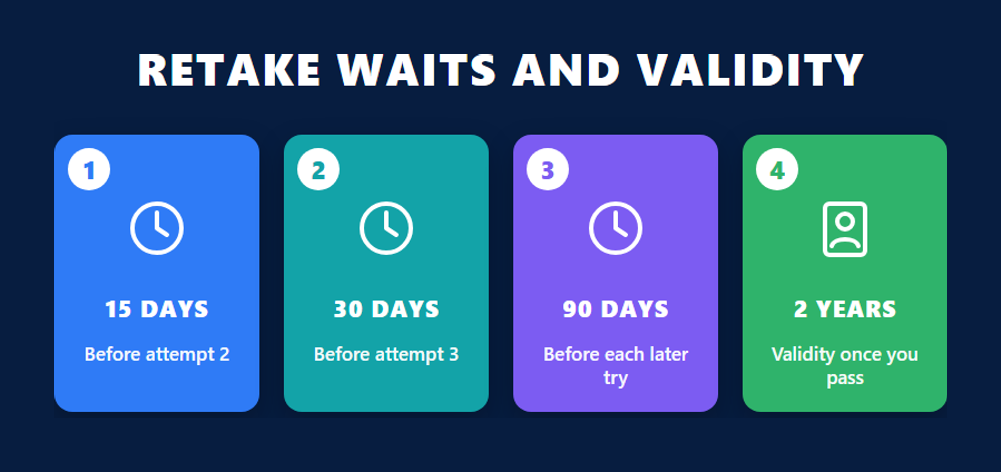
NetSec-Pro costs $200 USD, though Palo Alto notes the price and local taxes can vary by country. If you fail, you wait 15 days before a second attempt, 30 days before a third and 90 days before any attempt after that. Once you pass, the certification is valid for two years and you recertify by retaking the exam.
Two further rules in the Palo Alto certification FAQ shape how you plan the two years:
- After a pass you cannot sit the same exam again for 18 months (545 days), so recertification by retake falls in the final six months of validity.
- Passing a higher-level exam in the same track automatically extends your active lower-level certifications by two years. Earning Network Security Analyst, for example, extends an active Network Security Professional.
A failed attempt is not wasted either. You receive a results report broken down by exam domain, which you can lay against the blueprint to decide where the 15 day gap is best spent. After a pass, the badge is issued through Credly.
How Should You Prepare for the NetSec-Pro Exam?
Prepare for NetSec-Pro by starting from the official datasheet, studying in weight order with the 30 percent platform domain first, building one mental model of security policy, monitoring and logging that you reuse across four domains, then testing your pace against timed questions. Palo Alto recommends its digital learning path alongside the blueprint.
A preparation order that follows the weighting looks like this:
- Download the official datasheet and mark every objective you could not explain to a colleague today.
- Study Platform Solutions, Services, and Tools first, because it carries 30 percent, and learn each of the six CDSS services by the problem it solves.
- Learn the security policy, NAT, monitoring and logging model once, since it recurs in the functionality, platform, maintenance and management domains.
- Work through the 17 percent domains next, Network Security Fundamentals and Infrastructure Management and CDSS, paying attention to decryption modes and Strata Cloud Manager tasks.
- Cover the 13 percent and 10 percent domains, firewalls, SASE, maintenance and remote user connectivity, then read up on post-quantum and AI security risks.
- Sit timed practice at 72 seconds per question and revisit every domain where your score drops.
Palo Alto’s own NetSec-Pro exam datasheet adds a useful detail: every exam item is referenced to a publicly available technical or scholarly source. That means the product documentation really is the answer key, and researching each blueprint keyword in the official documentation is time well spent.
For the SASE concepts, learn the vendor-neutral idea of secure access service edge first and the Prisma product names second, which makes the Prisma Access objectives easier to place.
What Comes After the Network Security Professional Certification?
After NetSec-Pro, most candidates move to one of the $250 specialist exams on the same track: Network Security Analyst, Next-Generation Firewall Engineer, SD-WAN Engineer or Security Service Edge Engineer. Each goes deep on one product area. Passing one also extends your Network Security Professional by two years, so the next step doubles as recertification.
The choice usually follows your job. Administrators who spend their days in Strata Cloud Manager writing objects and policy lean towards Network Security Analyst. Engineers who deploy firewalls with Panorama, templates and automation lean towards NGFW Engineer, and our breakdown of the NGFW Engineer exam shows how much deeper that specialist blueprint goes. Those running branch networks or remote access lean towards SD-WAN Engineer or Security Service Edge Engineer.
The Network Security Architect sits at the top of the track at $300, for people who design secure, highly available systems across the portfolio. NetSec-Pro is the broad foundation all of those build on.
Frequently Asked Questions
How many questions are on the NetSec-Pro exam?
The Palo Alto Network Security Professional exam has 75 multiple choice questions to answer in 90 minutes.
What is the passing score for NetSec-Pro?
The pass mark is 860 on a scale of 300 to 1000.
How much does the Palo Alto Network Security Professional exam cost?
The fee is $200 USD, the price for every professional-level Palo Alto exam. Palo Alto notes that the price and local taxes can vary by country.
Is NetSec-Pro the same as the Network Security Analyst exam?
No. NetSec-Pro is the professional-level exam covering the whole network security portfolio. Network Security Analyst is a specialist-level exam at $250 focused on object configuration, policy creation and centralised management in Strata Cloud Manager.
Are there prerequisites for the Network Security Professional certification?
Palo Alto lists no prerequisite certification. The datasheet expects basic knowledge of securing networks and of configuring Strata and Prisma SASE products.
How long is the NetSec-Pro certification valid?
It is valid for two years from the date you pass. You recertify by retaking the exam, or by passing a higher-level exam in the same track, which extends it by two years.
How long must I wait to retake NetSec-Pro after failing?
You wait 15 days after a first failed attempt, 30 days after a second, and 90 days after a third and any later attempt.
Is the exam available in languages other than English?
Palo Alto delivers its exams in English worldwide, and candidates testing in non-English speaking countries receive a 30 minute extension by default.
Are Palo Alto certifications worth it for network security roles?
For anyone who installs, operates or administers Palo Alto firewalls and SASE products, NetSec-Pro proves broad, platform-wide knowledge in one exam and opens the specialist tier. Its value depends on how much of your work runs on the Palo Alto platform.
Conclusion
The Palo Alto Network Security Professional certification is the one exam on the network security track that asks about the whole platform at once. Its 75 questions in 90 minutes span firewalls, Prisma SASE, six cloud-delivered security services, trust, quantum and AI risks, with Platform Solutions, Services, and Tools alone worth 30 percent. Study in weight order, learn the shared policy and logging model once, and use the official datasheet as your checklist. With $200 at stake, a two-year validity and fixed retake waits, it pays to sit the exam ready rather than early. Once you pass, a specialist exam both deepens your skills and renews this credential.


